

How to Decrystallize Honey Without Losing Its Nutrients
Oct 23, 2026
You reach for your honey jar and find a cloudy, grainy block instead of a smooth, pourable syrup. Don't panic — and don't toss it. That crystallization is proof you bought real, raw, unprocessed honey, not a sign it's spoiled. This guide walks you through exactly how to decrystallize honey safely, so you restore its texture without destroying the enzymes, antioxidants, and natural goodness that made you choose raw honey in the first place.
Before You Start: What You Need and Why Honey Crystallizes
Signs Your Honey Has Crystallized vs. Spoiled
Crystallized honey looks grainy, cloudy, or almost sugary at the bottom of the jar. Sometimes it hardens all the way through. That's it. There's no sour smell, no mold, no bubbling, no off taste. If your honey still smells sweet and floral and just feels gritty on a spoon, it's simply crystallization, not decay.
Real spoilage in honey is rare. Its low moisture and natural acidity make it inhospitable to most microbes. What you're looking for instead are signs like fermentation bubbles, a boozy or yeasty smell, or visible mold on the surface — honey that's absorbed excess moisture can occasionally ferment this way. None of that resembles crystallization at all.
Before you touch a water bath, gather what you'll need: the jar of crystallized honey, a pot, warm (not boiling) water, a thermometer if you've got one, and a spoon for stirring. Simple tools, but they matter. Overheating is the one mistake that actually damages honey, and the next section covers it in detail.
Why Raw Honey Crystallizes Faster Than Processed Honey
Honey is a supersaturated sugar solution — more glucose is dissolved in it than the water content can technically hold stable. Over time, that excess glucose separates out and forms crystals. It's a slow chemical settling, not a problem with the jar. Heavily filtered commercial honey resists this because it's been heated and stripped of the particulates that make crystallization possible in the first place.
Raw, unfiltered honey still contains pollen grains, trace enzymes, and tiny natural particulates, and those act as nucleation points — physical anchors crystals latch onto and grow from. Strip them out through fine filtering and heat, and the honey stays liquid far longer on a shelf. That's a processing trick, not a quality win.
Floral source plays a big role too. Honeys with a high glucose-to-fructose ratio, like clover, crystallize within weeks; others resist it almost entirely. If you want a jar that stays pourable longer, reading about premium 100 pure orange blossom honey is a good place to start, since its fructose-heavy profile slows the process, while Jarrah behaves similarly thanks to its own chemistry. Buckwheat and clover-type honeys, by contrast, often firm up fast. None of this is a flaw — it's floral chemistry, and it's one of the clearest tells that a honey was never over-processed to begin with.
Step 1: Choose the Right Decrystallize Honey Method for Your Jar
Matching the Method to Your Jar and Honey Type
Not every crystallized jar needs the same fix. The right approach depends on the jar material, how much honey you're treating, and how much patience you've got. A glass jar handles heat far better than plastic, which can warp or leach at high temperatures. And a small jelly jar of raw honeycomb drippings behaves nothing like a bulk gallon tub bought for a retail shelf.
The warm water bath is the gold standard. It's gentle, even, and preserves the enzymes and pollen that make raw honey worth buying in the first place. The microwave gets the job done fast, but it heats unevenly and can scorch sugars near the jar's edge before the center even softens. Sunlight or ambient warming is slowest of all, sometimes taking days, but it risks almost nothing. Here's how the three stack up:
| Method | Best Jar Type | Time Needed | Nutrient Risk |
|---|---|---|---|
| Warm water bath | Glass or heat-safe plastic | 15–30 minutes | Low |
| Microwave | Microwave-safe glass only | 30–90 seconds | High |
| Sunlight/ambient warming | Glass, any size | 1–3 days | Very low |
| Combination (sun then water bath) | Glass, large batches | Several hours | Low |
For a single 12-ounce jar, the water bath wins almost every time. For a bulk order destined for resale, many local businesses lean on ambient warming in a heated back room, since it needs no monitoring and no risk of a melted plastic lid. If you're curious how climate and hive location shape crystallization in the first place, it's worth learning more about a bee farm in warm sunny Southern California and how its seasonal nectar flow affects the final jar. Skip the microwave for anything labeled raw. It's just not worth the gamble.
Step 2: Warm the Water Bath Without Overheating the Honey
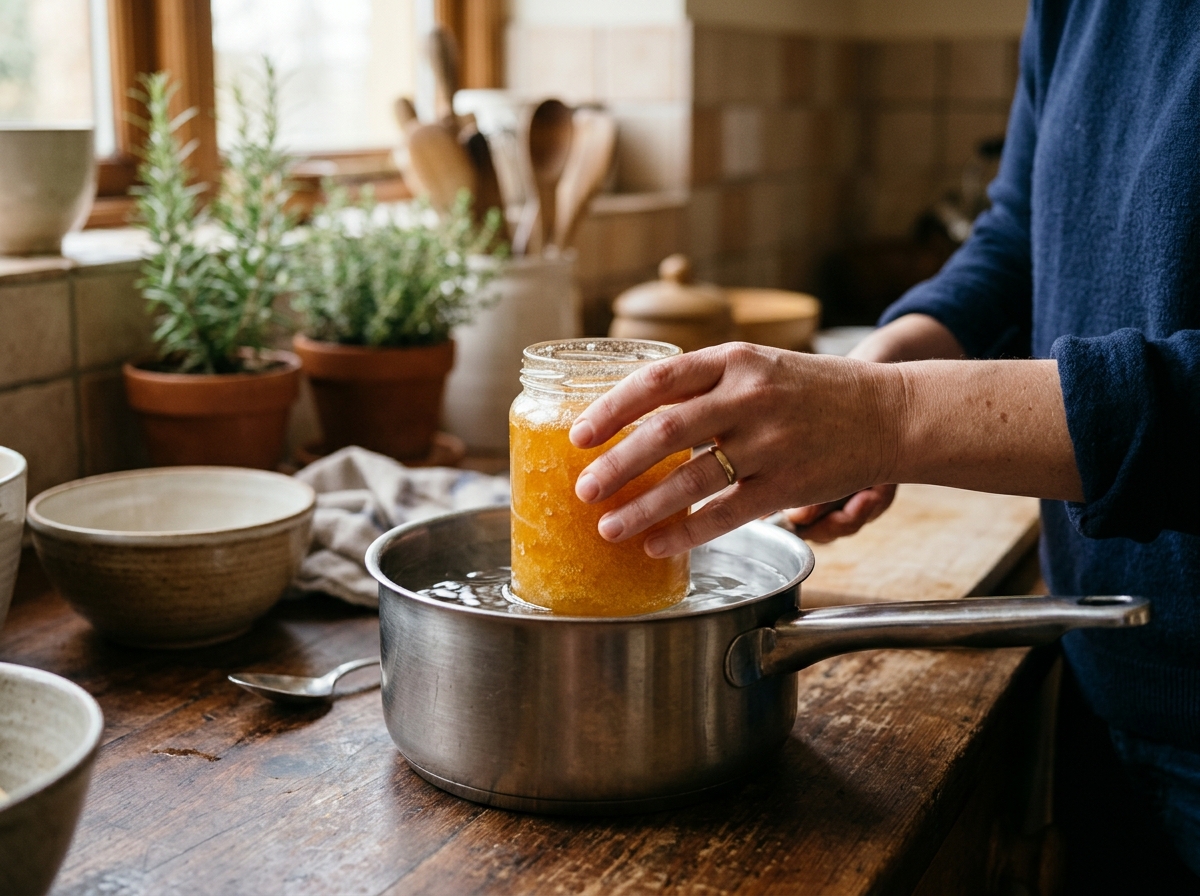
Grab a thermometer before you touch the stove. Water between 95-110°F (35-43°C) is the sweet spot for loosening crystals without cooking off the enzymes, pollen, and antioxidants that make raw honey worth buying in the first place. Anything hotter starts breaking down those compounds, and you lose exactly what you paid for. Once the water hits temperature, pull the pot off the burner. You want gentle, residual heat doing the work, not an active flame underneath — a rolling simmer will creep past safe range faster than you'd think.
Loosen the lid, peel off the paper label so it doesn't turn to mush, and lower the jar in. Let the water rise to about the level of the honey inside, not over the rim — you're not trying to give the jar a bath. Every 5 to 10 minutes, give it a stir with a clean spoon or chopstick. This moves warm honey past the stubborn crystal clumps and cuts your total wait time noticeably. If you've ever wondered why the jelly-style products taste so different depending on how they're handled, it's the same principle: royal jelly is not for the taste when it's kept raw, and heat changes that balance fast in honey too.
One hard rule: never boil honey directly in a pan, and never microwave a jar with a metal lid or trim. Metal in a microwave sparks. Boiling scorches sugars and kills nutrients permanently — there's no undoing either mistake. Low, slow, and patient wins here.
Step 3: Monitor, Stir, and Test for Full Dissolution
Once the jar is sitting in warm water, patience matters more than heat. Most jars fully clear in 20 to 45 minutes, depending on how far the crystallization had progressed and how large the jar is. A pint of lightly grainy honey might be done in 20. A quart that's gone fully solid could need the full 45, maybe a touch more. Either way, don't walk away and forget about it.
What to Check Each Time You Come Back
Set a timer and check in rather than guessing. This short routine, repeated every 10 minutes, keeps you from overheating the honey or leaving it half-crystallized:
- Check the jar every 10 minutes rather than leaving it to sit for the entire session unattended, since crystal density can change faster than expected once the honey warms through.
- Tilt the jar gently and watch the bottom edge for any cloudy or grainy residue that hasn't gone fully clear yet.
- Stir with a clean, completely dry spoon to spread the warmth evenly and break apart any remaining sugar clusters stuck to the glass.
- If crystals are still visible after 10 minutes, repeat the warm bath in short increments instead of leaving the jar in one long, continuous heat exposure that risks damaging enzymes.
- Keep every utensil and jar surface bone dry, since even a few water droplets introduced into the jar can encourage fermentation weeks later.
That last point trips people up more than they'd expect. A damp spoon seems harmless in the moment, but raw honey is a living product, and any added moisture gives wild yeast something to work with down the road. If you want a second reference point on timing and technique before you commit to a method, this rundown of practical ways to decrystallize honey covers a few variations worth comparing. Either way, the goal is the same: clear, pourable honey without a single scorched or cloudy patch left behind.
Step 4: Cool, Store, and Slow Future Crystallization
Ideal Long-Term Storage Conditions for Raw Honey
Once your honey has gone fully liquid again, don't rush it back into the cupboard. Let the jar sit on the counter until it reaches room temperature, lid off, so condensation doesn't form inside. Sealing a warm jar traps steam, and that steam becomes water sitting right on top of your honey. That extra moisture is exactly what kickstarts the next round of crystals. A 20 to 30 minute cool-down costs you nothing and saves you another warm bath down the road.
Where you store the jar matters just as much as how you cool it. A pantry shelf around 70°F, away from the stove and out of direct sun, is ideal. The fridge feels like the safe, cautious choice, but it's actually the worst spot you could pick. Cold temperatures between roughly 50°F and 59°F accelerate crystal formation dramatically, which is the opposite of what you want. Researchers studying honey's behavior in storage have linked moisture migration and temperature swings directly to how fast sugars seed and spread; one widely cited study on the effect of crystallization on the water activity of honey breaks down why water movement inside the jar drives the process more than most people realize.
Keep the lid tightly sealed between uses. A loose or warped lid lets humid kitchen air creep in, and moisture absorption is one of the most common triggers for crystallization nobody thinks about. Glass jars with rubber-gasket lids seal better long-term than plastic screw caps, which can warp slightly after repeated opening. If your lid doesn't click shut firmly anymore, it's worth replacing before the jar goes back on the shelf.
Try to resist reheating the same jar over and over. Each warm bath is fine on its own, but repeated cycles gradually dull the flavor, darken the color, and chip away at the natural enzymes raw honey is prized for. Think of it like repeatedly reheating leftovers: technically fine once or twice, noticeably worse by the fifth round. If you're decrystallizing often, you're probably storing the jar somewhere too cold, or opening it too frequently, and it's worth fixing that root cause instead.
Finally, use a dry spoon, every single time. Even a few drops of water or leftover crumbs on a used spoon can introduce the exact conditions crystals need to form. Keep one spoon dedicated to the honey jar and nothing else, and skip spoons that have touched tea, oatmeal, or anything with moisture. It's a small habit, but it's one of the easiest ways to keep a jar smooth for months.
Troubleshooting: When Decrystallizing Doesn't Work or Isn't Worth It
Crystallization vs. Fermentation: Key Differences
Not every jar that looks "off" is actually a problem, and not every problem can be fixed with a warm water bath. Some signs mean you overheated the honey. Others mean something changed in the jar long before you touched it. Knowing the difference saves you from wasting good honey, or worse, eating something you shouldn't.
| Sign You Notice | What It Actually Means | Can It Be Fixed? |
|---|---|---|
| Dark, caramelized color or a burnt smell | Overheating damage — sugars have scorched | No, this is permanent |
| Sour smell, foam, or a boozy odor | Fermentation, not simple crystallization | No, reheating won't reverse it |
| Thick, grainy, fully solid texture | Normal crystallization | Yes, or just eat it as-is |
| Cloudy or dense appearance in Jarrah or Manuka | Natural mineral content, not crystallization | Nothing to fix |
A burnt jar is done for. That's the trade-off of pushing heat too far, and no amount of stirring brings it back. Fermentation is a separate issue entirely: it happens when excess moisture lets wild yeast get to work on the sugars, and a water bath only warms the problem, it doesn't undo it. If you're curious about the physics some producers use instead of heat, research into the use of ultrasound for preventing honey crystallization shows there are gentler alternatives being studied. On the other hand, heavily crystallized honey is perfectly fine eaten with a spoon or spread thick — a natural stand-in for the creamed honey you'd find elsewhere, since Go Honey doesn't make a whipped version. And dense, cloudy Jarrah or Manuka? That's often just mineral richness, not a sign of anything going wrong. When a jar genuinely puzzles you, skip the guesswork. A quick email or call to whoever sold it to you beats a ruined batch every time.
Choosing Honey That Crystallizes the Way Raw Honey Should
Here's something most shoppers never consider: the way honey hardens tells you more than the label does. Crystallization is a purity signal, not a defect. Honey that stays liquid in the jar forever, year after year, has usually been heated and ultra-filtered until it can't crystallize — a process that also strips out pollen and enzymes along the way. If your honey never changes, ask why.
What Lab-Verified, Single-Source Honey Looks Like on the Label
Single-source, unblended honey behaves predictably, because it comes from one floral origin instead of a mixed drum of unknown syrups. Orange Blossom Honey, for instance, naturally turns soft and spreadable as it crystallizes — that's rawness showing itself, not spoilage. Buckwheat's deep, malty bite and Jarrah's caramel finish aren't added flavorings, either. They're what the flowers actually taste like, with nothing infused or blended in. A label worth trusting will usually show you:
- A single floral source named outright, like orange blossom, buckwheat, or Jarrah, rather than a vague "blend" of unnamed honeys;
- A harvest date and hive location, so you know roughly when and where the honey was pulled;
- A current third-party lab certificate, renewed roughly every six months, confirming purity and 10-HDA levels where royal jelly is involved;
- Explicit confirmation of no glyphosate or synthetic additives, not just a generic "natural" claim;
- A texture that's allowed to change over time, since soft crystals or grain are expected in raw honey, not hidden by over-processing;
- Traceability you can actually verify, meaning you could, in theory, connect the jar in your hand back to its lab report.
That last point matters most. Anyone can print "raw" on a jar. Full traceability from hive to certificate is what actually backs it up.
Wrap-Up: Keeping Your Raw Honey Fresh for the Long Run
When in doubt, go back to the warm-bath method. Jar in water, water never above 110°F, patience instead of a microwave. It's slow, but it's the only approach that loosens crystals without cooking out the enzymes and pollen you bought raw honey for in the first place. If you've followed the earlier steps, you already know the drill: gentle heat, occasional stirring, done in twenty minutes or so.
Here's the bigger mindset shift, though: crystallization isn't a flaw. It's what happens when honey hasn't been stripped of pollen and overheated into submission. Honey that never, ever hardens has usually been filtered and heated hard enough to lose most of what made it worth buying raw. Store your jar away from sunlight, somewhere cool and dry, and you'll stretch the time between decrystallizing sessions considerably.
If you're shopping for honey that behaves this way on purpose, look for single-source, lab-tested varieties — Manuka, Jarrah, Buckwheat, Orange Blossom — where crystallization patterns and pollen content are documented, not hidden. Raw Orange Blossom, for instance, often sets into a soft, spreadable texture naturally; that's rawness, not spoilage, and it's the closest thing to a creamed honey you'll find in a single-source jar. For households going through honey quickly, or retailers stocking shelves, Go Honey's wholesale and bulk ordering program makes more sense than buying one jar at a time, and free shipping kicks in once orders cross the $99 mark.
Choosing between a contract pollination arrangement and simply harvesting honey from established hives often comes down to what a grower actually needs that season — temporary pollination muscle versus a long-term relationship with a honey source. It's worth asking which problem is being solved: a pollination gap on the farm, or a reliable supply of raw honey and bee products once the season's work is done. Those are different questions, and clarity on that point usually makes the next decision much easier.


