

Why Crystallized Honey Isn't Bad (And How to Fix It)
Oct 27, 2026
You open your pantry, reach for that jar of raw honey, and find it cloudy, grainy, and stubbornly solid at the bottom. It's a little unsettling. Did it spoil? Not even close. Crystallized honey is one of the clearest signs you bought the real, unprocessed thing, and this guide walks you through exactly why it happens, how to soften it safely, and when a jar of raw honey's texture is actually telling you something good about what's inside.
What Is Crystallized Honey
Why Raw Honey Behaves Differently Than Processed Honey
At its core, crystallization is just glucose breaking away from water inside the honey and settling into solid crystals. Honey is a supersaturated sugar solution. That means it holds more sugar than water can technically dissolve long-term. Over time, glucose molecules link up, form a lattice, and turn grainy or solid. It's chemistry, not magic. Fructose stays liquid longer, which is why crystallized honey often looks like a two-layer mix before it fully hardens into one texture.
Here's the part people get wrong: crystallization is a physical change, not spoilage. Nothing is rotting, fermenting, or going bad. The sugar structure is simply shifting from liquid to solid, the same way water turns to ice without becoming a different substance. Nearly every jar of raw honey will crystallize eventually. Some in a few weeks, others after a year or more. It depends on the floral source, the glucose-to-fructose ratio, and storage temperature. A jar sitting at 50-59°F will crystallize fastest, since that range is the sweet spot for crystal formation.
Crystallized honey is still 100% edible, still packed with its natural enzymes and nutrients, and still perfectly safe to eat straight from the jar. You can spread it, spoon it into tea, or warm it gently to loosen it back up. If you're sourcing honey for the first time, a raw unfiltered honey buying guide is worth working through before you judge a jar by its texture, since grainy honey is often the purer product, not the inferior one. Smooth and runny forever usually means something else happened to it along the way.
Raw, unheated, unfiltered honey crystallizes faster than the heavily processed stuff you'd find on most supermarket shelves, and there's a clear reason why. Commercial honey is typically heated and ultra-filtered to strip out pollen, fine wax particles, and tiny air bubbles — the very things that act as seed points for crystal formation. Remove them, and the honey stays liquid on the shelf for months, sometimes years. It looks more appealing. It's also lost a fair amount of what made it raw honey in the first place.
Unfiltered honey keeps its pollen grains, propolis flecks, and natural enzymes intact, and those particles give glucose something to grab onto. That's why raw honeycomb or a jar of unprocessed orange blossom honey will often firm up within weeks, while a bear-shaped bottle from the grocery store stays syrupy indefinitely. Quick gut check: if your honey never, ever crystallizes, ask what was filtered out to make that happen. Faster crystallization isn't a flaw. It's honestly a decent clue that you're holding something closer to what came out of the hive.
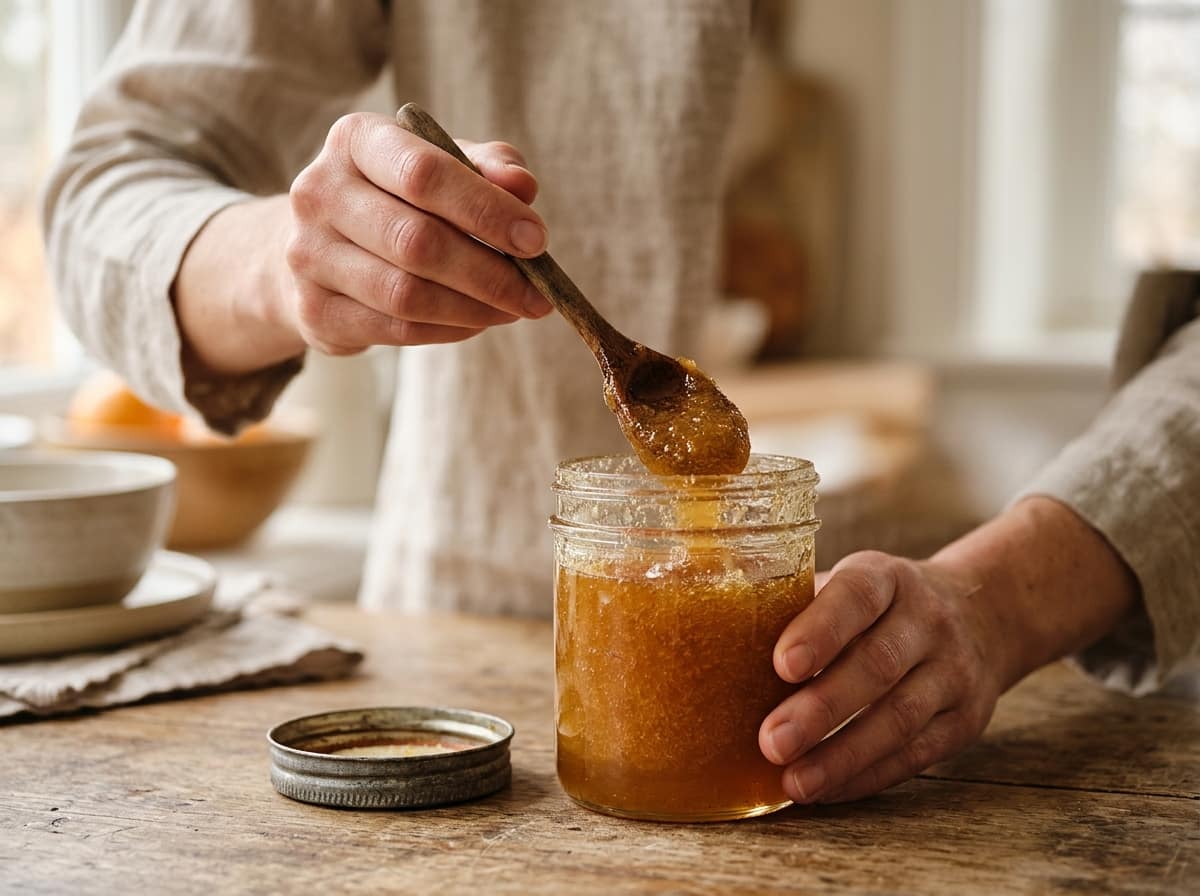
Why Does Honey Crystallize
Floral Source and Sugar Ratios
Every jar of honey is really a sugar solution, and the ratio between its two main sugars decides how fast it turns solid. Glucose doesn't dissolve as easily as fructose, so once a honey's glucose content climbs past a certain point, the excess sugar molecules start locking into crystals. It's chemistry, not a flaw. Honeys low in moisture and high in glucose, like clover or dandelion varieties, tend to firm up within weeks of harvest.
Floral source changes everything about the timeline. premium 100 pure orange blossom honey is a good example: it starts out light and pourable, but over several months it naturally sets into a soft, spreadable texture you can scoop with a knife. That's not spoilage — it's actually a strong sign the honey was never heated or filtered to delay the process artificially.
Buckwheat and Jarrah honeys tell a different story entirely. Buckwheat's higher mineral content and darker, molasses-like composition make it crystallize slower and often grainier, while Jarrah honey, with its unusual sugar profile drawn from Western Australian eucalyptus, resists crystallization almost entirely and can stay liquid for a year or more. Same bees, wildly different behavior. That's the floral source talking, not the beekeeper.
Temperature's Role in Crystallization Speed
Temperature acts like a dial on the whole process. Honey crystallizes fastest in a fairly narrow cool range, roughly 50 to 59°F, which happens to be a common temperature in pantries, garages, and unheated cabinets during fall and winter. Below that range, the honey gets too thick for sugar molecules to move and link up, so crystallization actually slows down again. Above 77°F or so, the sugars stay dissolved and the honey resists forming crystals at all.
That middle zone is the trap most people fall into without realizing it. A countertop near a window that cools at night, a cellar, a cold kitchen cupboard — all of these sit right in that sweet spot for faster crystallization. Keep in mind this isn't about freshness or quality fading; temperature simply speeds up or slows down a natural process that was always going to happen eventually.
For readers curious about the sugar chemistry behind it, resources on the family tree complete guide to bjj's royal family and general food science writing both illustrate how lineage and composition — whether in honey or elsewhere — shape predictable patterns over time. Store honey somewhere warm and stable, and you'll buy yourself months of smooth, liquid texture before nature does its thing anyway.
Crystallized vs. Liquid vs. Raw Honeycomb: A Side-by-Side Comparison
Put these three side by side and the differences stop being confusing fast. Each form comes from the same raw material, just handled differently (or not handled at all), and each one tells you something about processing. Here's the quick breakdown.
| Form | Texture | Shelf Stability | Typical Use | Purity Signal |
|---|---|---|---|---|
| Crystallized Honey | Thick, grainy, spreadable | Very stable, stores for years | Toast, spreading, easy portioning | Usually means minimal heating or filtering |
| Liquid Honey | Smooth, pourable | Stable short-term, may crystallize later | Tea, drizzling, baking, cooking | Can be heated/filtered to delay crystallizing |
| Raw Honeycomb | Solid wax cells with liquid honey inside | Stable, but comb honey crystallizes too over time | Eating whole, chewing, cheese boards | Strongest sign of zero processing |
Crystallized honey gets a bad reputation it doesn't deserve. People see sugar grains forming and assume spoilage. It's the opposite. Crystallization is a natural behavior of raw, unfiltered honey, and it actually makes portioning easier since it won't run off a spoon or drip down a jar. Liquid honey feels more familiar, sure, but that smooth pour is sometimes the result of light heat treatment that delays crystals from forming, which also happens to soften some of the finer textures people associate with raw batches.
Raw honeycomb is the rawest of the three, by definition. You're getting liquid honey still sealed in the wax cells bees built it in, nothing extracted or filtered out. Over time, even the honey inside the comb will crystallize, which is normal and still perfectly edible. If you want a fun way to use comb beyond spreading it straight, there are simple ideas for turning it into chocolate covered honeycomb that make a good starting point. Bottom line: don't judge quality by how a jar looks on day one.
How to Decrystallize Honey Without Destroying Its Nutrients
Crystals aren't a flaw. But if you want your honey pourable again, how you warm it matters more than most people think. Blast it with high heat and you'll melt away the very enzymes and antioxidants that made raw honey worth buying in the first place. Gentle, patient heat is the whole trick.
The Warm Water Bath, Done Right
The safest fix is a low, slow soak. Keep the jar sealed, keep the water cool enough to touch, and let time do the work instead of your stove. A few habits make the difference between honey that bounces back and honey that loses what made it valuable:
- Submerge the sealed jar in water kept below 110°F, since anything hotter starts to break down heat-sensitive enzymes and natural antioxidants.
- Avoid microwaving the jar or setting it directly over boiling water, both of which heat unevenly and can scorch sugars near the glass.
- Stir the honey gently every few minutes once it starts to soften, which helps distribute warmth without needing to raise the temperature further.
- Check consistency in short intervals rather than leaving the jar in the bath for an hour unattended and hoping for the best.
- Replace the water once it cools, since a lukewarm bath left too long just stalls the process instead of speeding it up.
- Pull the jar as soon as it turns pourable, because any extra time in the bath buys you nothing but risk.
If you want a visual walkthrough of this same approach, a solid guide on how to fix a jar of crystallized honey covers the water-bath method step by step with photos. It's a good gut check if you're doing this for the first time.
Sometimes, Just Don't Bother
Here's the blunt truth: not every jar needs saving. If you're only using a spoonful at a time, skip the whole process. Crystallized honey spreads beautifully on toast, dissolves fine in hot tea, and tastes exactly the same. Reserve the water bath for jars you genuinely need liquid, like for baking or drizzling, and let the rest crystallize in peace.
12 Honey Myths vs. Facts
Honey picks up a lot of bad information along the way. Most of it comes from people judging a jar by how it looks on the shelf, not how it actually behaves. Here's where the myths fall apart.
- Myth: crystallized honey has gone bad. Fact: crystallization is just glucose separating from water and forming natural crystals — it's reversible with gentle warmth and doesn't mean the jar spoiled.
- Myth: crystallization means someone added sugar. Fact: it actually signals the opposite — minimal processing and a naturally high glucose-to-fructose ratio, which varies by floral source.
- Myth: all honey crystallizes the same way. Fact: clover sets up fast and fine-grained, while tupelo or acacia stays liquid for months; the nectar source drives both speed and texture.
- Myth: raw honey belongs in the fridge. Fact: cold temperatures actually speed up crystal formation; room temperature storage, away from light, keeps it liquid longer.
- Myth: liquid honey is automatically the purer choice. Fact: much of the clear honey on grocery shelves is heated and ultra-filtered to look that way, a process that strips out pollen and enzymes.
- Myth: honey lasts forever no matter how it's stored. Fact: it rarely spoils outright, but heat and sunlight quietly degrade flavor, color, and enzyme activity over time.
One more worth busting: crystallized honey can't be used in recipes. Wrong — it dissolves fine in warm tea, spreads well on toast once slightly softened, and some bakers prefer it crystallized because it measures and mixes more evenly into batter. If you want a deeper technical breakdown, researchers have documented various treatments for honey crystallization and how each affects texture and nutrient retention. The short version: crystallized honey isn't a flaw. It's honey acting like honey.
From Hive to Jar: How Traceable, Lab-Tested Honey Is Produced
The basic path from comb to counter is simple, and that's the point. Frames come out of the hive, honey gets strained just enough to catch wax flecks and bits of debris, and then it goes straight into the jar. No heating. No fine filtering that would strip pollen or enzymes. That minimal-touch approach is exactly why raw honey crystallizes the way it does — and why a grainy jar should read as a good sign, not a defect.
Why Lab Verification Matters for Raw Honey Buyers
Here's the thing: "raw" is a claim anyone can print on a label. Verification is what separates a real raw honey from a marketing word. Independent lab testing, done roughly every six months by a reputable provider, checks for purity, enzyme activity, and the absence of glyphosate or synthetic additives. Full traceability takes it a step further, letting a buyer match their specific jar to a hive location and harvest date through a certificate. If a seller can't show you that paperwork, that's worth noticing.
Pesticide-free, sustainable practices across hive sites affect more than taste. They keep crystallization behavior consistent batch to batch, which is itself a quiet purity marker. If you want the deeper chemistry of why glucose crystals form the way they do, understanding honey crystallization in more technical detail helps explain why texture varies by floral source.
| Production Step | What Happens | Why It's Checked |
|---|---|---|
| Hive harvest | Frames pulled once capped and ripe | Confirms moisture content is low enough for stability |
| Minimal filtering | Wax and debris removed only | Preserves pollen, enzymes, and natural crystallization pattern |
| No heating | Bottled at natural hive temperature | Heat destroys enzyme activity and masks adulteration |
| Bottling | Jarred with harvest date recorded | Enables batch-to-batch traceability |
| Lab verification | Third-party testing every six months | Confirms purity, 10-HDA levels, no glyphosate or additives |
Ask any seller for a current certificate before you buy. A real one names the hive region, the test date, and the lab itself. That's traceability you can actually check, not just a phrase on a label.
Choosing and Storing Raw Honey for Long-Term Quality
Where you keep your honey matters more than people think. A cool, dark pantry shelf beats a cabinet above the stove every time. Heat and light speed up crystallization and quietly break down the enzymes that make raw honey worth buying in the first place. Skip the fridge too — it actually accelerates graining. Room temperature, away from direct sun and stovetop steam, is the sweet spot. Simple rule, easy to forget in a busy kitchen.
Variety matters just as much as storage. Single-source honeys behave in predictable, specific ways: Buckwheat crystallizes into a coarse, malty spread, Jarrah stays smoother and slower to set with a caramel note, and Manuka tends toward a dense, thick-bodied texture even before it fully grains. That's floral origin at work, not an additive. Blended supermarket syrups can't tell you any of that, because they're mixed from unknown sources and often cut with cheaper sweeteners. If you want to actually predict how a jar will age on your shelf, buy single-origin and skip anything that doesn't name its floral source.
Not everything in a wellness pantry needs this kind of babysitting, though. Freeze-dried Royal Jelly Powder, concentrated to 6%+ 10-HDA, sits shelf-stable right next to your honey jars without crystallizing, clouding, or needing special handling. It's a practical option if you want the benefits without monitoring texture. Retailers and bulk buyers have their own version of this question, just at scale: a wholesale program lets you order larger volumes of raw honey and royal jelly while holding onto the same lab-verified purity standards as a single jar. And if you're genuinely curious how the farms themselves operate, don't show up expecting a tour. Call support directly at 832-464-6639 — a quick phone conversation will tell you more than guesswork ever will.
Choosing between a contract pollination arrangement and simply keeping bees for harvest often comes down to what a grower actually needs that season — guaranteed hive placement and timing, or a relationship built around the honey and bee products themselves. It's worth asking who answers the phone when something goes wrong, how pricing scales with volume, and whether the goal is pollination output or a steady supply of raw ingredients. Those priorities rarely overlap neatly, so it helps to separate them clearly before committing to either path.


