

Recommended Manuka Honey MGO Levels for Every Health Goal
Sep 30, 2026
Shelf after shelf of jars labeled "Manuka" promise miracle healing, but most shoppers have no clue what separates a genuine UMF-rated jar from a sugary imitation. You're left guessing, overpaying, or worse, buying honey that's barely Manuka at all. This guide breaks down what to look for, so every recommended manuka honey pick you consider actually earns its price tag. We'll also show you where real purity testing matters most, and how Go Honey's own raw, single-source jars fit into that standard.
What Makes a Manuka Honey 'Recommended' in 2026
Why MGO rating alone isn't enough
A big number on the front of the jar feels like proof. It isn't, not by itself. MGO measures the concentration of methylglyoxal, the compound behind manuka's antibacterial reputation. But that number can be manipulated, diluted after testing, or printed by a brand that never sent a sample to an independent lab at all. A rating without a verifiable test behind it is just marketing copy.
This list ranks jars on five things together: the MGO rating itself, whether a third party verified it, whether the honey is raw and unfiltered, whether the seller can trace the jar back to a hive and harvest date, and what you're actually paying per unit of real potency. Skip any one of those and the rating stops meaning much. A 500+ MGO honey that's been heat-processed to extend shelf life has already lost some of the enzymes and pollen that made raw honey worth buying in the first place.
Price matters too, and not in the obvious way. Two jars both claiming MGO 263+ can differ by $30, and the cheaper one isn't automatically the bad deal. What you want is price-per-UMF value: cost relative to verified potency, not cost relative to the label's bragging rights. That's the math worth doing before checkout, not after.
Signs of an authentic, unblended jar
True manuka comes from a single plant: Leptospermum scoparium, a shrub native to New Zealand and parts of Australia. Genuine manuka honey is single-floral, meaning bees foraged mostly on that one bloom during a short harvest window. Blended honey, cut with cheaper floral sources to stretch volume, can still legally say "manuka" on some labels depending on the country of origin. That's the loophole recommended picks have to clear.
Look for a batch number tied to a specific lab certificate, not just a generic seal. Look for harvest dates, hive location, and test results you can actually pull up and read, not a vague claim of "tested for purity." Raw, unfiltered texture is another tell: real manuka often looks thick, slightly cloudy, sometimes grainy, because nothing's been strained out or heated smooth. If a jar pours like syrup and looks perfectly clear year-round, ask why.
It also helps to understand what you're signing up for, taste-wise and health-wise, before you buy. Manuka and other raw bee products carry a flavor and intensity that surprise first-time buyers. Some brands even publish explainers on why royal jelly is not for the taste but for what it delivers nutritionally, and the same honest-expectations approach should apply to manuka. A jar that's upfront about sourcing, taste, and lab limits is usually the one telling the truth about potency, too.
MGO vs UMF vs NPA: Decoding the Grading Systems
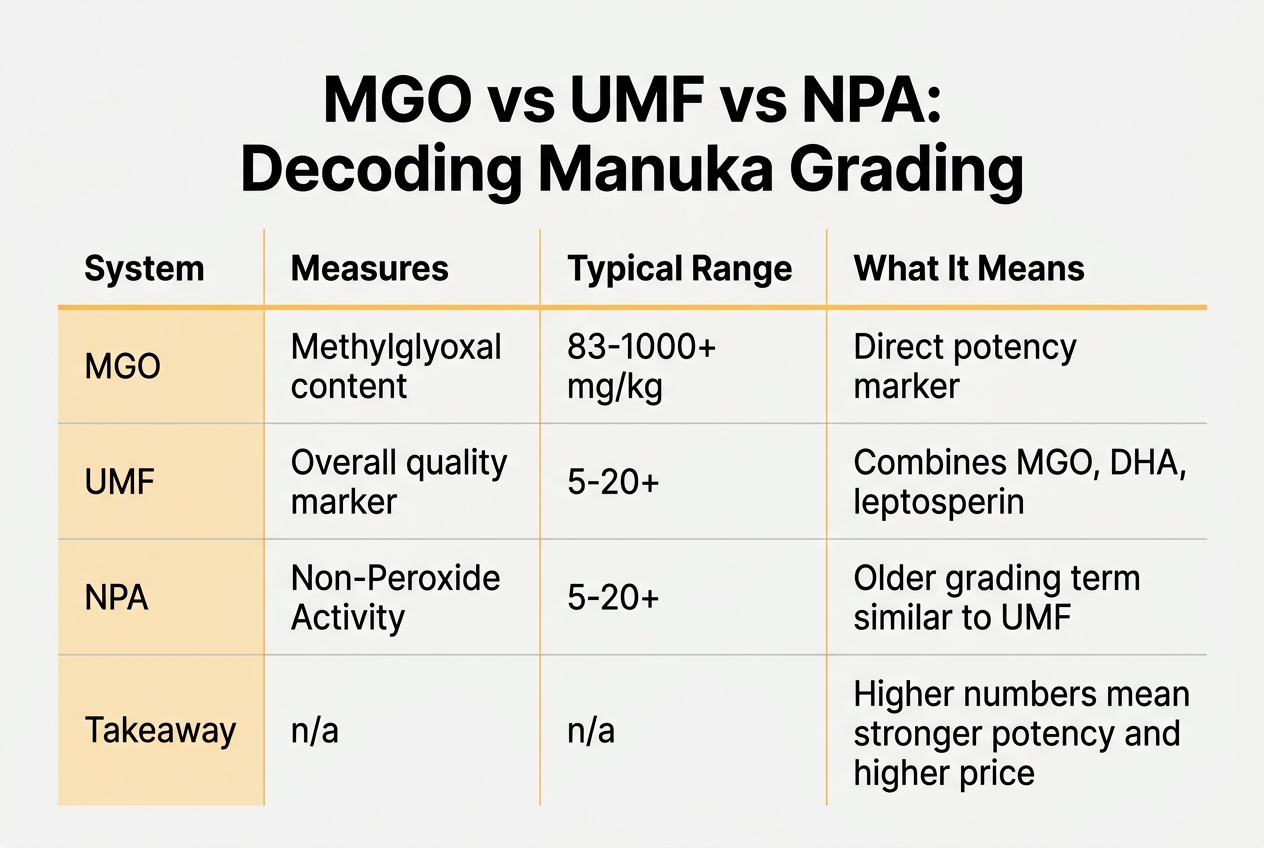
Three different labels show up on manuka jars, and brands rarely explain why. MGO stands for methylglyoxal, the compound that gives manuka its unique antibacterial punch. It's a direct lab measurement, reported in milligrams per kilogram. Simple enough. UMF, short for Unique Manuka Factor, is a licensed trademark system out of New Zealand that bundles MGO with two other markers, leptosperin and DHA, plus a purity check. NPA, or Non-Peroxide Activity, is older terminology that largely overlaps with UMF but shows up less on current labels.
Here's the catch: a jar can carry an MGO number with no UMF license at all, since UMF certification costs brands an annual fee. That doesn't make the honey fake. It just means you're comparing a raw chemical reading against a bundled quality grade, so the numbers don't map one-to-one. A rough conversion helps when you're standing in an aisle comparing two brands with totally different labeling systems.
MGO-to-UMF rough equivalence chart
Treat this as a reference point, not a lab-certified formula, since testing labs vary slightly in method.
| MGO Level | Approx. UMF Equivalent | Typical Use Case |
|---|---|---|
| MGO 83+ | UMF 5+ | Daily wellness, general maintenance |
| MGO 263+ | UMF 10+ | Immune support, everyday boost |
| MGO 514+ | UMF 15+ | Targeted, higher-potency use |
| MGO 829+ | UMF 20+ | Therapeutic-strength applications |
Notice the jump isn't linear. Going from UMF 10 to 15 roughly doubles the MGO count, not just adds five. That's worth knowing before you pay double for a "slightly higher" grade. For context on why some buyers chase higher potency at all, it's worth noting that separate bee-derived products get studied for hormonal and reproductive support too. Research summarized under royal jelly fertility benefits is a good example of that broader interest in traceable, lab-verified bee products. Whichever system a label uses, ask for the certificate behind the number.
9 Recommended Manuka Honey Types by Potency and Use Case
Matching potency to your wellness goal
Not every jar of manuka needs to be the strongest one on the shelf. Think of MGO rating the way you'd think of coffee strength — some days call for a light pour, some days need the double shot. Matching the number to what you're actually doing with the honey saves money and avoids wasting a high-grade jar on everyday toast.
- Low MGO (80-100+): ideal for stirring into tea, drizzling on toast, or baking, where taste and versatility matter more than therapeutic strength.
- Mid-range MGO (260-300+): the sweet spot for daily immune maintenance, taken by the spoonful most mornings as part of a routine rather than a targeted fix.
- High MGO (500+): suited to more specific wellness goals, like supporting a sore throat or digestive discomfort during a rough week.
- Ultra-high MGO (1000+): a rare, premium tier that commands a steep price and is usually reserved for short-term, concentrated use rather than everyday eating.
- Raw, unfiltered single-origin manuka: retains natural pollen and sediment that blended versions strip out, giving you a less processed alternative with the same floral source.
- Manuka paired with raw honeycomb: a texture upgrade — chewy comb plus potent honey — that also signals minimal processing, since comb can't be faked or diluted easily.
Buying in bulk makes sense too, whether you're a household that goes through honey fast or a small retailer stocking shelves. Just confirm the MGO holds steady across the batch, not just the sample jar.
When higher MGO is worth the price jump
Here's the honest answer: most people don't need 1000+ MGO. It's a splurge, not a requirement. The jump from mid-range to high MGO is worth paying for when you're using the honey for something targeted and short-term, not as a daily condiment. If you're also exploring other raw honey varieties for flavor rather than potency, the premium 100 pure orange blossom honey profile is a good example of how floral source, not MGO, drives taste. For readers comparing broader grading claims across brands, learning how third-party manuka honey grading standards actually get verified is worth the time before paying extra for a number on a label.
Lab Testing and Traceability: What to Check Before You Buy
Reading a certificate of analysis
A real certificate of analysis isn't a marketing flyer. It's a lab document, usually dated, showing what was tested and when. Look for testing cadence first — purity results updated roughly every six months carry more weight than a one-time test done years ago. The report should name the lab, list the batch or harvest date, and spell out results for glyphosate screening and synthetic additives, not just a vague "pure" claim on the label. If a seller can't produce one on request, that's your answer.
Good resources exist for learning the basics before you compare labels side by side. Because the category is so easy to misjudge, learning how to select manuka honey before you shop will save you from a lot of overpriced, under-tested jars. Traceability matters just as much as the test itself: a jar that lists hive location and harvest date is much harder to fake than one with a generic "Product of New Zealand" sticker and nothing else. Diluted or adulterated imports have been a known problem in this category for years — rice syrup and sugar syrup cutting have both turned up in independent investigations. Hive-to-shelf documentation is what makes that kind of fraud harder to pull off.
One brand's manuka line (MGO 263+/514+) is tested every six months for purity and for quality markers alongside its royal jelly's 10-HDA benchmarks, with traceability running from the hive straight through to the lab certificate. That's the standard worth measuring other sellers against. Finally, check country of origin. Authentic manuka nectar only comes from New Zealand and Australia — nowhere else grows the manuka tea tree at commercial scale. Anything claiming manuka origin outside those two countries deserves real skepticism, no matter how convincing the label looks.
Comparing Recommended Manuka Honey Grades Side-by-Side
Low vs mid vs high MGO at a glance
Before you chase the biggest number on the label, it helps to see how the tiers actually stack up. Low MGO jars (around 30-80) taste mild and floral, almost like a standard wildflower honey with a faint earthy finish. Mid-range jars (100-250) bring a stronger, almost medicinal edge, while high MGO jars (300 and up) are thick, bitter, and meant for targeted use rather than your morning toast. The antibacterial activity of manuka honey does scale with MGO content, but that doesn't mean every household needs the strongest jar on the shelf.
| Tier | Taste | Typical Use | Price Range | Shelf Life |
|---|---|---|---|---|
| Low (MGO 30-80) | Mild, sweet, slightly earthy | Everyday tea, toast, general wellness | $15-$25 per jar | 2-3 years unopened |
| Mid (MGO 100-250) | Bold, herbal, lingering aftertaste | Sore throats, digestive support, daily immune habit | $30-$55 per jar | 2-3 years unopened |
| High (MGO 300-550+) | Intense, bitter, almost medicinal | Wound care support, targeted gut protocols | $60-$120+ per jar | 3+ years, stable due to low moisture |
Notice the price doesn't climb in a straight line. It jumps hard once you cross into triple-digit MGO, since fewer hives produce nectar potent enough to qualify. That's the honest tradeoff: you're paying for scarcity, not just strength. A parent managing seasonal sniffles rarely needs a 500+ jar; a mid-tier option usually does the job for less money. Save the high-potency jars for specific, short-term use, the way you'd treat a concentrated supplement rather than a pantry staple. Price alone shouldn't dictate the decision either, since value depends on matching potency to purpose, not defaulting to whatever number sounds most impressive on the shelf.
Common Mistakes When Buying Manuka Honey
Most manuka complaints trace back to one of a handful of buying habits, not bad luck. Once you know the patterns, spotting a questionable jar takes seconds.
How to spot a diluted or relabeled jar
A jar that just says "manuka" with a pretty label and vague honey-bee graphics isn't proof of anything. Real manuka carries a number — an MGO or UMF rating printed plainly on the label, backed by a batch code you can trace. No number, no deal. That's the short version. The longer version involves a few more habits worth breaking:
- Assuming any dark, robust-tasting honey labeled "manuka" is authentic, when color and flavor alone tell you nothing about actual methylglyoxal content;
- Overpaying for an ultra-high MGO rating (800+) when a mid-range jar in the 260-550 range covers daily wellness use just fine, saving real money without losing benefit;
- Storing the jar near a stove, sunny windowsill, or warm pantry shelf, which gradually degrades enzyme activity and the compounds that make manuka worth buying;
- Ignoring origin labeling entirely and grabbing a cheap import that's been blended with cheaper honey from outside New Zealand or Australia to stretch the batch;
- Skipping the batch or lab-test reference number on the label, which is the one detail that lets you verify the jar against an actual certificate of analysis;
- Buying from a listing with no harvest date or farm location at all, which usually means the seller can't tell you either.
Clinical interest in manuka's wound-care properties has grown for good reason — research including NCT02259491 | Manuka Honey for Wound Care has examined its topical use in real patients, which only underscores why potency claims on a kitchen jar deserve the same scrutiny. Store any jar you buy in a cool, dark cupboard, away from the stove. Heat is the enemy here, full stop. And if a seller can't produce a lab certificate on request, that's your answer right there.
Raw Honey and Royal Jelly as Everyday Companions to Manuka
Building a simple daily raw-honey and royal jelly routine
Manuka doesn't have to be the only jar in your cabinet. Think of it as the specialist, called in for sore throats or a stubborn immune dip, and let Orange Blossom, Buckwheat, and Jarrah fill in the everyday gaps. Orange Blossom brings a light, floral sweetness that's easy on tea and toast. Buckwheat has a darker, almost malty depth that works well stirred into oatmeal. Jarrah, an Australian raw honey with a caramel-like finish, rounds out the rotation. Rotating raw honeys this way keeps things interesting and exposes you to a wider range of floral sources and trace nutrients than any single jar can offer.
Royal jelly is where the routine gets more targeted. Royal Jelly Premium, fresh and raw with 2.1%+ 10-HDA, is a reasonable daily starting point for energy and immune support — something honey alone, even manuka, isn't formulated to deliver. For those who find the fresh paste's sharp, sour taste hard to manage, the freeze-dried Royal Jelly Powder concentrates 10-HDA to 6%+, three times the strength, and dissolves easily into a smoothie or cold drink. One documented study worth knowing about examines the from-skin-to-smile-antibacterial-strength-of-manuka, which helps explain why manuka earns its reputation while royal jelly is valued for a different job entirely.
Propolis fills the remaining gap. Organic Bee Propolis Powder is raw and unextracted, with no added sugar, while the alcohol-free Propolis Immune Support Spray suits anyone avoiding ethanol-based tinctures, kids included. Both are simple daily additions, not replacements for manuka.
If you're ordering for a household, free shipping kicks in over $99. That makes stacking a few jars and a jelly or propolis item at once worth planning around. Wellness retailers eyeing manuka for their shelves should also look at a wholesale or bulk ordering program, since stocking raw honey, royal jelly, and propolis together gives customers reasons to come back monthly rather than once. Either way, the real goal is a small rotation. One jar can't do everything — spread the work around, and your honey shelf actually earns its space.
If you're weighing a contract pollination arrangement, the real questions are about acreage, bloom timing, and the grower's own track record with a given apiary — not which jars happen to sit on a shelf somewhere. It's worth asking any prospective partner how long they've worked your specific crop, how they handle hive placement and timing around weather, and what happens if a season underperforms. Those practical details, more than anything else, will tell you whether an arrangement is built to actually serve your orchard.


