

Best Quality Manuka Honey: A Buyer's Guide to MGO Grades
Sep 25, 2026
Shelf after shelf claims to be "genuine" Manuka, yet UMF numbers vary wildly and price tags don't always match purity. You've probably wondered if that jar in your pantry is worth what you paid for it. It's a fair concern. This article breaks down exactly what separates the best quality manuka honey from clever marketing, so you can shop with confidence in 2026 and beyond.
What makes manuka honey different from regular honey
MGO
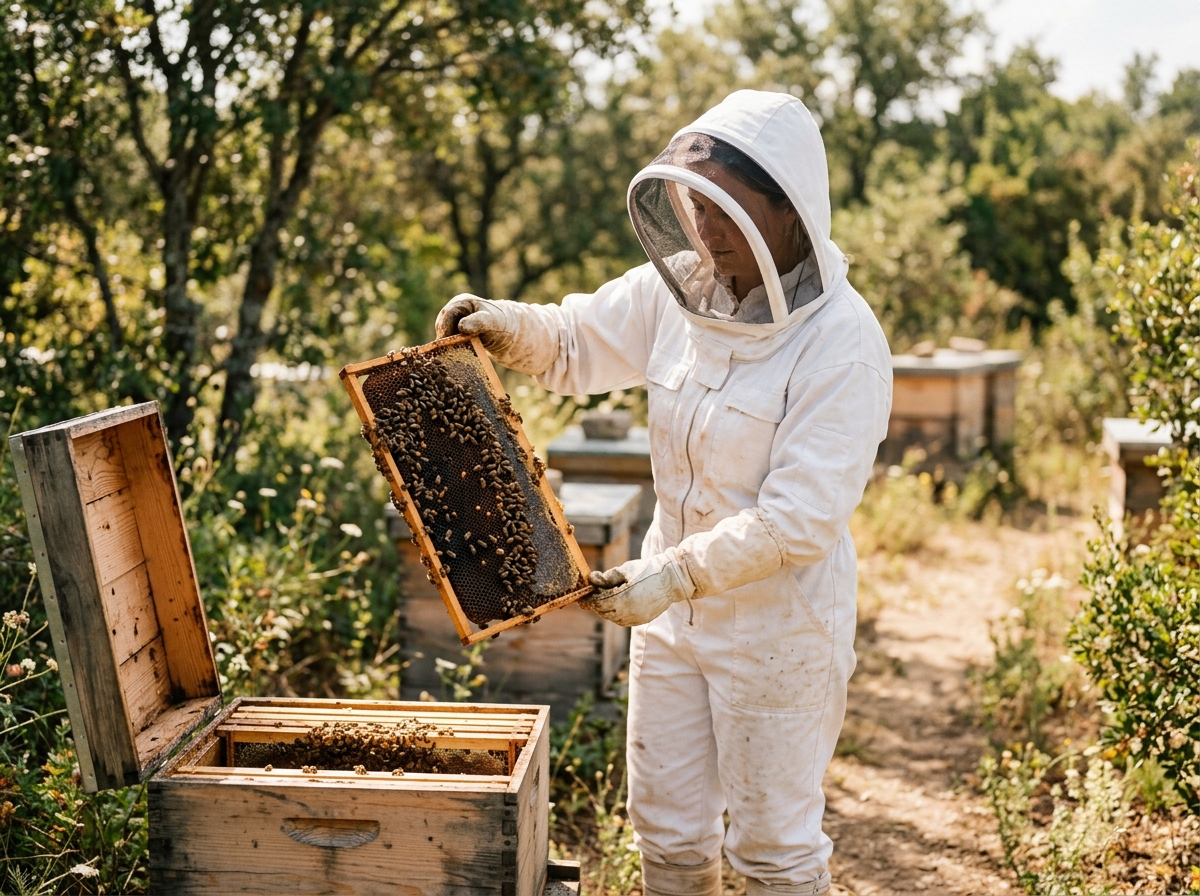
Manuka honey starts with a single plant: the Leptospermum scoparium tree, a scrubby shrub native to New Zealand and parts of Australia. Bees that forage its blossoms produce nectar with a chemical fingerprint no clover field or wildflower meadow can match. That fingerprint is methylglyoxal, or MGO. It's a naturally occurring compound, and it's what gives manuka its antibacterial punch.
Regular honey has some antibacterial activity too, thanks to hydrogen peroxide formed by enzymes. Manuka's MGO works differently. It holds up even after that peroxide activity fades. The higher the MGO number on a label, the more concentrated the compound. That's why one jar might run $20 and another, sourced from the exact same tree, might run well over $100.
UMF
MGO isn't the only number you'll see stamped on a jar. UMF, or Unique Manuka Factor, is a separate rating system developed in New Zealand to verify authenticity beyond just methylglyoxal content. It checks for a handful of markers found together in genuine manuka, not just one isolated compound. Think of it as a second signature, confirming the honey is what it claims to be.
The two systems overlap but aren't identical, and that trips people up constantly. Curious readers comparing the two head-on should spend time on a plain-language breakdown of manuka honey vs raw honey before assuming higher numbers always mean better honey for their specific use. A UMF 10+ jar and an MGO 263+ jar might describe honey that's nearly identical in strength, just measured on different scales.
Why grading exists
Grading exists because manuka isn't just another sweetener. People buy it for wellness, not tea. That distinction matters: a spoonful of clover honey and a spoonful of manuka serve completely different goals, and pricing follows accordingly. Without standardized grading, there'd be no way to tell a genuinely potent jar from one riding on the name alone.
There's also the matter of scarcity. The Leptospermum bloom lasts just a few weeks a year, in remote, often rugged terrain across New Zealand and parts of Western Australia. Beekeepers have a short window to capture that nectar before it's gone. Add in the lab testing required to verify MGO and UMF levels, and you start to see why real manuka never sits in the bargain bin. Cheap "manuka" usually means diluted manuka. Grading is the only thing standing between you and a very expensive bottle of ordinary honey.
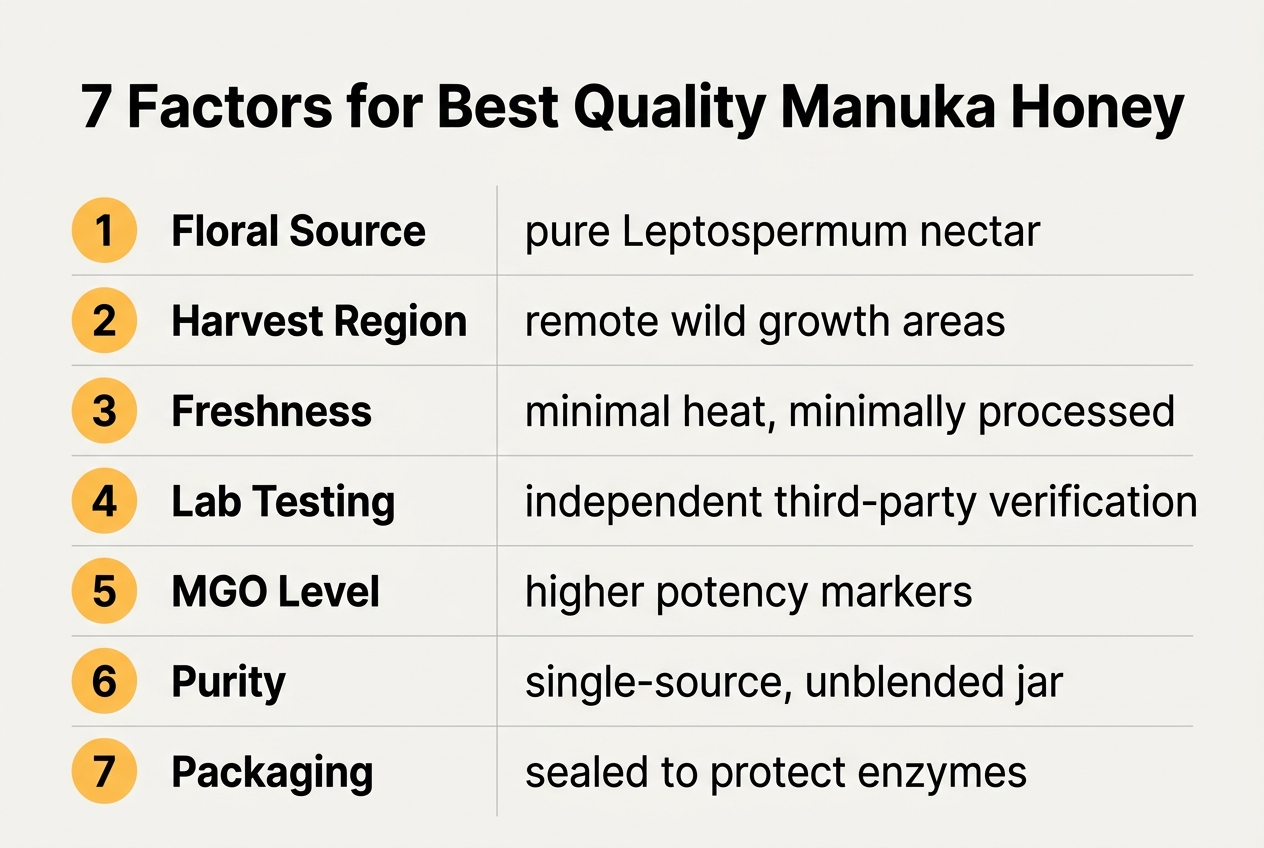
7 factors that determine the best quality manuka honey
Reading an MGO or UMF label correctly.
Most people pick up a jar, see a big number, and assume bigger means better. Not quite. MGO measures methylglyoxal concentration, the compound responsible for manuka's antibacterial punch, while UMF is a broader grading system that factors in MGO alongside other markers. Neither number tells you whether the honey is raw, whether it's been heated to hide crystallization, or whether it's actually from New Zealand or Australia at all. That's a separate question, and it matters just as much as potency.
Before you trust a label, run through the basics. A solid raw unfiltered honey buying guide will walk you through most of these, but here's the short version worth memorizing:
- Check the MGO or UMF number against a batch-specific lab certificate, not just a general brand claim printed on the packaging.
- Confirm the honey is raw and unheated, since pasteurization can quietly strip enzymes while leaving the potency number untouched.
- Look for glyphosate-free testing results, which confirm the hives weren't exposed to herbicide drift near the foraging area.
- Trace the honey back to a specific origin and harvest date, ideally down to the region or hive cluster it came from.
- Inspect the color and texture, since genuine raw manuka tends toward a dark, dense, slightly sticky consistency rather than a thin, glassy pour.
- Ask whether lab testing happens per batch or just once a year for the whole product line, because a lot can change between harvests.
Higher MGO ratings, like 263+ or 514+, do indicate stronger antibacterial potency. They say nothing about purity, though. A honey can test high on MGO and still be blended, heat-treated, or sourced from questionable hives. Raw, unfiltered honey keeps its natural enzymes and pollen intact — the stuff that gets lost the moment honey is heated and forced through fine filters. If a seller can't produce a lab certificate for the exact batch you're buying, the MGO number on the front of the jar is basically a guess dressed up as a fact.
Manuka honey grading and lab-tested brands compared
Manuka honey gets sold under two overlapping systems, MGO and UMF, and the numbers matter more than the marketing around them. A low MGO jar is fine for everyday tea or toast. A high one is what people reach for when they want targeted, temporary immune support. Neither is "better" in some absolute sense. It depends on what you're actually trying to do with it.
| Tier (MGO/UMF) | Typical use | Raw/unheated status | Common origin | Price tier |
|---|---|---|---|---|
| MGO 30–100 / UMF 5+ | Everyday wellness, cooking | Often heat-treated for shelf stability | New Zealand or blended | Low |
| MGO 100–250 / UMF 10+ | General immune support | Varies by producer | New Zealand | Mid |
| MGO 263+ / UMF 13+ (raw, third-party tested) | Targeted immune support, sore throat use | Raw, unheated, unfiltered | New Zealand | Mid-high |
| MGO 514+ / UMF 20+ | Concentrated, short-term therapeutic use | Raw when labeled as such | New Zealand | High |
| Non-manuka Australian raw honey (e.g. Jarrah) | Daily use, caramel-toned flavor variety | Raw, unheated | Australia | Mid |
A few things separate a serious jar from a shelf-filler. Raw status means it hasn't been pasteurized, which preserves enzymes but also means the honey can crystallize — that's normal, not spoilage. Glyphosate testing is the other quiet dividing line: many mass-market jars never get screened for it, while smaller producers running independent lab checks every few months will actually show you the certificate. Origin matters too. True manuka only comes from New Zealand and parts of Australia, so anything vague about sourcing deserves a second look. One reference point worth knowing: a 100% pure raw manuka offered at MGO 263+ and 514+ tiers, both lab-verified, sits at the higher end of that spectrum without added processing. For comparison, drugstore blends and some big-name imports rarely disclose testing frequency at all.
Here's the part nobody tells you at checkout: a higher MGO number doesn't guarantee better flavor. It often tastes more bitter and medicinal, not smoother. If you're using honey daily for toast or tea rather than as a targeted remedy, a mid-tier raw jar — or even a non-manuka raw honey like premium 100 pure orange blossom honey, which crystallizes naturally and reads as a floral, everyday option — may deliver more actual enjoyment per dollar. Save the top tiers for when you need them.
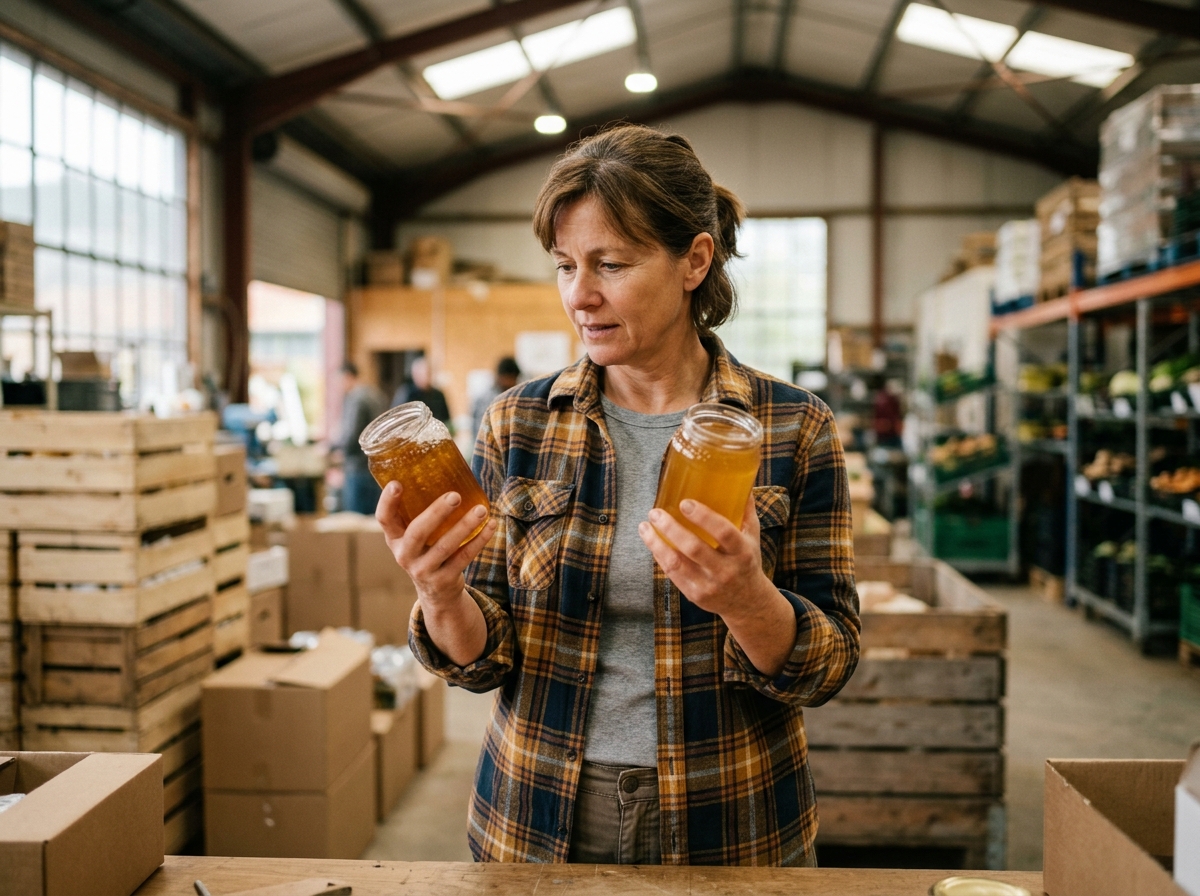
How to verify purity before you buy
Questions to ask a seller directly
Before you hand over your money, put the seller on the spot. A good one won't flinch. Most manuka marketing leans hard on the MGO number printed on the front label, but that figure only tells you about antibacterial strength, not whether the jar is free of pesticide residue, glyphosate, or fillers mixed in to stretch profit margins. You need to ask sharper questions than "what's the MGO?"
- Ask whether the honey is independently lab tested for glyphosate and other synthetic additives, not just graded for MGO content — purity and potency are two separate tests, and plenty of sellers only run one of them.
- Ask to see traceability records that connect the jar in your hand to a specific hive location, a harvest date, and a certificate of analysis you can actually read, not just a vague "sourced from New Zealand" claim.
- Ask how often testing happens — a single certificate from three years ago tells you nothing about the batch currently sitting on the shelf.
- Ask directly whether the product is pure manuka or a blend labeled as "manuka-style," a phrase that has no enforceable grading standard behind it and often signals dilution with cheaper honey.
- Ask what verification method backs up any potency claim, since 10-HDA and MGO figures are meaningless without a named lab and a repeatable testing process behind them.
If a seller gets cagey about any of that, take it as your answer. Reputable sources of raw honey and royal jelly welcome this kind of scrutiny, because how to select manuka honey is a question more shoppers are learning to ask before they buy. Some producers test every batch every six months, checking not just MGO but glyphosate absence and 10-HDA-equivalent potency, with hive-to-spoon traceability documented from harvest date to lab certificate. That level of transparency is rare — and it's exactly what separates a trustworthy jar from a guess.
Raw vs. processed: why heat and filtering matter
Most commercial honey gets flash-heated and forced through fine filters before it hits the shelf. That trick keeps it clear and pourable for years. But heat and ultra-filtering strip out the good stuff — live enzymes, trace pollen, and some of the antioxidant compounds that make raw honey worth buying in the first place. You end up with something that looks perfect and does a lot less. It's basically syrup wearing a honey costume.
So when raw honey turns cloudy or hardens into a grainy paste, don't panic. That's crystallization, and it's completely natural — a sign the honey was never cooked or stripped down. A jar of raw Orange Blossom honey is a good example: left in a cool cupboard for a few months, it'll shift from smooth and pourable to thick and semi-solid, sometimes almost spreadable, as the natural glucose settles out of solution. Warm the jar gently and it loosens right back up. Nothing was added, nothing was lost.
Processing isn't the only thing that decides final quality, though. How the bees were kept matters just as much. Hives sitting near sprayed fields or treated with synthetic chemicals pass those residues straight into the honey, no matter how gently it's later handled. Pesticide-free, sustainably managed hives give you a cleaner starting point. That combination — minimal processing plus clean sourcing — is what actually determines whether a jar deserves the word "raw" on its label.
Other raw honey varieties worth comparing to manuka
Manuka gets the spotlight, but it's not the only honey worth your attention. If your goal is antioxidant intake, flavor variety, or just enjoying honey in its rawest state, other single-source varieties hold their own. Buckwheat honey brings a malty, almost molasses-like depth and a mineral richness that makes manuka taste mild by comparison. Jarrah honey, a rare Australian raw honey, has a caramel note and a floral scarcity that beekeepers often mention in the same breath as manuka. And raw honeycomb is about as unprocessed as honey gets — comb wax and all, edible in small pieces, pollen intact.
Building a raw honey sampler at home
You don't have to pick just one. A sampler lets you taste the range and match honey to mood, season, or health goal. Here's a simple framework to follow.
| Step | What to do | Why it matters |
|---|---|---|
| 1 | Choose two honey types (e.g., Buckwheat + Jarrah) | Gives contrast in flavor and floral source |
| 2 | Add a Manuka jar for comparison | Sets a benchmark since it's the most studied variety |
| 3 | Include Raw Honeycomb | Shows the least-processed form, with pollen and wax |
| 4 | Check order total against the $99 free-shipping threshold | Bundling jars often clears it, cutting cost per jar |
| 5 | Taste side by side, room temperature | Cold honey mutes flavor; warmth reveals real character |
A five-jar sampler isn't a gimmick. It's the fastest way to figure out what you actually like, rather than guessing from a label. Buckwheat for baking and immune support, Jarrah for a spoonful with tea, honeycomb for the novelty and the wax, manuka as your control group. Skip the pre-made gift boxes some retailers push. Building your own costs less, and you know exactly what's in it.
Pairing manuka honey with other raw bee products
Manuka honey doesn't have to work alone. Plenty of people pair a jar with royal jelly or propolis to cover more ground — energy, immunity, and general wellness, all at once. The trick is picking the right format for how you actually live, not the one with the fanciest label.
Choosing between spray, powder, and raw honey
Fresh royal jelly is the classic pairing. A Premium Raw Royal Jelly with 2.1%+ 10-HDA works well stirred into honey for a daily energy and immune ritual, while a never-frozen Limited Edition batch running 2.3%+ 10-HDA suits anyone chasing maximum potency. Both taste sharp and a little sour. That's normal, not a flaw. If that taste is a dealbreaker, don't force it. Just switch formats.
Here's how the options actually differ in practice:
- Freeze-Dried Royal Jelly Powder (6%+ 10-HDA) hides easily in a smoothie, cutting the strong taste that turns people off fresh royal jelly, while delivering three times the concentration by weight.
- Organic Bee Propolis Powder gives you a raw, unextracted daily supplement for anyone who wants propolis in its most unprocessed form, spooned into honey or water.
- Alcohol-Free Propolis Immune Support Spray works as a family-friendly alternative to ethanol-based tinctures, useful for kids or anyone avoiding alcohol entirely.
- Raw manuka honey itself functions as the base — a spoonful with propolis powder mixed in, or a drizzle over royal jelly, turns two products into one habit.
- Wholesale and bulk ordering lets retailers stock manuka honey and royal jelly side by side for resale, rather than sourcing each from a different supplier.
None of this is complicated. Match the format to your routine, and you'll actually use it. That matters more than which one sounds most impressive on a label.
Choosing a hive product often comes down to what you actually need it to do—whether that's a daily wellness habit, a pantry staple with real floral character, or something to give as a thoughtful gift—and matching the format to that purpose matters more than chasing a trendy label. It's worth asking how the item was harvested, whether it's been heated or blended, and whether a raw, single-source option might serve the same goal more simply. Taking a moment to weigh those questions usually points toward a clearer, more satisfying choice than the packaging alone would suggest.


