

Manuka Honey vs Raw Honey: Which One Should You Buy?
Sep 01, 2026
Standing in the pantry aisle, jar in hand, you're stuck wondering if that premium price tag is actually worth it. The manuka honey vs raw honey debate isn't just marketing noise. It's about knowing what you're really paying for and whether it matches your health goals. Maybe you need proven antibacterial strength. Or maybe you're after the enzyme-rich, unfiltered goodness of local honeycomb. Either way, you deserve a clear answer.
Manuka Honey vs Raw Honey: The Core Difference
Why this is really 'one type vs the whole category'
Here's the mix-up almost everyone makes: they treat these as two competing products on a shelf. They're not. Raw honey is an umbrella term. It covers any honey that hasn't been heated, pasteurized, or filtered, no matter what flowers the bees visited — clover, orange blossom, buckwheat, wildflower, all of it. Manuka honey, on the other hand, is one specific varietal. It comes from bees foraging on Leptospermum scoparium, the manuka bush, which grows almost exclusively in New Zealand and parts of Australia.
So the real relationship is inclusion, not competition. All manuka honey can be raw. But not all raw honey is manuka — it's a subset, a single entry in a much bigger family. Think of it like asking "sparkling water vs beverages." One is a broad category; the other is a narrow, geographically limited product within it. If you want a deeper breakdown of how floral source changes composition and behavior, learning about how manuka compares with other honey varieties fills in a lot of the nuance.
What actually separates manuka from the rest chemically is methylglyoxal, or MGO. This compound forms naturally as manuka nectar converts to honey, and it's responsible for the antibacterial strength manuka is famous for. Most other raw honeys don't develop MGO in meaningful amounts. That's the real distinguishing line — not "raw vs processed," but a specialty honey measured against the broader category it belongs to. Keep that framing in mind. It'll make every comparison ahead much easier to follow.
What Counts as Raw Honey
How raw honey differs from processed supermarket honey
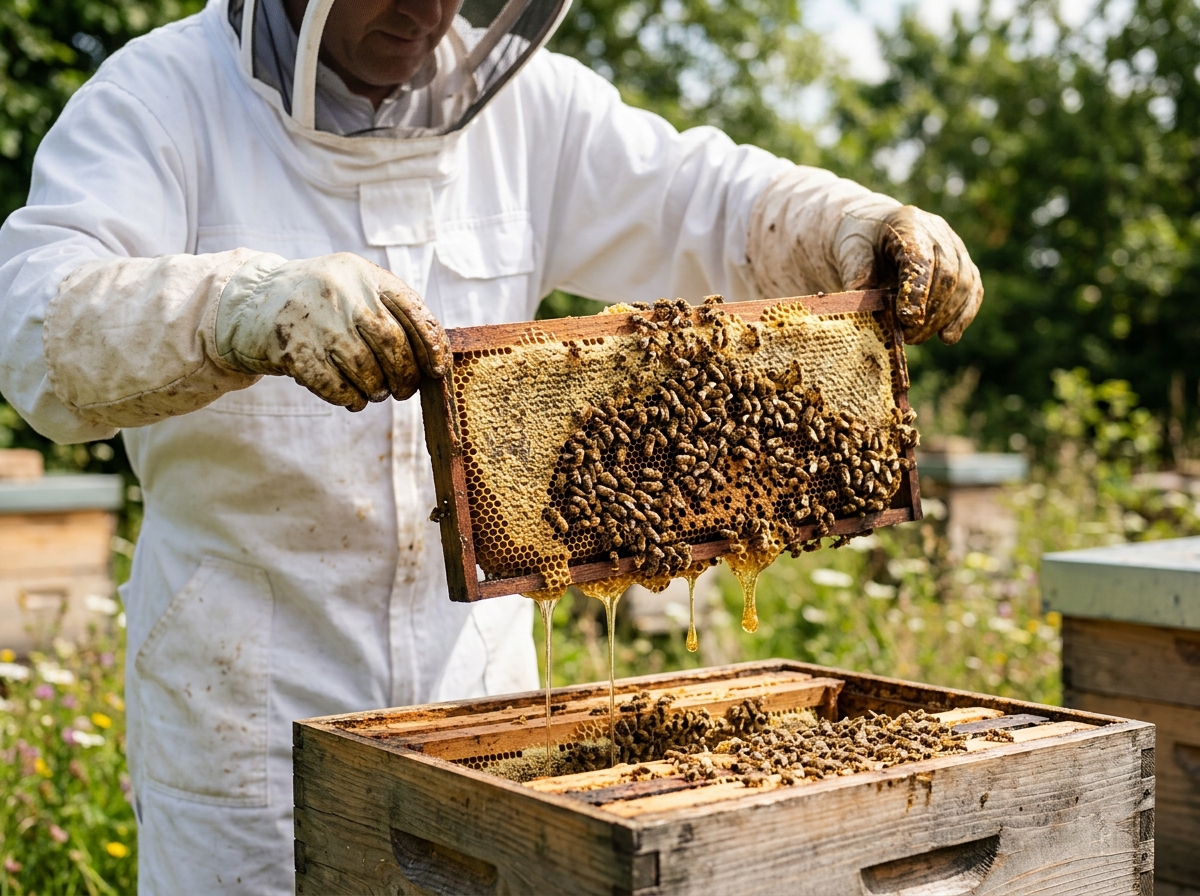
Raw honey is honey pulled straight from the comb, spun out, maybe strained through a coarse mesh, and jarred. That's it. It's never heated above roughly 95°F, the natural temperature inside a hive, and it's never microfiltered. Those two steps sound minor. They aren't. Skip them and you keep the honey exactly as the bees made it, instead of cooking and scrubbing away what made it worth eating in the first place.
What survives that gentle handling matters: trace pollen, tiny bits of propolis, active enzymes like glucose oxidase, and antioxidants that give raw honey its cloudy look and complex flavor. Glucose oxidase is actually the enzyme responsible for honey's mild natural hydrogen peroxide production, which is part of why raw honey has a long folk history as a wound salve. Heat and filtration knock all of that out or reduce it substantially.
Commercial supermarket honey usually gets pasteurized and ultra-filtered, a process that strips pollen almost entirely, partly to extend shelf life, partly to make the honey look clear and pretty on a shelf. Many jars are also blends, sourced from multiple countries and mixed together with zero traceability back to a single farm or hive. That's not necessarily dangerous. It's just not raw, no matter what the front label implies.
How raw honey differs from processed supermarket honey
Varietal matters more than most shoppers realize. A dedicated provider working orange blossom trees produces honey with a citrusy aroma and light color, while buckwheat honey comes out almost black, molasses-thick, and rich in antioxidants. Jarrah honey, harvested from a single eucalyptus species in Western Australia, has a distinct earthy depth. Learning more about premium 100 pure orange blossom honey is a good way to see how forage location shapes both flavor and nutrient makeup. Wildflower honey, by contrast, changes jar to jar depending on whatever's blooming nearby that season.
None of that nuance means anything without proof behind it, though. Traceability — knowing which hive, which farm, which harvest date, backed by a lab certificate — is what actually separates trustworthy raw honey from a jar that just slaps "raw" on the label. Plenty of brands do that, and there's no real enforcement stopping them. If a seller can't tell you where the bees foraged or hand you a recent purity test, take the "raw" claim with a grain of salt.
What Makes Manuka Honey Unique
The role of MGO potency ratings
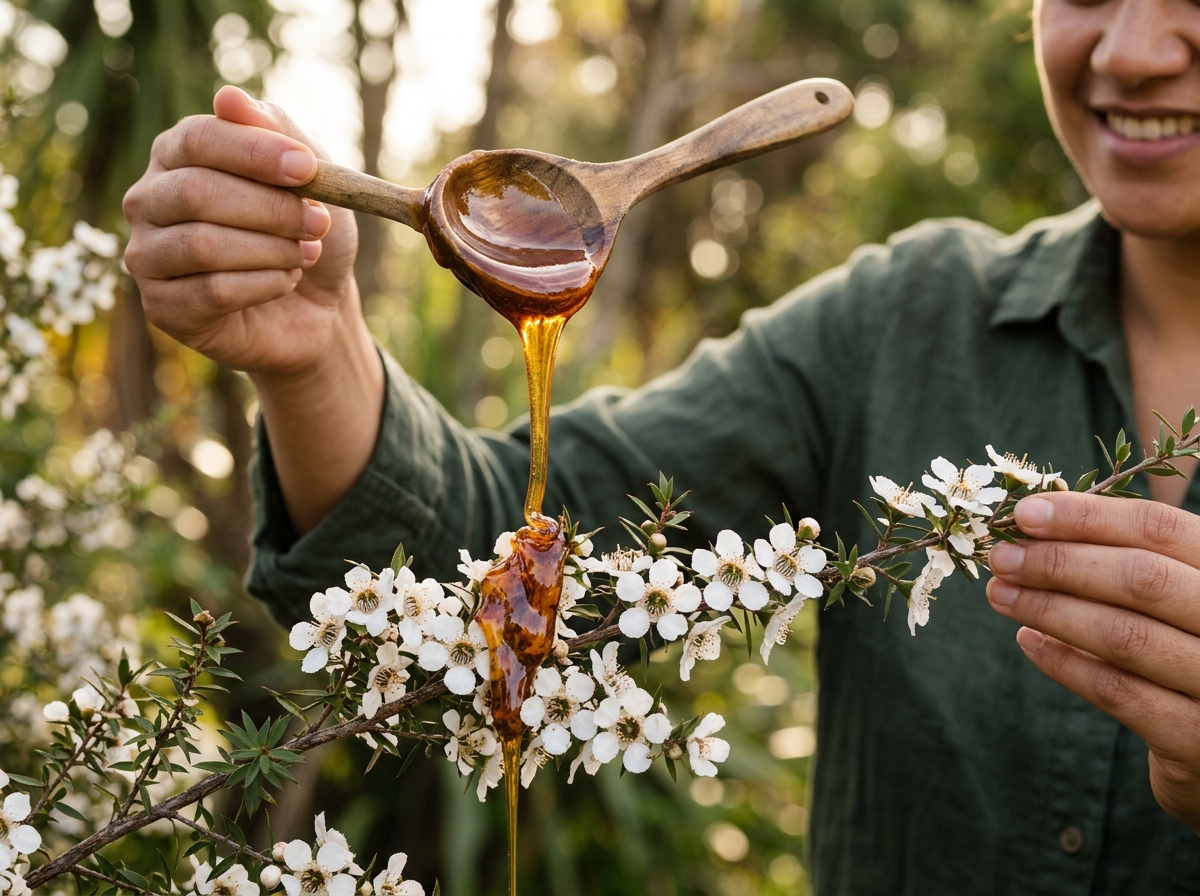
Manuka honey comes from one plant, basically: the manuka bush, which blooms for just a few weeks a year across New Zealand and pockets of Australia. That short window matters. Bees can only forage the flower while it's actually flowering, so supply is naturally capped every single season, and that scarcity shapes almost everything else about the honey, including its cost and its reputation.
What sets manuka apart from other single-origin honeys is the MGO rating — methylglyoxal, a compound that drives its antibacterial strength. You'll see labels like MGO 263+ or MGO 514+, and the number isn't marketing fluff. Higher counts mean more concentrated antibacterial activity, verified through lab testing rather than taste or color. Some brands also use the UMF scale, which correlates closely with MGO but adds its own certification layer.
This antibacterial action doesn't rely on hydrogen peroxide the way most raw honey's mild antimicrobial quality does. That's why manuka has a real clinical history. It's shown up in wound-care dressings and hospital-grade products, not just kitchen cabinets. Expect a thick, sticky texture, a dark caramel color, and a flavor that's earthy and a touch bitter, quite different from lighter florals. Between the tiny bloom season, the geography, and the grading systems, prices climb fast. If you want the full picture on sourcing claims and industry updates, browsing current beekeeping news is a smart step before buying.
Manuka Honey vs Raw Honey: Side-by-Side Comparison
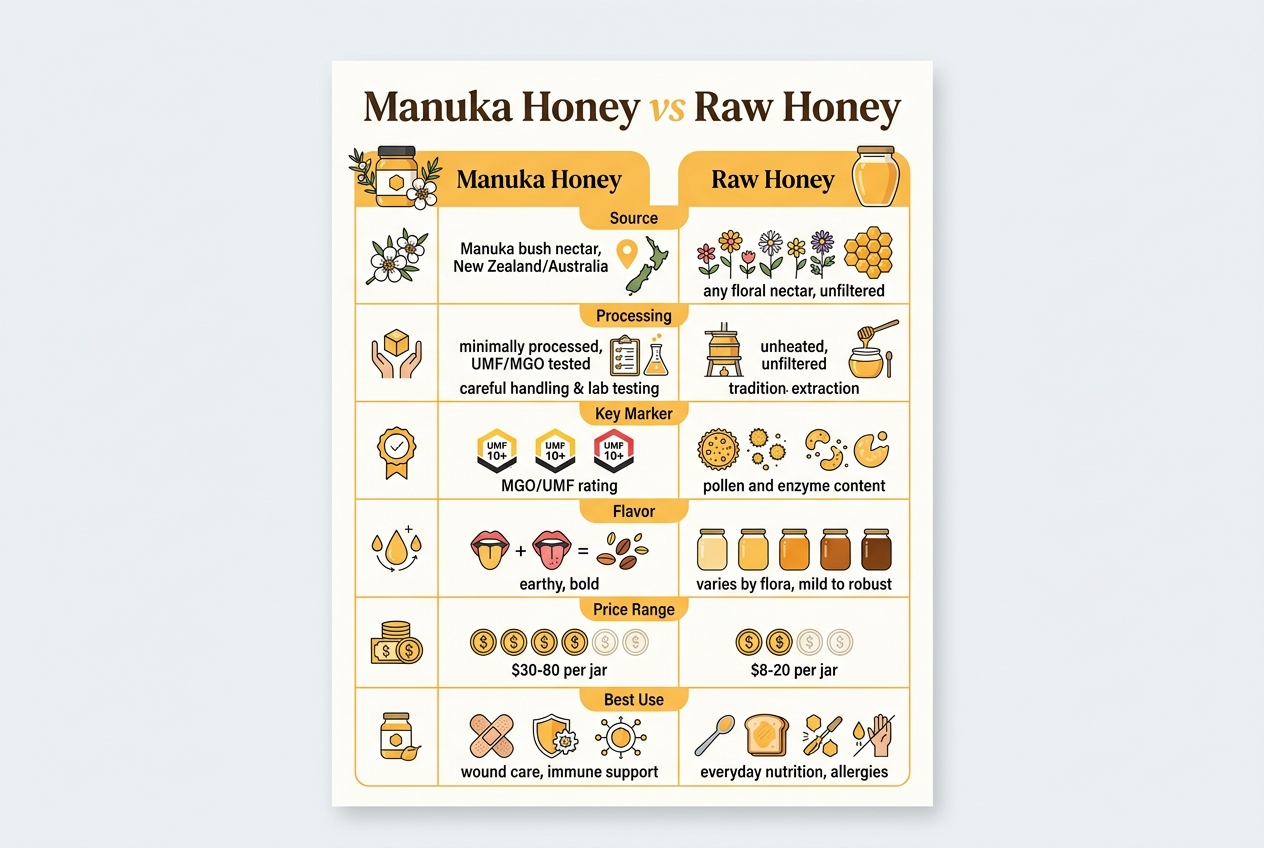
Sometimes you just need the numbers laid out flat. Below is a quick-reference table covering the practical differences that actually affect your buying decision — not the biology, just the specs that matter at checkout.
| Factor | Manuka Honey | Raw Honey (General) |
|---|---|---|
| Source/Origin | Single floral source — manuka bush, New Zealand or Australia only | Multiple floral sources — wildflower, orange blossom, buckwheat, and more, from farms worldwide |
| Processing Level | Raw, unheated, minimally filtered | Raw, unheated, unfiltered when sourced properly |
| Antibacterial Strength | High and measurable, rated by MGO (methylglyoxal), often 100-500+ | Moderate, driven mainly by natural hydrogen peroxide activity |
| Taste Profile | Earthy, bitter, slightly medicinal | Milder, floral, varies by nectar source |
| Price Range | Higher, often $30-$100+ per jar depending on MGO grade | Wide range, roughly $8-$40 depending on variety and origin |
Notice the gap in price isn't random. It tracks directly with MGO grading and limited geography. For a deeper breakdown of how these two are classified and tested, differences and benefits between manuka and regular honey are worth reviewing before you shop. On lab testing: reputable manuka producers publish MGO or UMF ratings on every batch, while quality raw honey sellers should offer similar third-party purity and pollen-source verification. If a seller can't show you either, that's your answer. Best use case? Manuka leans toward wound and immune support; raw honey covers everyday nutrition and seasonal allergy relief.
Health Benefits: How They Stack Up
Where local raw honey may have an edge for allergies
Both raw honey types share the same foundation: natural enzymes, antioxidants, and trace pollen that many people believe helps build tolerance to seasonal allergens. That pollen link is anecdotal, not clinically proven, but plenty of parents swear by a spoonful of local raw honeycomb during pollen season. Raw honey also does simple things well. It coats a sore throat and calms a nagging cough, which is half the reason it's been a kitchen staple for centuries.
Manuka honey earns its reputation elsewhere. One detailed comparison of manuka honey vs. raw honey found that manuka's documented antibacterial strength sets it apart for topical use, gut comfort, and gum health. That strength comes from methylglyoxal, not pollen, so don't expect the same allergy-season perk from a manuka jar.
Royal jelly and propolis, often harvested from the same hives, round out the picture with complementary support rather than overlap. Consider how naturopathy-minded users tend to combine them:
- Local raw honey with visible pollen and comb fragments, used daily in small amounts to support seasonal allergy tolerance.
- Manuka honey applied topically on minor cuts or taken internally for occasional digestive upset and gum irritation.
- Royal jelly worked into a morning routine for steady energy and skin-supporting nutrients.
- Propolis spray used at the first sign of a cold to give immune defenses a nudge.
- Manuka paired with propolis spray or royal jelly for a fuller daily wellness routine, rather than relying on one product alone.
One firm rule applies to every jar on this list: none of these products, raw or manuka, belong anywhere near a child under 12 months. Botulism spores are rare but real, and infant immune systems can't handle them. Adults and older kids, though, have plenty of room to experiment.
Pros and Cons of Each Type
When to choose one over the other
Neither honey wins every category. It depends on what you're actually trying to do with it. If you're stirring honey into tea every morning or looking for something local to pair with a seasonal allergy routine, raw honey usually makes more sense. If you want a documented antibacterial grade for a specific health goal, manuka earns its higher price tag. Reading up on the differences between these two honeys before you buy in bulk will save you money and confusion later.
- Raw honey tends to be more affordable, comes in a wide range of flavors like orange blossom or buckwheat, and supports local beekeeping operations you can actually visit or call.
- Raw honey works well for everyday cooking, baking, and daily allergy routines, since it's flexible and doesn't demand a specific dosage or ritual.
- Raw honey's antibacterial strength varies batch to batch and isn't standardized, so you can't always predict its potency from jar to jar.
- Manuka honey carries a standardized MGO grading system, giving it stronger clinical backing for wound care and antibacterial use than most raw varieties.
- Manuka honey stores longer on the shelf, but it costs more, gets imported from New Zealand or Australia, and loses the "support your local farm" appeal.
- Manuka's taste is bold, earthy, almost medicinal — not everyone's going to enjoy spreading that on toast.
Here's the part people skip: both types are only as good as their paperwork. A jar without lab verification of purity, potency, and freedom from glyphosate or additives is a gamble, no matter what the label promises.
How to Verify Purity Before You Buy
Red flags that signal over-processed or diluted honey
A jar labeled "raw" doesn't mean much on its own. That word isn't regulated the way you'd hope, so it gets slapped on plenty of products that have been heated, filtered, or cut with cheaper syrups. Real purity shows up in the details: a harvest date, a hive location, a lab certificate you can actually read. If a retailer can't produce those three things, keep shopping.
Texture tells a story too. Genuine raw honey crystallizes over time, sometimes within weeks, depending on the floral source. That's not spoilage. It's a sign the sugars and enzymes haven't been stripped out by heat processing. Honey that stays perfectly clear and syrupy for a year straight has probably been treated to prevent exactly that natural change.
Questions to ask any honey retailer
Before you buy, ask a few pointed questions. Below is a quick reference for what to ask and why the answer matters.
| Question to ask | Why it matters |
|---|---|
| Do you have a current lab certificate? | Confirms MGO or 10-HDA levels, purity, and absence of synthetic additives |
| How often is the honey retested? | Testing every 6 months signals ongoing quality control, not a one-time snapshot |
| Where and when was this harvested? | Traceability to a specific hive location and date rules out vague sourcing claims |
| Is this a single-origin batch? | Blended origins often mask lower-quality or diluted honey mixed in |
| Has it been heated or filtered? | Heat and fine filtration destroy enzymes and pollen that define raw honey |
Small farms that publish their lab results tend to be more trustworthy than big brands hiding behind marketing copy. For a deeper breakdown of how manuka, raw, and standard grocery-store honey actually differ on paper, learning about the difference between regular, raw, and manuka honey is a smart step before you spend money. Ask questions, read labels twice, and trust results over marketing.
Final Verdict: Which Should You Choose
A simple decision guide for your next purchase
Start with what you actually need. If your goal is affordable, everyday nutrition and some help with local seasonal allergies, a raw wildflower, orange blossom, or buckwheat honey is the clear winner. These varieties cost less, work beautifully stirred into tea or drizzled over yogurt, and still deliver the enzymes and local pollen traces that make raw honey worth choosing over the clear, heat-processed stuff on grocery shelves. There's no need to overspend here.
If you're dealing with a stubborn wound, digestive discomfort, or gum health issues, that's where manuka honey earns its price tag. Its MGO rating gives you a measurable antibacterial strength that generic raw honey simply doesn't have. A quick comparison of raw honey vs. manuka honey makes clear the two aren't competing for the same job.
Plenty of wellness-minded households don't pick one at all. They keep a jar of raw honey in the kitchen for daily use and a high-MGO manuka on hand for targeted moments — a sore throat, a scrape, a rough patch of skin. Regardless of which you buy, insist on raw, unheated, unfiltered honey with lab-verified purity and full hive-to-jar traceability. Marketing claims are cheap; a lab certificate isn't. Pair either one with royal jelly or propolis, and you've got a genuinely complete natural wellness routine.
Before you commit to a jar, it's worth asking where the honey actually came from, whether a single floral source is named, and how it was handled after extraction — heat and filtration quietly strip away much of what makes raw honey worth seeking out in the first place. A label that tells you the bloom, the region, and the harvest season is giving you something a generic "pure honey" claim never will, and that transparency tends to travel with producers who keep their own hives rather than buying on the commodity market. Take your time with those questions; the difference between a truly raw, single-origin honey and a blended supermarket bottle shows up in the taste, the texture, and the way it behaves in the jar over the months you keep it.


