

Raw Honey vs Regular Honey: The Real Differences Explained
Aug 28, 2026
Standing in the honey aisle, you've probably noticed two jars that look nearly identical but carry wildly different prices and promises. That gap isn't marketing fluff. The raw honey vs honey debate actually comes down to processing, nutrients, and what survives from hive to jar—details that matter whether you're soothing a child's seasonal allergies, formulating a skincare remedy, or stocking a wellness shelf with products customers trust. Here's what separates the two, and why it changes what you're really buying.
Raw honey vs honey: what actually separates them
How raw honey is harvested and bottled
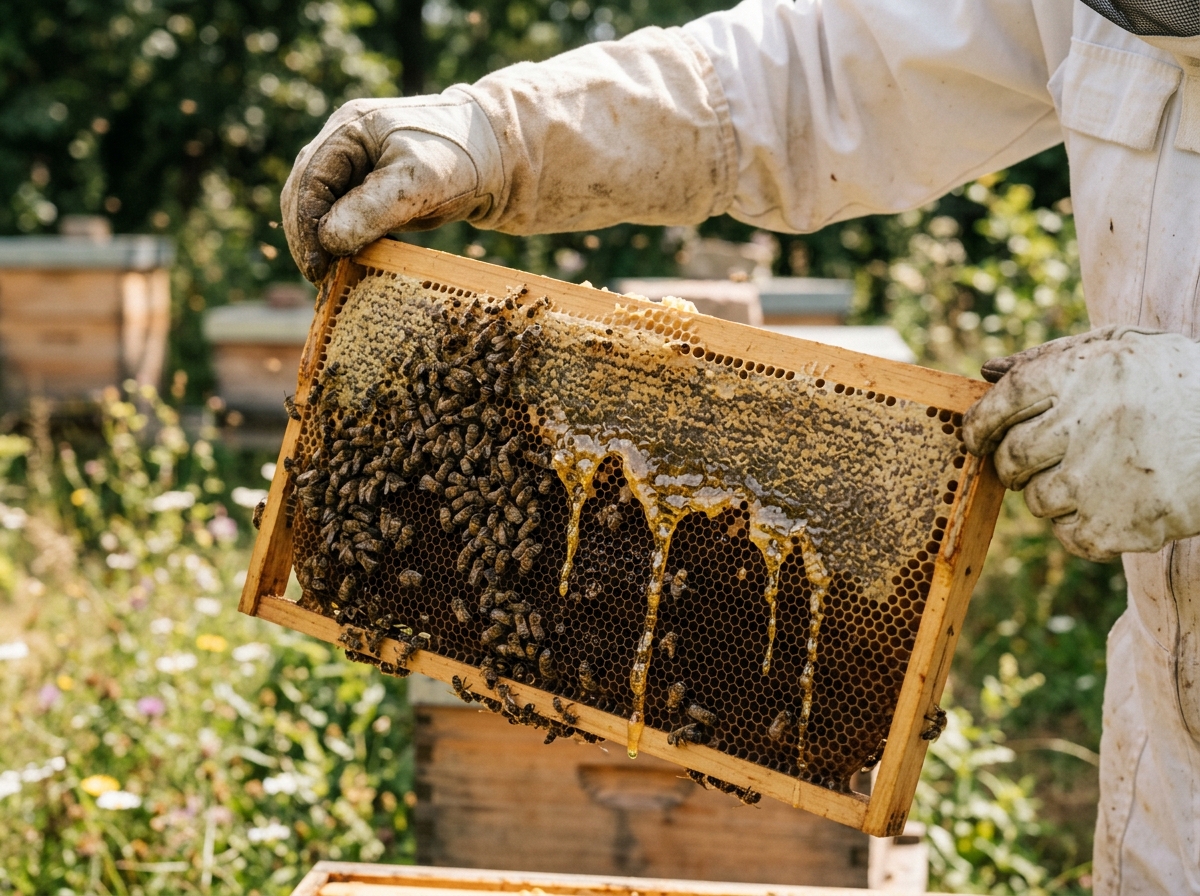
Raw honey's journey is short and simple. A beekeeper pulls frames from the hive, spins them in an extractor, strains out wax chunks and bee parts, and pours the honey straight into a jar. No heat. No pasteurizing. No fine-filtering. That's it. What you're getting is basically what the bees made, with all the pollen grains, tiny propolis flecks, and trace enzymes still floating around inside it.
That lack of processing is exactly why raw honey looks a little cloudy, sometimes crystallizes fast, and can vary in color and flavor from batch to batch. A jar from a spring wildflower harvest won't taste like one from late-summer buckwheat, and it shouldn't. Single-source traceability is the whole point here: one hive, one region, one harvest date. Chef Alex Guarnaschelli made this exact distinction in a video where she explained the difference between raw vs. regular honey, and it lines up with what most beekeepers will tell you directly.
How commercial honey is processed at scale
Commercial honey has a very different job to do. It needs to look pretty on a shelf, pour easily in cold weather, and stay clear for a year or two without turning cloudy. To pull that off, producers heat it well above 117°F and run it through micro-filters fine enough to strip out pollen, propolis bits, and the beneficial microbes that came along for the ride. What's left is smooth, uniform, shelf-stable — and nutritionally hollowed out.
Heat is the bigger issue, honestly. Past that 117°F threshold, natural enzymes start breaking down, antioxidants degrade, and the delicate aroma compounds that give raw honey its floral, sometimes smoky character just vanish. You're left with something that tastes sweet and little else. Flavor and function both take a hit.
Then there's the sourcing problem. Most bottles labeled simply "honey" at the grocery store are blends pooled from multiple countries — China, Argentina, Ukraine, wherever supply is cheapest that quarter — pasteurized together in massive batches with zero single-source traceability. You can't trace it to a farm, a season, or even a continent with any real confidence. No hive location, no harvest date, no lab certificate. Just a label that says "honey" and leaves the rest to your imagination.
Nutritional and compositional differences
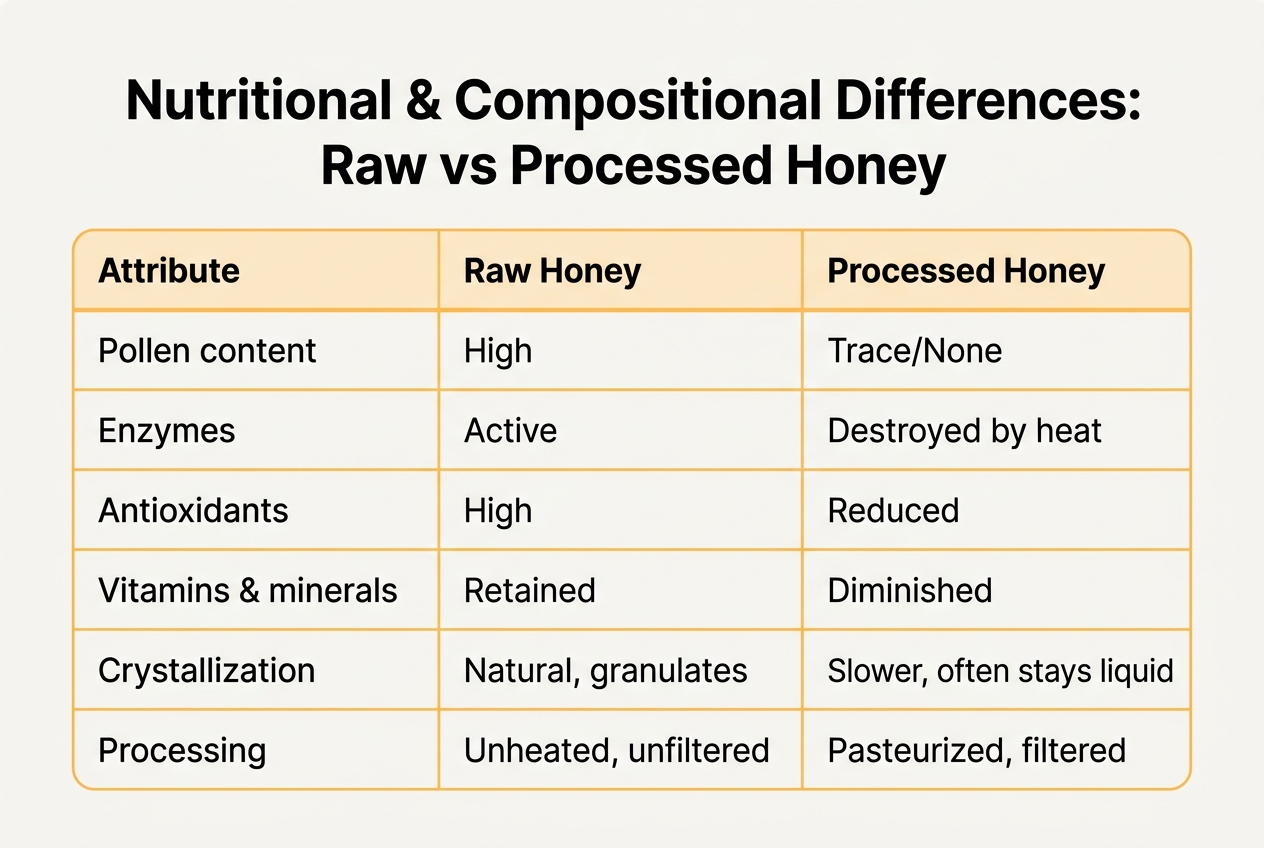
Once you get past labels and marketing, the real story is in the composition. Raw honey keeps compounds that heat and filtering strip away, while regular honey has often been stripped down to little more than sweetness. The gap isn't imaginary — it shows up in lab tests, and it shows up on your spoon.
- Raw honey retains higher concentrations of flavonoids and phenolic compounds, the antioxidants credited with much of honey's reputation as a functional food, not just a sweetener.
- It also carries trace amounts of bee pollen, propolis resin, and live enzymes like diastase, all picked up naturally during collection and never filtered out.
- Pasteurization, the heating step most commercial honey goes through, measurably reduces enzyme activity and can lower antioxidant levels — one reason heated honey tastes flatter and simpler.
- Some mass-market brands, especially cheap imported blends, get cut with corn syrup or other added sugars, a practice that's been flagged repeatedly in industry purity investigations.
- Raw honey's color, crystallization speed, and flavor shift by floral source — buckwheat runs dark and malty, orange blossom stays light and citrusy, and both crystallize on their own timelines.
That last point trips people up. They see a jar turning cloudy and grainy and assume it's spoiled. It's not — that's just glucose crystallizing out, a normal sign of minimal processing. And because raw honey often carries pollen alongside these compounds, learning the best way to consume bee pollen is worth doing before you start eating it by the spoonful daily. Regular honey, by contrast, stays uniform and syrupy indefinitely — smooth, sure, but that consistency is itself a clue about how much has been processed out.
Side-by-side comparison at a glance
Sometimes you just need the facts lined up, no fluff. Here's how the two stack up across the traits that actually matter when you're standing in an aisle deciding which jar goes home with you.
| Factor | Raw Honey | Regular (Processed) Honey |
|---|---|---|
| Processing | Unheated, unfiltered, straight from the comb | Pasteurized and filtered to remove particles |
| Nutrients | Retains enzymes, pollen, antioxidants | Diminished levels after heat treatment |
| Texture | Crystallizes naturally over weeks or months | Stays syrupy and pourable much longer |
| Sourcing transparency | Often single-farm, traceable to hive and harvest date | Frequently blended from multiple, unnamed sources |
| Shelf behavior | Can ferment if moisture content runs high | Shelf-stable indefinitely, barely changes over years |
Price is where the split gets personal. Raw honey usually costs more, sometimes double, because small-batch harvesting, slower extraction, and lab testing all add real expense. Processed honey benefits from scale: big blending operations spread costs across huge volumes, which is how a bear-shaped bottle ends up costing less than lunch. That's not a knock on either option, just economics. If you're curious what small-scale, pesticide-free beekeeping actually looks like day to day, it helps to read about a working bee farm in warm sunny Southern California and see why the labor behind raw honey costs what it does. Crystallization, by the way, isn't a flaw. It's just glucose doing what glucose does.
Health benefits and who each type suits best
Raw honey for immune and skin support
Sore throats are where raw honey earns its reputation. A spoonful straight or stirred into warm tea coats irritated tissue, and its natural enzymes and mild antibacterial compounds make it a go-to for both eating and topical use. Some people dab it directly on small cuts, scrapes, or burns, since unprocessed honey retains hydrogen peroxide-producing enzymes that plain filtered honey often loses to heat during processing. That enzyme content is the whole point — it's what separates a jar meant for wellness from one meant for sweetening cereal.
Parents exploring seasonal allergy support often turn to local raw honeycomb, hoping trace pollen builds tolerance over time. The evidence here is genuinely mixed; some small studies show modest benefit, others show none at all. It's a low-stakes experiment for most healthy adults, but honey should never go to a child under one year old, raw or otherwise, because of infant botulism risk.
Naturopathy-minded consumers rarely stop at honey alone. It's common to see raw honey paired with royal jelly or propolis, stacking enzyme content with amino acids and flavonoid compounds for broader immune and hormonal support. If you're new to the space, it's worth spending time in a beekeeping community thread where hobbyists and buyers debate raw versus natural honey; one particularly detailed discussion on how beekeepers define raw versus natural honey shows just how loosely those terms get used on store shelves.
When regular honey is the safer or simpler choice
Regular, filtered honey isn't the enemy here. It still delivers natural sugars, quick energy, and a clean, consistent taste that works well in baking or everyday cooking. What it lacks is the bioactive punch — fewer live enzymes, less pollen, less propolis residue — because pasteurization smooths those out along with any crystallization. For a quick energy source before a workout or a simple sweetener swap, that's not a dealbreaker at all.
Where regular honey actually becomes the smarter pick is for higher-risk groups. Infants under 12 months, pregnant individuals, and anyone with a compromised immune system face a real, if small, risk of botulism spores from raw honey, since those spores survive the minimal processing that raw honey undergoes. Pasteurized honey's heat treatment neutralizes that risk. If you fall into one of those categories, ask a doctor before adding raw honey to your routine — it's a five-minute conversation that beats guessing.
Bottom line: raw honey isn't automatically "better," it's just different, and sometimes simpler is exactly what the moment calls for.
Raw honey vs organic honey: a separate distinction
People mix these terms up constantly. They're not the same thing. Raw is about processing — unheated, unfiltered, left as close to hive-state as possible. Organic is about upbringing: where the bees foraged, what (if anything) was sprayed nearby, and how the hive itself was managed. A jar can be raw and still not organic, if the bees fed near treated crops. It can also be certified organic and heavily filtered, stripped of the very pollen and enzymes that made it worth buying. One resource covering this exact confusion is worth reading if you want the nutritional angle spelled out plainly, and is there a real difference between the two labels is the question most shoppers should actually be asking first.
True organic certification isn't just a nice sticker. It requires a controlled foraging radius, verified pesticide-free land, and documented hive management practices — not just "no additives at the bottling stage." That's a much higher bar than raw alone demands. If purity is the goal, look for both labels together. Raw tells you the honey wasn't cooked or strained into blandness; organic tells you the bees themselves weren't exposed to glyphosate or synthetic residue while foraging.
Sustainably managed, pesticide-free hives matter more than most buyers realize. Bees travel miles from the hive, and whatever they touch ends up in the honey. A hive sitting near heavily sprayed farmland can produce honey that's technically raw yet carries trace contamination. Many local businesses lean on the word "natural" loosely, so ask directly about foraging location and hive practices before assuming purity.
How to verify real raw honey before you buy
Reading labels and lab certificates
Start with the jar itself. The word raw and the word unfiltered should both appear somewhere on the label — not just "pure" or "natural," which sound wholesome but legally mean almost nothing. Plenty of heated, filtered honey gets sold as "pure" without lying. That's the loophole most shoppers miss.
Before buying, especially in bulk, it's worth digging a little deeper than the label. A few habits will save you from guesswork:
- Ask the seller for third-party lab results confirming purity, sugar content, and the absence of glyphosate or other synthetic residues.
- Look for disclosure of hive location, harvest date, and floral source — vague sourcing usually means blended, anonymous supply chains.
- Check whether the testing is recent, ideally within the last six to twelve months, not a one-time certificate from years ago.
- Compare the price against regional averages; honey priced far below market rate is often cut with syrup.
- Favor sellers who name the actual farm or apiary rather than a generic "family farms" collective with no address.
If you want a broader primer on how processing affects quality, this comparison of raw honey and pure honey lays out the health tradeoffs in plain terms.
Simple at-home checks
Once it's in your kitchen, a few low-tech checks help confirm what you bought. Raw honey is usually cloudy, not glassy-clear, and it will crystallize in the jar over weeks or months. That's not spoilage — it's a good sign. You can also try the water test: drop a spoonful into a glass of water. Raw honey tends to clump and sink rather than dissolve instantly. It's not scientific proof, but it's a quick sanity check. Smooth, syrupy, never-crystallizing honey deserves a second look. When possible, buy from small-scale beekeepers or farms who show you the hive, not faceless blended brands stacking shelves at the supermarket.
Risks, storage, and choosing the right jar for your needs
Before you stock up, know the real risks. Raw honey carries a small botulism spore risk, which is why it's unsafe for infants under 12 months — their digestive systems can't yet handle those spores. Allergic reactions are possible too, and this applies to any honey type since pollen is pollen, processed or not. If you or your kid has a known pollen allergy, patch-test with a small amount first. It's a quick, short video, but this rundown on how raw and regular honey actually differ is a decent gut-check before you buy.
Storage and shelf-life comparison
Store raw honey at room temperature, away from direct sunlight — a pantry shelf is fine, a sunny windowsill isn't. Crystallization is normal and totally reversible; just warm the jar gently in warm water. Regular honey wins on predictability: it's been heated and filtered, so it resists crystallizing and holds a longer, more uniform shelf life, with less nutritional variability to fuss over.
| Factor | Raw honey | Regular honey |
|---|---|---|
| Shelf life | Long, but crystallizes faster | Very long, stable texture |
| Storage risk | Botulism spores (unsafe for infants) | Same infant risk applies |
| Best storage spot | Cool, dark pantry shelf | Pantry or cupboard, less sensitive |
| Fixing crystallization | Warm water bath, gentle heat | Rarely needed |
Choosing a specialty raw honey for your goal
Not all raw honeys do the same job. Manuka, buckwheat, and jarrah varieties differ mainly in antibacterial strength, often measured by MGO ratings — manuka honey graded MGO 263+ or higher is typically chosen for wound care or gut support, while buckwheat's prized more for its mineral content and robust flavor. If you're a retailer or buying in bulk, don't skip the paperwork: confirm testing frequency and request current certificates of analysis before committing to a large order. That one step separates a legitimate supplier from someone just slapping a nice label on a jar.
Final verdict: which one should you choose
If you want the full nutritional picture, raw honey wins. It keeps its enzymes, pollen, and antioxidant compounds intact because nobody heated or filtered them away. Regular, pasteurized honey has its place, mostly on a pantry shelf for years without crystallizing, but that stability comes at a cost. You're trading nutrients for convenience. For anyone weighing that tradeoff, this breakdown of benefits, risks, and uses lays out the science plainly, and it's a fair starting point before you commit to either jar.
Health-conscious shoppers, naturopathy-minded readers, and parents hunting for gentle allergy remedies all land in the same place: raw, unheated, lab-verified honey does more work for the body. It's not close, honestly. Processed honey is fine on toast; it's not doing much for your immune system. Whichever type ends up in your cart, check three things first — where it came from, whether a third party tested it, and when it was harvested. Skip that step and you're just guessing.
For daily wellness, don't stop at honey alone. Pairing it with propolis or royal jelly rounds out what a single jar can't offer on its own — think immune compounds, amino acids, and antimicrobial support working together. A teaspoon of raw honey with a small dose of royal jelly each morning is a simple, low-effort habit. Small routine, real payoff.
Before you commit to a hive rental contract, it's worth asking the practical questions that determine whether the arrangement actually pays off: how many colonies per acre your crop truly needs, what the beekeeper's inspection and frame-strength standards are, how bloom timing will be coordinated, and who carries the risk if weather or pesticide drift cuts into colony health. Reputable pollination brokers and local beekeeping associations are the right place to start that conversation, and a clear written agreement will spare you a lot of guesswork come spring. If your interest in bees runs more toward the harvest than the orchard, that's a different path entirely — raw single-source honeys, royal jelly, and propolis are things you can simply source directly from people who keep hives for the table rather than the field.


