

How to Tell If Your Honey Is Pure Honey or Raw Honey
Sep 04, 2026
Standing in the store aisle, you've probably wondered whether that jar labeled "pure" is actually better than one labeled "raw"—or if it's just clever marketing. The truth is, most shoppers can't tell the difference. Honey brands rarely make it easy. This confusion matters more than you think, especially if you're buying honey for allergy relief, immune support, or skincare remedies rather than just sweetening tea. Below, we'll settle the pure honey or raw honey debate for good, so you know exactly what you're buying in 2026 and why it matters for your health goals.
Pure Honey or Raw Honey: What Are You Actually Asking?
Why the Two Terms Get Confused
Here's the root problem: "pure" and "raw" aren't answering the same question. Pure is really a purity claim. It means nothing was added. No corn syrup, no rice syrup, no artificial anything mixed into the jar. Raw is a processing claim instead. It tells you whether the honey was heated or filtered after it left the hive. A honey can be pure and heavily processed at once. A honey can also be raw but technically blended with other raw honeys. They're two different measuring sticks, not two names for the same thing.
The confusion gets worse because neither word is locked down by federal regulation in the US. There's no agency stamping "raw" onto a label the way the USDA controls "organic." So brands use both terms however they like, sometimes accurately, sometimes as pure marketing polish on an otherwise ordinary jar. A bottle can say "100% pure raw honey" and still have been warmed enough to strip out pollen and enzymes. Reading up on how raw honey stacks up against regular processed versions helps explain why that gap between the label and the actual product exists so often, and it's a gap worth understanding before you spend money on the wrong jar.
How This Guide Compares Them
Rather than treat "pure or raw" as a single yes-or-no question, the rest of this article breaks it into specific, checkable criteria: how each is made, what happens to nutrients, how to verify claims, and how they behave in your pantry. That's a more useful way to shop than chasing a label word.
Think of it less like picking a side and more like building a checklist. By the end, you'll know exactly what to look for on a jar, and what questions to ask before you buy, whether that jar is sitting on a supermarket shelf or came straight from a small apiary.
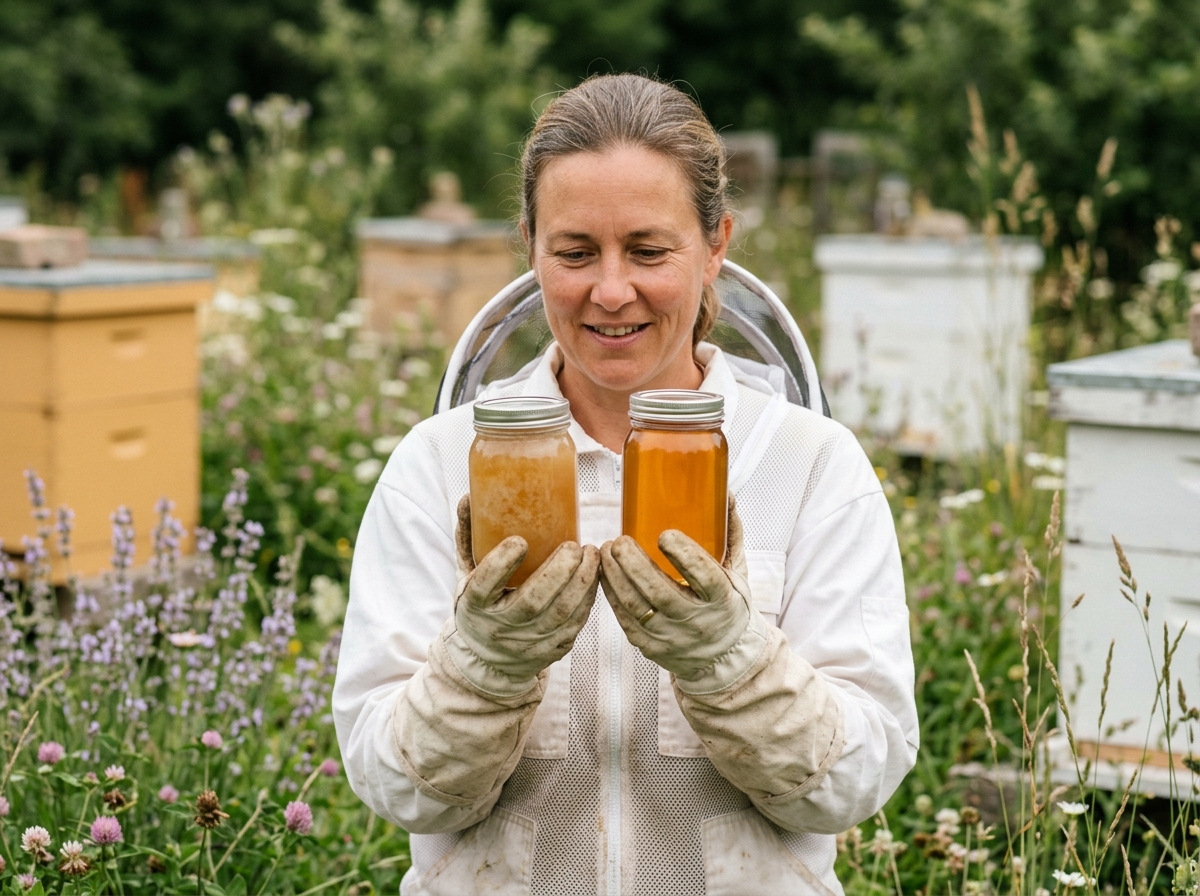
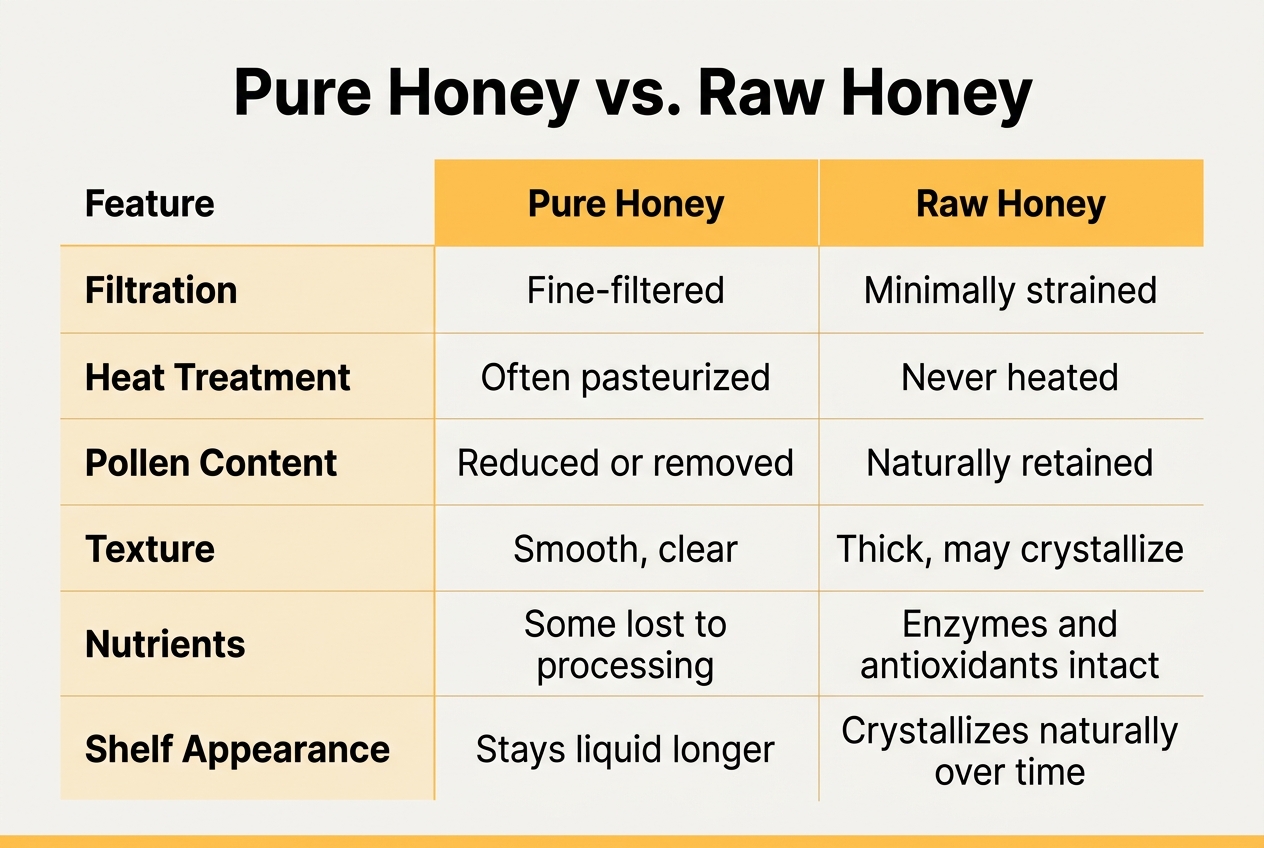
Pure Honey vs. Raw Honey: Side-by-Side Comparison
Sometimes the clearest way to see the gap between these two is to line them up side by side. The table below breaks down what separates a jar labeled "pure" from one that's genuinely raw, across the traits that actually matter when you're standing in an aisle deciding.
| Trait | Pure Honey | Raw Honey |
|---|---|---|
| Processing | Often pasteurized and heated | Unheated, straight from the hive |
| Filtration | Fine-filtered, sometimes ultra-filtered | Unfiltered, may contain flecks of pollen or wax |
| Additives | Legally shouldn't have any, but mislabeling with corn syrup happens | None — nothing added, nothing removed |
| Nutrient content | Reduced enzymes and antioxidants from heat | Retains enzymes, propolis traces, and live pollen |
| Appearance & taste | Clear, syrupy, uniform flavor | Cloudy, thick, crystallizes fast, flavor shifts by season |
Pure honey earns its keep in everyday cooking and baking, where a smooth pour and mild, consistent taste matter more than trace nutrients. It's fine for sweetening tea or glazing a ham. Nobody's pretending it's a wellness product, though some labels try. That's the whole problem, honestly — "pure" sounds impressive on a bottle, but it's a loose term with no guarantee behind it. That's exactly why a breakdown of what these honey labels really mean is worth understanding before you buy based on packaging alone.
Raw honey makes more sense for daily wellness use — stirred into warm (not boiling) water, drizzled over yogurt, or taken by the spoonful for seasonal allergy support. If you're new to sourcing it, working through a raw unfiltered honey buying guide will help you spot the difference between a real raw jar and clever marketing before you commit to a purchase.
How Each Type Is Made
The Heating and Filtering Process
Pure honey starts out normal enough. It's pulled from the frame, spun out in an extractor, then sent through heat and fine filters before it ever sees a jar. The heating usually runs somewhere between 150-170°F, hot enough to melt away any early crystals and thin the honey so it flows fast through micron filters. The goal is clarity and shelf appeal: a bottle that pours smooth, looks glassy, and never turns cloudy on a store shelf. It's a cosmetic fix, really, not a quality upgrade.
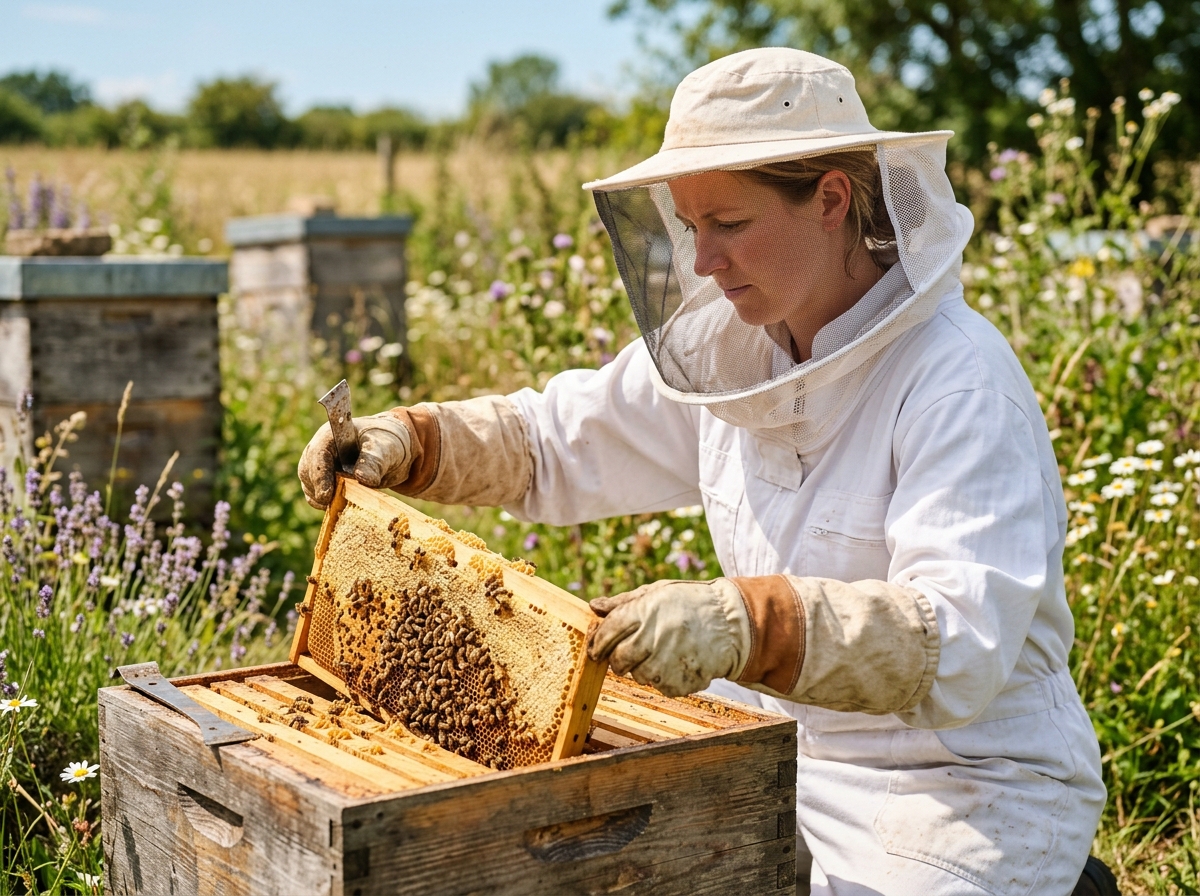
Raw honey skips almost all of that. It's cold-extracted, meaning the frames are spun and the honey drains out on its own, with maybe a coarse strainer to catch wax bits or a stray bee wing. No heat above what the hive itself runs at, roughly 95°F. That's it. Some producers use gravity settling tanks instead of straining at all, letting heavier particles sink over a few days. It's slower. It's messier. It's also a lot closer to what came out of the comb.
Why Minimal Processing Preserves Nutrients
Heat is honey's enemy, at least if you care about what's inside it. High temperatures break down enzymes like diastase and invertase, the ones bees add during nectar processing to help predigest sugars. Fine filtration goes a step further and strips out pollen grains, propolis flecks, and trace minerals that give raw honey its cloudy look and its regional character. If you're curious how far people push these compounds for wellness use, it's worth learning about the best way to consume bee pollen, since pollen is one of the first things fine filtering removes entirely.
Antioxidants take a hit too. Studies on heated honey show measurable drops in flavonoid and phenolic content, sometimes 20% or more, depending on temperature and duration. Raw honey holds onto these compounds because it never crosses that heat threshold. None of this means pure honey is unsafe. It just means you're trading nutrition for polish. For a deeper breakdown of how labeling terms map onto these processing choices, Raw vs. Pure vs. Organic vs. Unfiltered is a genuinely useful read. Bottom line: less handling means more of the good stuff survives.
Health Benefits: Which One Wins?
Enzymes, Antioxidants, and Pollen Content
Here's the short version: raw honey keeps more of the good stuff. It's never heated past hive temperature, so enzymes like glucose oxidase survive, along with antioxidants, trace propolis, and bits of pollen the bees tracked in. Pure or processed honey isn't useless, though. It still carries natural sugars and a mild antibacterial quality from its low water content and slight acidity. But heat and filtering strip out most of the bioactive compounds that make raw honey interesting in the first place. Grasping the real differences between raw and pure honey helps explain why one jar tastes complex and the other tastes... fine.
Who Benefits Most From Raw Honey
Certain groups get more out of raw honey than a casual drizzle on toast suggests. Consider who actually stands to gain:
- Allergy sufferers often try local raw honey on the theory that trace pollen exposure builds tolerance to seasonal allergens, though evidence is more anecdotal than clinical.
- People chasing an immune boost sometimes pair raw honey with royal jelly or propolis, two complementary bee products prized for supporting immune response and skin repair.
- Athletes and busy parents like raw honey as a quick, natural energy source that doesn't come with the crash of refined sugar.
- Skin-focused users apply raw honey or propolis topically for its antibacterial and soothing properties on minor cuts or irritation.
- Anyone managing a sensitive gut may prefer raw honey's live enzymes over the flat, cooked profile of processed versions.
One firm caution, though: honey of any kind, raw or pure, is unsafe for infants under one year, due to botulism spore risk. That's not negotiable. Past that age, raw honey earns its reputation. Processed honey still has a place in the pantry — it's just not doing much beyond sweetening your tea.
How to Tell If Honey Is Actually Raw or Pure
Most shoppers judge honey by the jar's front label. That's a mistake. The real story is on the back, in the ingredient list, and it should say exactly one word: honey. Anything else — added sugar, corn syrup, "honey blend" — means you're not getting the real thing. This confusion is exactly why raw honey vs pure honey gets debated so often among buyers trying to sort marketing from fact.
Label Red Flags to Watch For
Words like "pure," "natural," or "100%" mean very little without backup. Unfiltered and unheated claims should match what you see: raw honey often looks cloudy, holds pollen specks, and crystallizes. If a jar stays glass-clear for a year on a warehouse shelf, be skeptical.
Steps to Verify Purity Before Buying
Crystallization is a decent clue, but home tests only get you so far. The table below breaks down what's actually reliable.
| Verification Method | What It Tells You | Reliability |
|---|---|---|
| Ingredient label check | Confirms no added sugars or syrups | Moderate — catches obvious blends only |
| Fridge crystallization test | Suggests minimal filtering/heating | Low — many pure honeys crystallize differently by floral source |
| Water/flame folklore tests | Popular online, not scientific | Very low — easily fooled |
| Third-party lab report | Measures moisture, pollen, glyphosate, additives | High — the only definitive answer |
| Harvest date and hive location | Confirms traceability and freshness | High — pairs well with lab data |
Bottom line: skip the kitchen science experiments. Ask directly for lab results, harvest date, and hive location before you buy. Bulk and wholesale buyers should go further and request a full certificate of analysis, not just a verbal assurance. Any dedicated provider confident in their honey will hand these over without hesitation — if they hedge, that tells you something too.
Shelf Life, Storage, and Texture Differences
Why Raw Honey Crystallizes
Pure, heavily filtered honey stays syrupy and clear for a long time. The fine filtration strips out pollen grains and tiny wax particles that would otherwise act as seeds for crystal formation, and the heat used in processing keeps sugars dissolved longer. That's why a plastic bear of store-brand honey can sit on a shelf for a year or two looking exactly the same. It's not necessarily fresher — it's just been engineered to resist change.
Crystallization in raw honey is a natural process, not a flaw. Glucose molecules separate from water and form crystals over weeks or months, turning smooth honey grainy or even solid. Cooler storage speeds it up, so a jar kept at 50°F will crystallize faster than one kept at 75°F. Some varieties, like clover, crystallize quickly, while tupelo and acacia stay liquid for a year or more.
None of this means the honey has gone bad. If your jar turns cloudy and thick, just set it in warm water for ten or fifteen minutes and stir. If you're curious about the science behind why this happens and what it means for quality, the discussion in raw honey vs. pure honey comparisons is a useful place to dig deeper.
Proper Storage for Both Types
Both types keep best at room temperature, in a sealed jar, away from direct sunlight. Heat and light break down enzymes and darken color over time, so a pantry shelf beats a spot near the stove or a sunny windowsill. Never refrigerate honey — cold temperatures accelerate crystallization dramatically and won't extend its shelf life at all. A tightly sealed lid also keeps moisture out, which matters because absorbed water can eventually lead to fermentation.
Texture varies a lot across raw honey styles, and that's worth knowing before you buy. Liquid raw honey is what most people picture: pourable, glossy, ready for tea or toast. Creamed honey has been intentionally crystallized under controlled conditions, giving it a smooth, spreadable consistency closer to soft butter — great on bread, awkward in a squeeze bottle. Honeycomb is the least processed of all, sold exactly as bees made it, wax cells and all; you can eat the whole thing or scoop honey straight from the comb. None is "better," honestly. It's just a matter of how you plan to use it.
Choosing the Right Honey for Your Needs
Best Honey by Use Case
Not every jar in your pantry needs to be a wellness product. If you're glazing a ham or baking muffins, plain filtered honey pours easier, measures consistently, and won't crystallize on you mid-recipe. That's a fair trade-off when the goal is flavor, not nutrition. But if you're chasing immune support, allergy relief, or skin benefits, raw honey and its cousins — propolis, royal jelly — do work that processed honey simply can't.
Plenty of people land somewhere in between, which is why matching the product to the purpose matters so much. A quick sorting guide helps:
- For everyday cooking and baking, a smooth, pourable pure honey saves you from clumping and repeated microwave softening.
- For seasonal allergy support, raw local honeycomb retains the pollen fragments many people seek out.
- For immune or hormonal support, fresh royal jelly or freeze-dried royal jelly powder offers concentrated 10-HDA content without the fuss of refrigeration.
- For skin care and DIY salves, organic propolis powder blends easily into balms, tinctures, and masks.
- For retailers or wellness practitioners, bulk raw honey and bulk royal jelly keep shelves stocked without sacrificing traceability.
Final Verdict
Raw honey wins on nutrition, enzyme content, and traceability, full stop. Pure honey only wins if shelf stability and pouring consistency are your top priority. There's no shame in keeping both in your kitchen — one for cooking, one for wellness. If you're still unsure what "raw" actually guarantees, it helps to see how confused even seasoned buyers get; a long community thread where beekeepers hash out what raw honey is supposed to be shows just how murky labeling can get without lab data behind it.
Before you buy, run any seller through a short checklist: look for recent third-party lab testing results, ask whether the farm discloses hive locations and harvest dates, confirm the bees aren't exposed to pesticide-treated crops, and check that the honey hasn't been heated above hive temperature. Skip that homework, and you're just trusting a label. Do it, and you'll know exactly what's in the jar.
If you're ready to taste the difference that truly raw, unfiltered honey makes, visit Go Honey's family-run farm office at 1225 Cypress Ave in Los Angeles, where every jar is traceable back to its hive and harvest date. From their sun-soaked Southern California apiaries to your table, this small family business has been sharing pure, pesticide-free honey since 2012 with the same care they'd give their own kitchen. Stop by, give them a call, or simply place an order online — either way, you'll know exactly where your honey came from and who put their heart into it.


