

Highest Quality Manuka Honey: How to Verify MGO Ratings
Sep 22, 2026
Shelf after shelf claims to be pure, potent, and worth the premium price — but most jars give you no real way to check. UMF numbers get faked, labels get rounded up, and "raw" gets stretched to mean almost anything. Finding the highest quality manuka honey means learning to read past the marketing, not trusting it. Here are seven ways to judge exactly what's in that jar before you buy it.
How to Spot the Highest Quality Manuka Honey Before You Buy
MGO vs UMF: what the numbers actually mean
Walk into any manuka honey conversation and you'll hit a wall of acronyms. MGO measures methylglyoxal, the compound behind manuka's antibacterial punch. It's a direct chemical number, not a vibe. UMF (Unique Manuka Factor) is a separate licensing system. It bundles MGO with two other markers, DHA and leptosperin, into one grade. Then there are softer words like "active" or "certified," which sound official but aren't tied to any single testing standard. Learn to separate the number from the noise.
Higher MGO ratings — 250+, 500+, 800+, 1000+ — generally signal stronger antibacterial activity. They also come with a stronger, more bitter taste and a much higher price per jar. A 1000+ jar isn't automatically "better" for you. It's simply more concentrated, and often more than a daily wellness routine actually needs. Most people looking for immune or gut support do fine in the 250-500 range. Save the higher numbers for targeted use.
Here's the blunt truth: a fancy label doesn't equal a fancy hive. Plenty of jars lean on "certified" language with no lab certificate in sight. If a seller can't show you the number behind the claim, treat the claim as marketing, not fact.
Why raw and unfiltered status affects grade
Potency is only half the story. A honey can carry an impressive MGO number and still be heat-treated and stripped of the enzymes, pollen, and trace nutrients that make raw honey worth buying in the first place. Processing extends shelf life and makes the honey look prettier on a shelf, but it quietly erodes the very qualities that drew you to manuka. If you're shopping strictly by number, you may skip past a lower-MGO jar that's actually more nutritionally intact than its flashier neighbor. This detailed raw unfiltered honey buying guide breaks down exactly what to check on a label before the MGO number even enters the conversation.
The real differentiator isn't the grade at all — it's what backs it up. Independent, third-party lab testing for glyphosate residue and adulteration (cheap syrup blended into "pure" honey is a known industry problem) tells you whether the MGO claim on the jar reflects what's actually inside it. A label can say anything. A lab report, updated regularly rather than run once years ago, is much harder to fake. Ask for it before you ask about price.
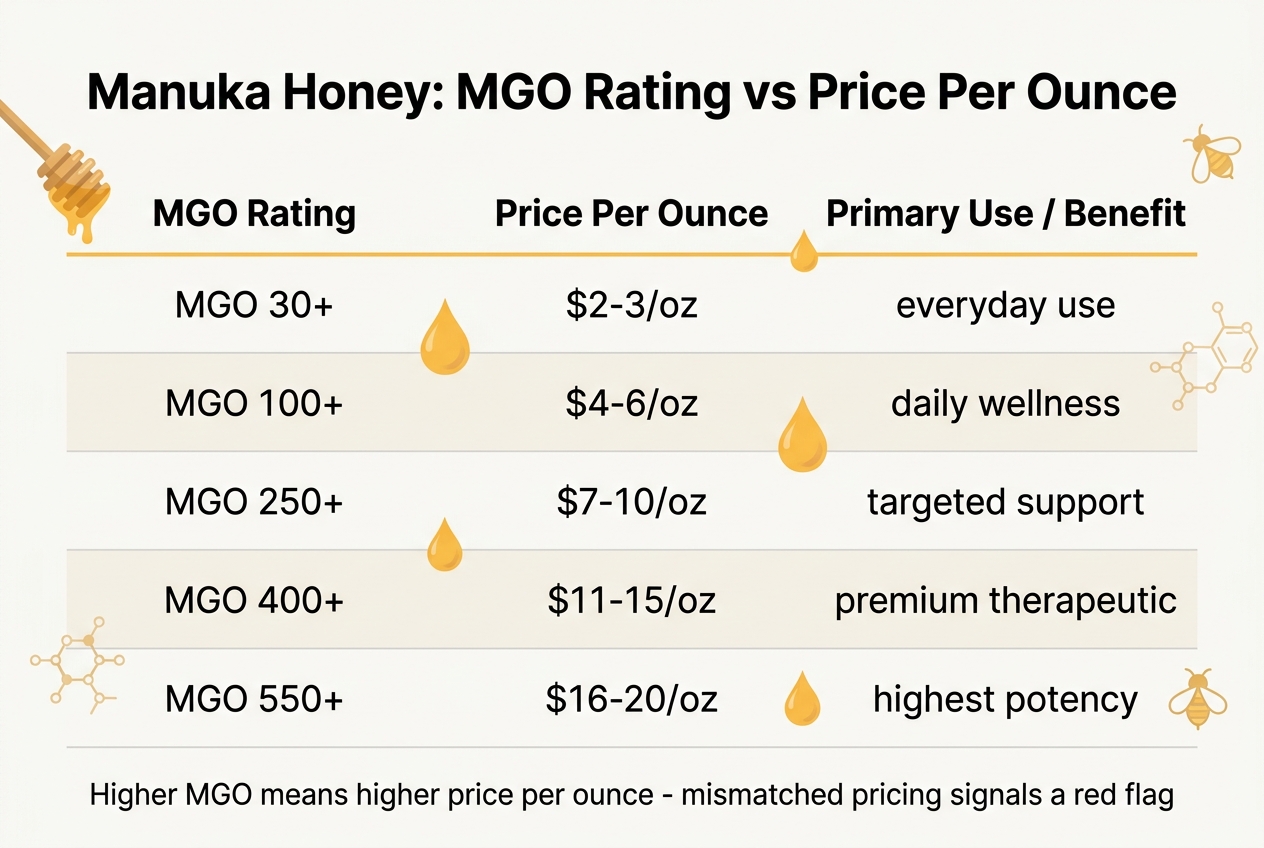
1. Check the MGO Rating Against the Price Per Ourse
MGO measures methylglyoxal, the compound responsible for manuka's antibacterial strength. It's the single number that should drive the price you pay. If it doesn't, something's off.
What each MGO tier is actually for
Not every jar needs to be therapeutic-grade. Here's roughly how the market breaks down, and where each tier makes sense.
| MGO Range | Category | Typical Use | Expected Price Signal |
|---|---|---|---|
| 100–250 | Everyday | Daily spoonful, tea, toast | Lowest cost per ounce |
| 250–500 | Elevated | Immune support, sore throats | Moderate step up |
| 500–800 | High potency | Digestive and wound-care interest | Noticeably higher per ounce |
| 800–1000+ | Therapeutic-grade | Concentrated, occasional use | Premium pricing expected |
The logic is simple: higher MGO takes rarer floral sources, more careful harvesting, and heavier lab testing to confirm. When a seller lists an 800+ jar for the price of a 250, that's not a bargain. That's a red flag with a bow on it. Genuine potency costs money to produce and verify, and legitimate sellers pass that cost along transparently.
A mid-to-high option, like a 263+ or 514+ MGO manuka honey with lab documentation behind it, covers most everyday and elevated needs without paying therapeutic-grade prices for a benefit you won't use daily. Reading up on premium 100 pure orange blossom honey is a useful comparison point, since floral source and rarity affect price the same way across honey types, not just manuka. Building any wellness habit takes patience — the same discipline behind a realistic BJJ belt progression applies to matching potency with purpose instead of chasing the highest number on the label.
2. Verify Third-Party Lab Testing and Traceability
A price tag and a nice label don't prove anything. The only real proof is a lab result you can actually read. Independent testing exists to answer a few blunt questions: is this honey what it claims to be, does the MGO number on the jar match reality, and is it free of glyphosate or synthetic additives that shouldn't be anywhere near raw food? Anyone can print "lab tested" on packaging. Far fewer will show you the paperwork.
What a real lab certificate should show
A credible certificate isn't vague. It should tie a specific batch to specific, checkable facts, not just a general promise of quality. Look for these elements before you trust the claim:
- The exact MGO or 10-HDA figure for that batch, not a rounded-up marketing range slapped across every product line
- Confirmation of purity, meaning no added sugars, syrups, or fillers diluting the honey or royal jelly
- A glyphosate and pesticide screen showing non-detect results, since raw doesn't mean pesticide-free unless it's actually tested
- A harvest date and hive location, so the batch can be traced back to a real farm rather than an anonymous blend
- A visible lab name and test date, ideally repeated on a schedule rather than a one-time certificate from years ago
Traceability is what turns a lab result into something you can trust. Some producers test twice a year across every farm location, publishing hive-to-spoon records that link harvest date, hive site, and lab certificate to the jar in your hand. Reading about a family apiary's origins, including a look at one bee farm in warm sunny Southern California, gives you a sense of what real traceability looks like in practice. Be wary of any brand that references testing but never lets you view the actual certificate. That's not transparency. That's a marketing line wearing a lab coat.
3. Confirm the Honey Is Raw, Unheated, and Unfiltered
Heat and fine filtering make honey look pretty on a shelf. They also strip out pollen, enzymes, and antioxidants that give raw honey its actual value. Commercial processing runs honey through high heat to keep it liquid and shelf-stable, then filters it fine enough to remove every trace of pollen. That's exactly what destroys the enzyme activity and floral markers you're paying for. If you're weighing options, how to select manuka honey and what it's used for is a solid starting point before you commit to a jar.
Here's the part that trips people up: crystallization isn't spoilage. Cloudy, grainy, or solid honey is often the most honest jar on the shelf. Raw, unfiltered honey holds natural glucose crystals and fine pollen particles that make it turn cloudy or firm over time, especially in cooler months. Warm the jar gently in hot water and it'll loosen right back up. Ultra-clear honey that never crystallizes, ever, has usually been heated hard enough to prevent it.
Labels don't make this easy. "Raw," "pure," and "natural" get thrown around like they mean the same thing. They don't. "Natural" has almost no legal teeth. "Pure" usually just means no added syrup or sweeteners — honey can still be heated and filtered and carry that label. "Raw" is the one that actually implies unheated and unfiltered, though even that's loosely policed, so a batch testing date matters more than the word itself. A full raw line, spanning Manuka, Jarrah, Orange Blossom, Buckwheat, and Raw Honeycomb, kept unheated and unfiltered, gives you a template for what the label should actually promise.
4. Compare Sourcing: New Zealand, Australia, and Beyond
Manuka trees grow wild in New Zealand and parts of Australia. That's it — those are the only two places real manuka honey comes from. Australian versions are often labeled Leptospermum honey instead, since manuka is technically a shared common name for several related tea tree species down there.
New Zealand UMF vs Australian Leptospermum honey
Here's where a lot of shoppers get tripped up. New Zealand built its own grading system, UMF (Unique Manuka Factor), which is licensed and audited specifically for New Zealand honey. Australia has no equivalent single standard — testing there relies on a mix of methylglyoxal (MGO) lab results and government export requirements instead. Neither country's system is "better" on its face. They're just different rulebooks measuring similar chemistry.
| Factor | New Zealand (UMF) | Australia (Leptospermum) |
|---|---|---|
| Grading body | UMF Honey Association license | No single national body |
| Primary metric | UMF rating (correlates to MGO) | MGO or NPA lab results |
| Legal labeling rules | Strict export certification | Varies by producer/state |
| Consumer familiarity | High, long-established | Growing, less standardized |
Neither system tells you how the jar was handled after harvest. A honey can carry a great rating and still get heated or over-filtered later, which quietly kills enzymes. That's a handling problem, not a geography problem.
If you want a single-origin option with its own naturally high antibacterial profile without wading into UMF-versus-MGO debates, Australian Jarrah honey is worth a look. It's raw, unblended, and judged on its own lab results rather than borrowed manuka prestige.
Bottom line: country of origin is a starting point, not a guarantee. Testing and handling decide the rest.
5. Match the Honey to Your Health Goal
Everyday wellness vs targeted potency needs
Not every use case needs the strongest jar on the shelf. Higher MGO costs more, and if you're just adding a spoonful to tea most mornings, mid-range strength does the job without draining your wallet. Think about what you're actually trying to fix before you pay for potency you won't use.
Here's how the goal should drive the purchase, not the other way around:
- For everyday digestive comfort or general immune upkeep, a mid-range MGO honey used consistently, day after day, tends to matter more than chasing the highest number on the label.
- Skin and wound-care traditions lean on higher MGO honey, but keep it food-grade and eaten or applied only with professional guidance, not smeared on a cut on your own.
- Parents hunting for natural allergy support often do better with raw local honeycomb, since retained local pollen is the traditional theory here, not manuka's MGO strength.
- Combining manuka with royal jelly for energy and immune backing, plus propolis for daily defense, gives broader coverage than manuka working alone.
- Bulk buyers stocking a wellness routine should budget potency by purpose: mid-grade for daily use, high-grade reserved for short, targeted stretches.
One honest note: manuka isn't a cure-all, and treating it like one wastes money. Match strength to purpose, and you'll get more out of every jar.
6. Avoid Common Red Flags When Shopping Online
Online shopping strips away most of the context you'd get standing in front of a shelf. No one to ask, no jar to turn over in your hand. That's exactly why certain warning signs matter more when you're buying manuka honey through a screen.
Language That's Doing the Dodging For You
Words like "Manuka blend" or "Manuka-type" aren't accidents. They're carefully chosen. A true single-origin manuka honey will say so plainly, with a specific MGO or UMF number attached. Vague phrasing usually means the jar is cut with cheaper filler honey, and the label is written to keep you from noticing.
Price is another tell. A jar priced far below the market rate for its stated MGO number should make you pause, not celebrate. Genuine high-MGO manuka is expensive to produce; there's no version of the supply chain where that changes.
- A product page with no batch number at all, meaning there's no way to trace your specific jar back to a harvest or testing event.
- No harvest date listed anywhere, which makes it impossible to judge freshness or how long the honey sat before reaching you.
- A lab certificate that's mentioned but never linked, or a link that leads to a generic homepage instead of an actual document.
- No physical farm address, company name, or working phone number anywhere on the site, just a checkout page and a shipping form.
- Customer support that only exists as a contact form with no response history, reviews, or evidence anyone's ever actually reached them.
If a seller can't answer where the honey came from, don't buy it. That's the whole test, really.
7. Build a Trustworthy Raw Honey and Bee Product Routine
Building a simple daily bee-product stack
Skip the blends. A single-source jar of Manuka or Jarrah honey lets you actually track what it's doing for you, because you know exactly what's in it. Blended honeys mix floral sources and harvest batches, which muddies the picture if you're watching for effects on allergies, energy, or gut comfort. One jar, one origin, one MGO number on the label. That's the whole point.
From there, pair your honey with a Royal Jelly Powder or an Organic Bee Propolis Powder, and you've got a full routine without a single capsule or tincture in sight. A spoon of honey in the morning, a scoop of royal jelly powder in a smoothie, a pinch of propolis powder stirred into water or tea at night. No pills to swallow, no alcohol-based extracts to worry about. Simple stacks like this tend to stick, unlike the seven-supplement routines that quietly die by February.
For wellness retailers, assembling a shelf from five unverified suppliers is a headache and a liability. A wholesale program that sources verified bulk royal jelly and honey from one traceable farm operation solves that in one order instead of five. And for regular households, free shipping over $99 plus FedEx 2-Day delivery makes reordering honey, powder, and propolis a routine errand rather than a project — which, frankly, is the only way a "daily routine" survives past week two.
Choosing between a contract pollination service and simply harvesting a strong honey crop comes down to what a grower actually needs season to season — rented hives for bloom, or a reliable supply relationship for what those hives produce afterward. It's worth asking whether the goal is short-term crop coverage or a longer partnership built around volume and consistency, since those two needs are rarely met by the same source. For operations leaning toward the latter, exploring an established wholesale and bulk program for raw honey and royal jelly is a reasonable next step to weigh.


