

Best Raw Honey Brands Worth Buying in 2026
Sep 18, 2026
Grocery store shelves are packed with jars labeled "pure" or "natural," yet most have been heated, filtered, and stripped of the very enzymes and pollen that make honey worth buying in the first place. You want the real thing. Finding the best raw honey means learning to spot lab-verified purity, single-source floral origin, and a seller willing to prove where their hives actually sit. This guide breaks down nine standout picks so you can buy with confidence instead of guessing at a label.
What Makes a Honey Truly Raw (And Why Most Store Shelves Get It Wrong)
Raw vs. Pasteurized: The Core Difference
Raw honey is exactly what a bee makes. It's extracted from the comb, strained lightly to remove wax and debris, then bottled. Nothing gets heated. Pasteurized honey, by contrast, is run through high heat, often above 145°F, to make it flow faster and look prettier on a shelf. That heat is the problem. Enzymes like invertase and glucose oxidase, the ones responsible for honey's natural antibacterial punch, break down and die under that temperature.
Pollen grains suffer the same fate. They're microscopic, fragile, and they carry the trace nutrients and local plant markers that make raw honey worth buying in the first place. Heat also drives off volatile aromatics, which is why mass-market honey often tastes flat and one-note. If you've ever wondered why grocery store honey tastes nothing like what a small producer sells, this is the whole answer.
Ultra-fine filtering compounds the damage, stripping out propolis bits and micro-particles of comb along with the pollen. What's left is shelf-stable, uniform, and nutritionally hollow. For a deeper technical breakdown, a raw unfiltered honey buying guide is worth reading before your next purchase, especially if you're comparing labels side by side at the store.
Label Terms That Don't Guarantee Quality
Here's the uncomfortable truth: words like "pure" and "natural" on a honey jar mean almost nothing legally. The FDA has no binding standard requiring either term to reflect minimal processing. A bottle can say "100% natural" and still have been heated, filtered, and blended from honey sourced across three continents. Regulation gaps like this are exactly why so many shoppers get fooled.
So you have to read the honey itself, not just the label. Ultra-clear, syrupy texture with zero cloudiness is a red flag; real raw honey usually carries some haze from pollen and fine particulate. Honey that never crystallizes, ever, in your pantry over months is another tell. Genuine raw honey crystallizes eventually because it's still alive with natural sugars and enzymes; the smoother, glassier stuff has usually been processed to resist that.
Vague sourcing is the last giveaway. "Produced in the USA" can legally mean bottled here, not harvested here, and blends from multiple countries are common in big commercial brands. Look for a specific farm, region, or harvest date instead. No traceability, no trust. That's really the whole test.
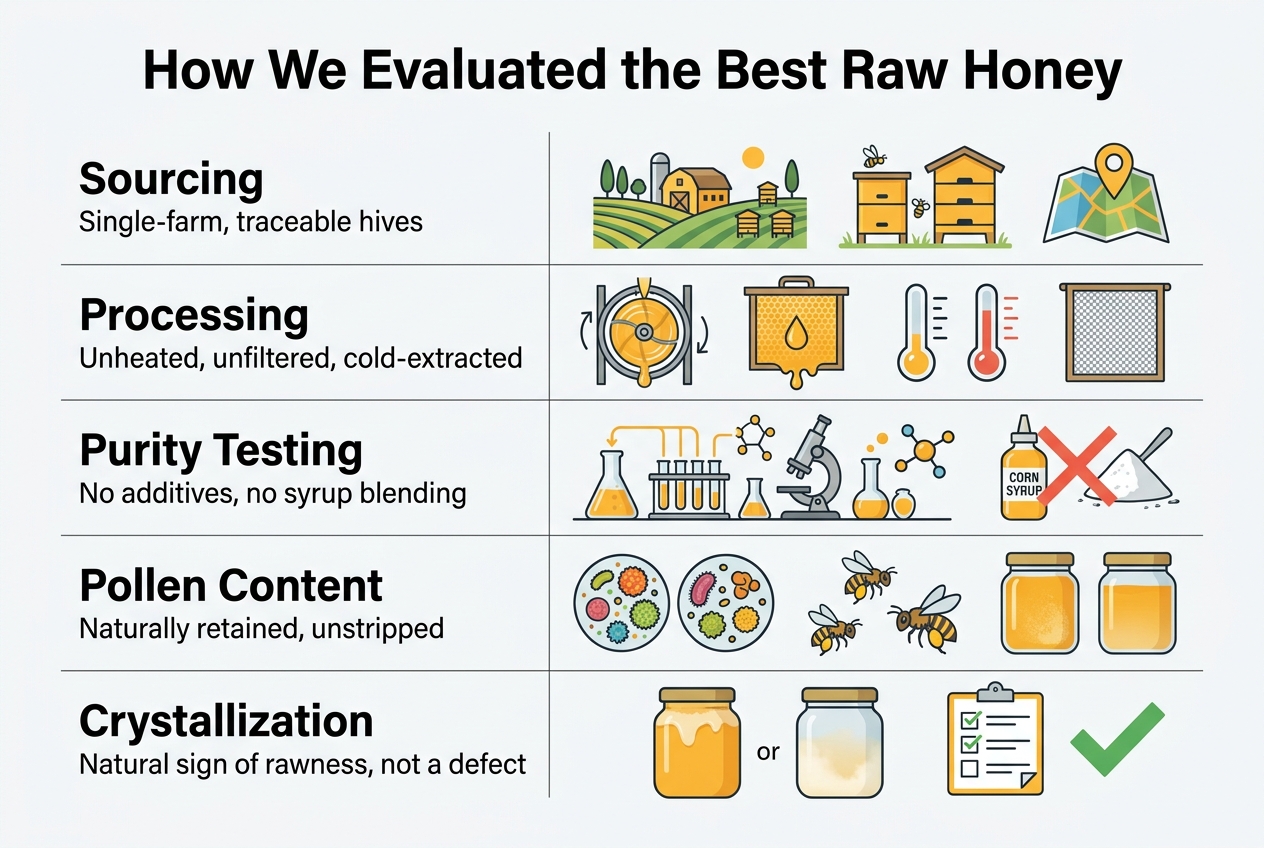
How We Evaluated the Best Raw Honey Options
Not every jar labeled "raw" earns the name. Before ranking anything, we looked at how each option is tested, sourced, and handled after harvest. That meant digging past marketing copy and asking harder questions: who tests this, how often, and what exactly are they checking for?
Purity & Lab Verification
Purity claims mean little without paperwork behind them. We favored options that treat lab verification as routine, not a one-time event triggered by a complaint.
- Testing happens on a fixed schedule, ideally every few months, rather than once at launch and never again.
- Results confirm the absence of glyphosate residue and other synthetic additives, not just sugar content.
- 10-HDA potency is disclosed numerically for royal jelly, since vague terms like "high potency" tell you nothing.
- Adulteration checks screen for cheap syrup dilution, a common trick in mass-market honey.
- Certificates are dated and accessible, so you're not taking anyone's word for it.
If a seller won't share a lab report, treat that as your answer.
Sourcing & Farm Transparency
Where the bees forage matters as much as what's in the jar. Pesticide-free hive placement, honest floral-source labeling, and harvest timing all shape flavor and nutrient content. We checked whether sellers name actual apiary locations, disclose single-source floral origins, and explain harvesting methods rather than hiding behind generic branding. For those avoiding ethanol-based extracts, learning about propolis tincture extract alcohol free options is worth the ten minutes it takes. Packaging and shipping speed round out the picture, since raw honey and royal jelly are heat-sensitive. Fast, temperature-conscious delivery preserves enzymes that slow, sun-baked shipping destroys. Traceability, frankly, separates a serious producer from a repackager.
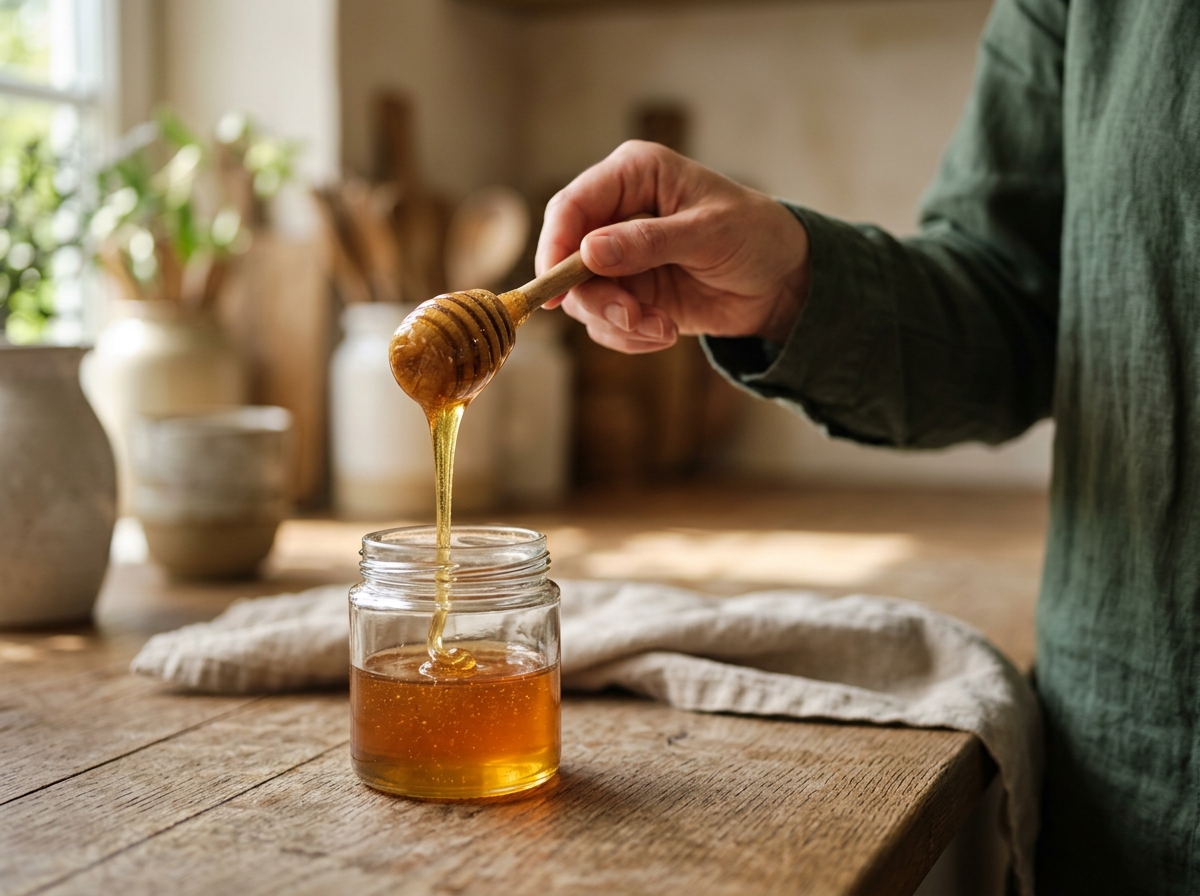
1. Orange Blossom Honey — Best Raw Honey for Everyday Use
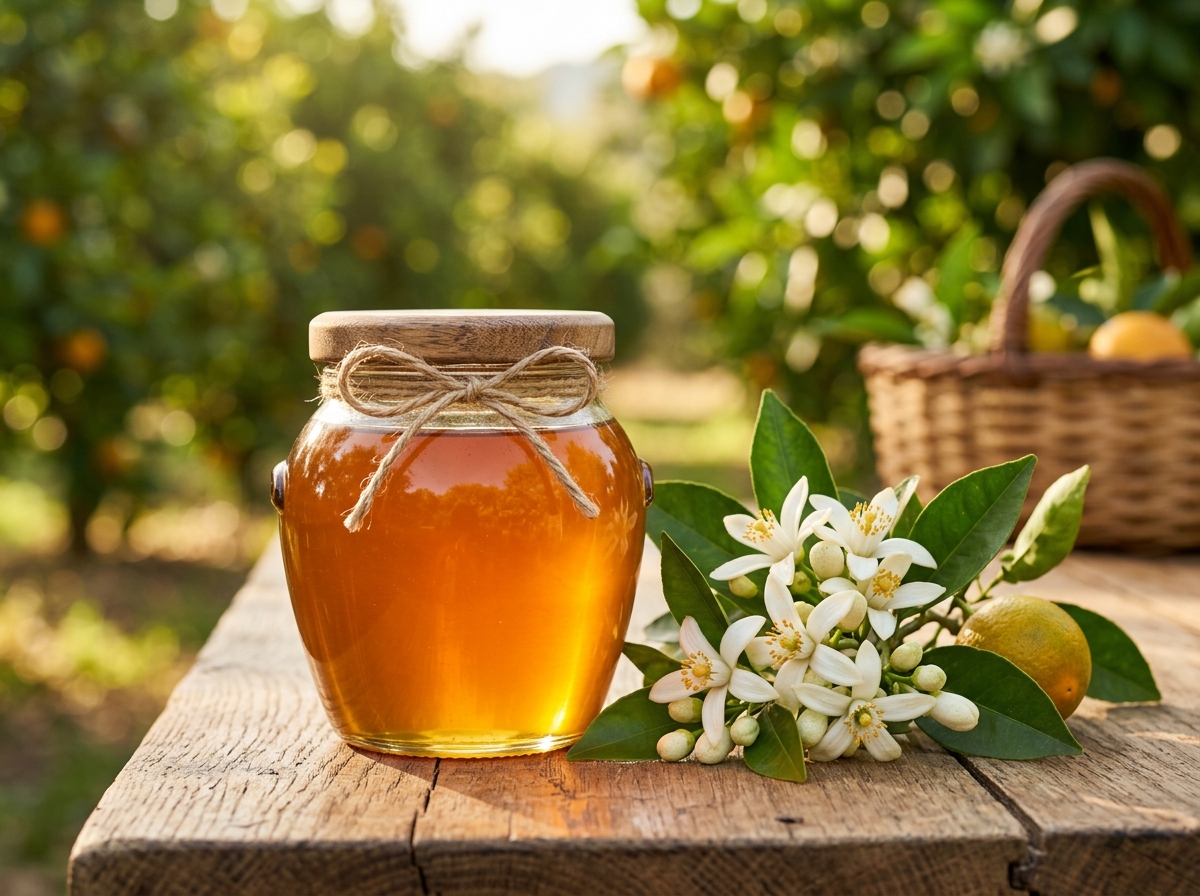
Some honeys are meant for special occasions. This one's meant for Tuesday morning. Orange blossom honey comes from bees that work citrus groves, and it shows in the taste — light, floral, with a faint citrus lift that never turns bitter or overpowering. It's the honey you reach for without thinking twice: stirred into tea, drizzled on toast, spooned into yogurt. Because it's drawn from a single floral source rather than mixed with other nectars, the flavor stays consistent jar after jar, which matters more than people realize once they've tasted a blended honey that changes character halfway through the bottle.
Give it time in the pantry and you'll notice it turning cloudy, then firm. That's crystallization, not spoilage. Raw honey still holding its natural glucose and pollen will do this; the overly processed stuff on grocery shelves often can't, because heat and filtering strip out what would otherwise crystallize. A quick read on premium 100 pure orange blossom honey explains why that texture shift is actually a purity marker worth trusting. A warm water bath softens it back down if you prefer it liquid.
Compare it to a supermarket clover honey and the difference is obvious within one taste. Clover is fine, sweet, unremarkable. Orange blossom has personality without demanding much of you — no acquired taste, no strong aftertaste, nothing to get used to. That's exactly why it earns the everyday spot on this list.
2. Buckwheat Honey — Best Raw Honey for Bold, Malty Flavor
If your idea of honey is something pale and mild, buckwheat will surprise you. It's dark, almost molasses-brown, with a deep malty taste that's more savory than sweet. That's not a defect — it's the floral source doing its job. Buckwheat flowers produce nectar naturally rich in minerals and antioxidant compounds, which is why raw buckwheat honey consistently tests higher in antioxidant content than lighter varieties like clover or orange blossom. The flavor intensity is earned, not engineered. No additives, no blending — just a different plant, a different result. This isn't honey with something stirred in; the boldness comes purely from where the bees foraged.
Bakers love it for a reason. Stir it into dark rye bread, drizzle it over oatmeal, or swap it into a glaze for roasted vegetables, and it holds its own instead of disappearing. Its robustness also pairs well with strong cheeses and dark chocolate, which lighter honeys tend to get lost next to. Some of the interest in darker honeys also ties to their natural compounds; research into antibacterial activities of honey bee against gram positive bacteria has looked at how variety and processing affect these properties. Worth remembering next time someone tells you all honey tastes the same.
3. Manuka Honey — Best Raw Honey for Immune Support
Manuka comes from the nectar of the manuka bush, native to New Zealand and parts of Australia. What makes it different from a jar of clover honey is a naturally occurring compound called methylglyoxal, or MGO. This is what gives manuka its reputation as a strong choice for immune support, and it's also why you'll see numbers like 263+ or 514+ stamped on the label. Higher MGO means more of that antibacterial compound is present. It's a lab-measured number, not a marketing phrase.
That distinction matters more than people realize. Plenty of jars lean on the term UMF, a grading system with looser tiers, while skipping a hard MGO figure altogether. An MGO rating tells you an actual concentration; UMF alone tells you a category. If you're weighing training styles, the same logic applies elsewhere too, since comparing gi vs no gi BJJ which jiu-jitsu style is right for you? comes down to specifics, not labels. Ask for the number, not just the badge.
Use manuka straight, by the spoon, ideally on its own or stirred into lukewarm water. Baking or adding it to hot tea breaks down the very compounds you're paying for. Save it for cold or room-temperature use, ideally daily, and treat it as a wellness habit rather than a pantry staple for pancakes.
4. Jarrah Honey — Best Raw Honey for a Unique Caramel Profile
Jarrah honey comes from the Jarrah tree, a eucalyptus species that grows almost exclusively in the forests of Western Australia. It's a niche varietal, and harvest windows are short and weather-dependent. That scarcity is part of the appeal. The flavor is the real draw: deep, toasty, almost caramel-like, with none of the floral lightness you'd get from a clover or orange blossom honey.
Nothing about that taste comes from an additive. It's simply what the tree's nectar produces. That distinction matters if you're comparing it to honey with cinnamon or vanilla stirred in — Jarrah earns its complexity through floral source, not a mixing bowl. If you're building a small rotation of single-origin honeys to taste side by side, Jarrah belongs next to Buckwheat for the boldest contrast in the lineup.
Because supply is limited each year, expect it to be priced and stocked like a specialty item, not a pantry staple. Worth grabbing when it's available. Just don't expect it every month.
5. Raw Honeycomb — Best Raw Honey for Natural Pollen and Enzymes
Comb is honey in its rawest possible state. Nothing gets extracted, spun, or filtered out. You're getting the wax cells exactly as bees built and capped them, which means pollen grains, tiny propolis traces, and active enzymes all stay right where nature put them. This is the version purists reach for, and it's easy to see why: nothing between hive and jar means nothing lost. If you're chasing the bee pollen benefits people rave about but can't find raw pollen granules on their own, comb is your closest bet, since the pollen never left the wax.
How to Serve and Store Honeycomb
Eating comb is simpler than people expect. Cut a small square and just chew it — the wax is edible, and most of it will soften down while the honey releases. Some people swallow small bits of wax, others spit it out like gum. Both are fine. It's also a striking addition to a cheese board, especially next to sharp cheddar or soft brie, or dropped straight into hot tea, where it slowly melts and sweetens as it dissolves.
One clarification worth making: comb is a food, not a craft material. It won't behave like beeswax blocks or candle wax, and melting it down for a DIY project will waste good honey and leave you with a sticky mess. If you're after wax for candles or cosmetics, you'll need to look to a dedicated beeswax supplier — this jar stays in the kitchen, not the craft drawer.
Store comb at room temperature in a sealed container, away from direct sunlight. Refrigeration isn't necessary and can actually make it harder and less pleasant to chew. Many parents exploring natural, local allergy-support routines gravitate toward comb specifically, since it's the least processed way to get honey from a nearby region onto a spoon.
Best Raw Honey Comparison: Flavor, Potency, and Best Use
Not every raw honey does the same job. Some are built for your morning tea, others for immune support, and a couple are just fun to gift. Here's how the five stack up side by side.
| Honey Type | Flavor Profile | Texture | Potency Marker | Ideal Use Case |
|---|---|---|---|---|
| Orange Blossom | Light, floral, citrus notes | Smooth, crystallizes naturally over time | Standard raw enzyme content | Daily use, tea, everyday cooking |
| Buckwheat | Bold, malty, molasses-like | Thick, dense | High antioxidant content | Cough relief, gourmet pairing |
| Manuka | Earthy, robust, slightly bitter | Thick, creamy | MGO 263+ to 514+ | Immune support, targeted wellness use |
| Jarrah | Rich caramel, mild sweetness | Smooth, semi-thick | Naturally low glucose, high mineral content | Gifting, gourmet flavor exploration |
| Raw Honeycomb | Sweet, waxy, pure honey burst | Solid comb, chewable | Whole pollen and enzyme retention | Gifting, natural allergy support |
Chasing an immune boost? Manuka's MGO rating makes it the clear pick. Want something you'll actually enjoy every day? Orange Blossom wins that fight easily. Buckwheat and Jarrah are for people who treat honey like a fine ingredient, not just a sweetener. Honeycomb sits in its own lane: pollen, wax, and enzymes in their most unprocessed form.
6. Royal Jelly and Propolis — Best Raw Honey Companions for Wellness Goals
Royal Jelly: Fresh vs. Freeze-Dried
Royal jelly isn't honey, but it comes from the same hive and it's worth understanding if energy and immune support are your goal. It's not something you'll find in a queen bee starter kit or sold as part of a hive package — this is purely a food product, harvested from what queens are raised on. Fresh royal jelly comes in two grades worth knowing. A Premium tier typically runs 2.1%+ 10-HDA, the fatty acid used to measure potency. A Limited, never-frozen edition pushes past that at 2.3%+, kept cold rather than frozen to protect enzyme activity. Both are meant to be taken fresh, in small daily doses, straight off a spoon.
If you travel a lot or hate the taste of fresh jelly, freeze-dried powder solves a real problem. It's concentrated to 6%+ 10-HDA, about three times the strength of fresh, and it doesn't need refrigeration. There's no capsule here — you won't find pills or softgels in this lineup. You measure it by spoon, which some people actually prefer since you can dial the dose up or down instead of being locked into a fixed pill amount.
Verdict: fresh is for people who plan ahead, powder is for people who don't. Neither is better across the board — it depends on your routine.
Propolis: Powder vs. Spray
Propolis is the resin bees use to seal and protect the hive, and humans have used it for immune support for centuries. Organic propolis powder is the raw, unextracted version — nothing pulled out, nothing added. It's a fine daily supplement if you're comfortable mixing a small amount into water or food and don't mind its sharp, slightly bitter edge.
For people avoiding alcohol-based tinctures, an alcohol-free spray delivers the same propolis compounds in a quick, family-friendly format. No ethanol, no burn under the tongue, just a fast spray you can use daily. Parents especially lean toward this version. Both formats are ingestible wellness products, not skincare — so don't go dabbing either one on your skin expecting a topical fix. If you're after a propolis serum or honey-infused face mask, that's a separate skincare category entirely, and not what these products are built for.
How to Verify Purity Before You Buy
Anyone can slap "raw" on a label. Verifying it takes about five minutes, and it's worth doing every time. Start by requesting a third-party lab certificate showing purity, 10-HDA levels for royal jelly, and a glyphosate screening. No certificate, no sale.
Next, check the harvest date and hive location. A jar that can't tell you where or when it came from isn't traceable — it's a guess. Testing frequency matters too. Every six months is a solid benchmark; annual or "as needed" testing tells you less than you'd think.
Here's a quick reference for the checks that actually matter:
| Verification Step | What to Look For | Red Flag |
|---|---|---|
| Lab report | Purity, 10-HDA%, glyphosate screen | No report available on request |
| Testing frequency | Every 6 months | "Tested at harvest" with no follow-up |
| Crystallization | Natural, uneven granulation over time | Never crystallizes at all |
| Farm location | Named hive region, listed address | Vague "sourced globally" language |
| Shipping/storage | Fast, temperature-conscious delivery | Long transit with no cold-chain mention |
One more thing: watch the price. Real raw honey and royal jelly cost more to produce. If it's priced like a supermarket squeeze bottle, it's probably blended, and someone's cutting corners you can't see.
Buying Raw Honey Online: What to Check Before Checkout
Signs of a Trustworthy Online Seller
Anyone can slap "raw" on a label. Before you hand over your card number, look for a few concrete signals that the seller actually backs up the claim. Shipping policy is a good place to start. Free shipping over a set order size (often around $99) tells you the seller expects repeat, higher-volume buyers, not just one-off tourists. And an expedited option like FedEx 2 Day matters more than it sounds, since raw honey and royal jelly are perishable-leaning products that shouldn't sit in a hot truck for a week.
Next, figure out who's actually behind the jar. Some brands are really just repackagers; others keep their own hives. Farm-direct sourcing beats a third-party marketplace listing almost every time, because you can trace the honey to a specific hive and harvest date instead of a warehouse blend. A seller with hives in, say, California and New Jersey and nothing more than that to show is fine — you're not looking for a hive tour or a beekeeping class, just proof the product comes from a real farm. A few other checks worth running before checkout:
- Confirm the return policy actually allows exchanges on unopened jars, not just a vague "satisfaction guaranteed" banner with no process behind it.
- Look for a real volume of reviews, ideally 100 or more verified ones, since a handful of five-star ratings proves very little.
- Ask whether bulk or wholesale pricing exists if you're a retailer or just someone who goes through royal jelly fast.
- Check that each product is single-source and labeled by floral origin, not a vague "gourmet blend."
- Skip the pre-made gift basket and build your own sampler from individual jars, say Manuka, Jarrah, Orange Blossom, and a Honeycomb, so every item is full-size and traceable on its own.
Skimp on this checklist and you're basically gambling on a sugar syrup with good marketing.
Choosing between hive rental for pollination and simply harvesting honey for sale comes down to what a grower or buyer actually needs season to season, and that's worth sitting with before committing to either path. Contract pollination is a specialized service best sourced from operators who do that work directly, while anyone looking to buy raw honey, royal jelly, or propolis in volume is really asking a different question about supply and consistency. Weighing those two goals separately, rather than expecting one arrangement to cover both, tends to make the decision much clearer.


