

The Best Honey in 2026: How to Choose Quality Raw Honey
Sep 17, 2026
Walk down any grocery aisle and you'll count a dozen amber jars promising "pure," "natural," or "raw." Most have been heated, filtered, and blended until there's little left worth paying for. Finding the best honey means reading past the label: what bloom it came from, whether pollen and enzymes survived bottling, and if anyone actually tested the jar. That's a lot to sort out alone. Below, we break down nine honey varieties worth your money in 2026 — from Manuka and Jarrah to buckwheat and raw honeycomb — plus how each one earns its place in your pantry.
How to Judge Honey Before You Buy
Most honey shopping happens on vibes. The jar looks rustic, the label says "natural," and the investigation ends there. But label language is mostly unregulated. You have to read for the few terms that carry real weight, and learning what separates a raw unfiltered honey buying guide from marketing copy will save you money on jars that aren't worth it.
The Four Labels That Actually Mean Something
Four terms do real work. Everything else on the front of the jar is decoration.
- Raw means the honey was never heated past about 104°F, so enzymes like diastase and invertase stay intact along with most pollen traces — pasteurization at 145°F or higher strips both.
- Unfiltered means pollen, tiny propolis flecks and trace wax are still present; ultrafiltered honey loses the botanical fingerprint that makes origin testing possible in the first place.
- Single-source (monofloral) honey comes from one dominant bloom, while blended commodity honey pools barrels from several countries and often lists origin as vaguely as legally allowed.
- Third-party lab tested should mean a batch certificate covering glyphosate, synthetic additives, C4 sugar adulteration, and MGO or UMF numbers for Manuka.
- Traceable means you can name the hive location and harvest date, not just a state.
Red Flags on a Honey Jar
Watch for "packed in the USA" with no country of harvest. Watch for perfectly clear honey that never changes texture, and MGO claims with no certificate number attached. Crystallization, though, isn't a defect — it's what raw honey does as glucose settles out, and warm water loosens it right back up. Cloudy, grainy honey is usually the honest jar in the aisle.
1. Manuka Honey (MGO 263+ and MGO 514+)
Manuka comes from the nectar of Leptospermum scoparium, a scrubby flowering bush native to New Zealand and parts of Australia. Nobody buys it for sweetness. The draw is methylglyoxal (MGO), a compound that forms as the honey matures and gives it an antibacterial profile you won't get from clover or wildflower jars. Flavor-wise, expect something dense and mineral-heavy, faintly bitter, almost medicinal on the back end.
The texture surprises people too. Manuka is thixotropic — it sits thick and gel-like until you stir it, then loosens up. That's normal. If your Manuka pours like syrup straight off the shelf, something's off. And while you'd judge a lighter varietal like orange blossom honey mostly on aroma and clarity, Manuka gets judged on its number.
Choosing Your MGO Tier
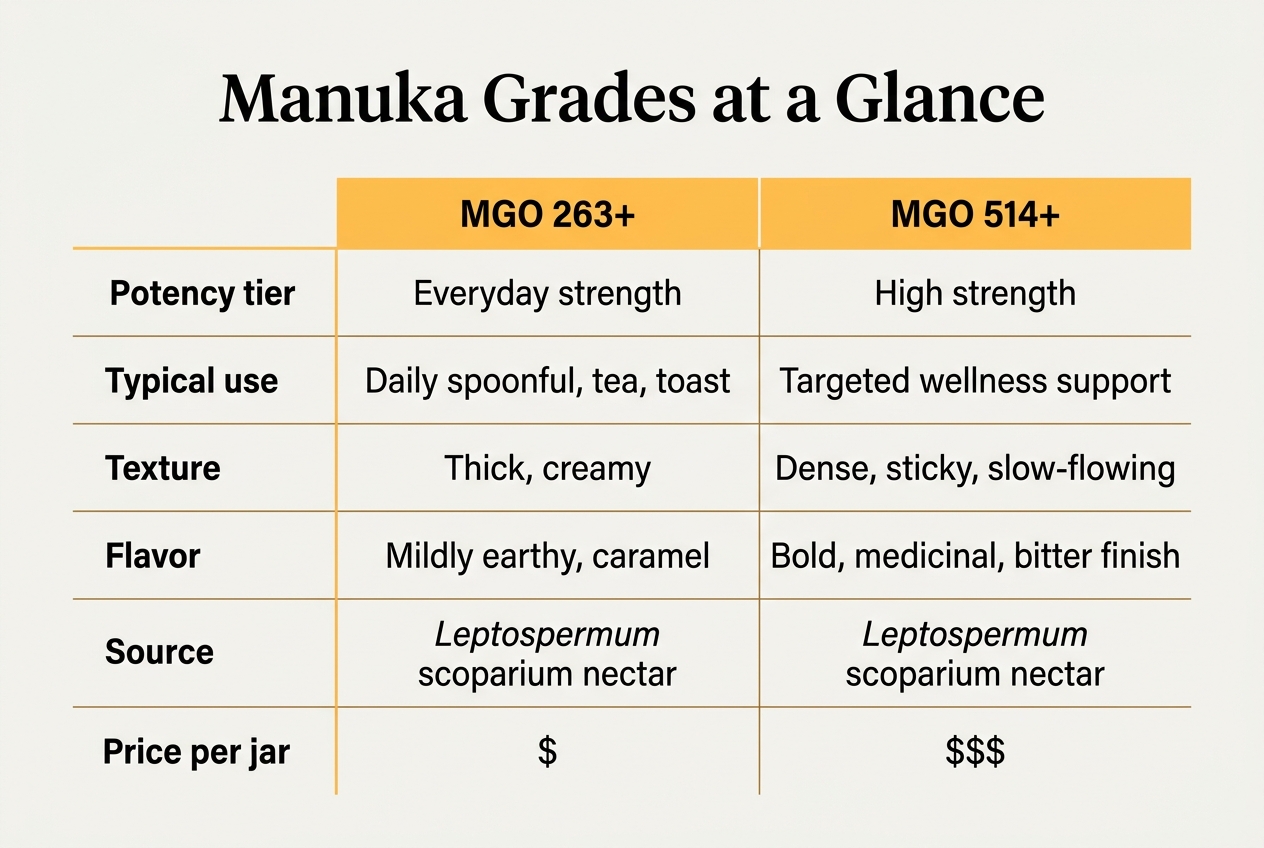
MGO grading is a direct measurement in milligrams per kilogram. UMF is a broader New Zealand system that checks MGO alongside leptosperin and DHA, so UMF 10+ roughly tracks MGO 263+, and UMF 15+ lands near MGO 514+. Either system works. What doesn't work is a jar labeled "Manuka" with no number at all — that's a marketing word doing a lab test's job, and you have no idea what you're paying for.
For daily use, MGO 263+ is the sensible pick. A teaspoon in the morning, stirred into warm (not hot) tea or eaten straight. It's potent enough to matter without burning through a small jar in two weeks.
MGO 514+ costs considerably more. Most people hold it back for targeted stretches — a sore throat, travel season, a run-down week. Both tiers are worth buying only with lab-verified grading behind them, sourced raw and unheated so the enzymes survive. Brands like Comvita and Wedderspoon publish their grading openly. That's the bar to hold any jar to.
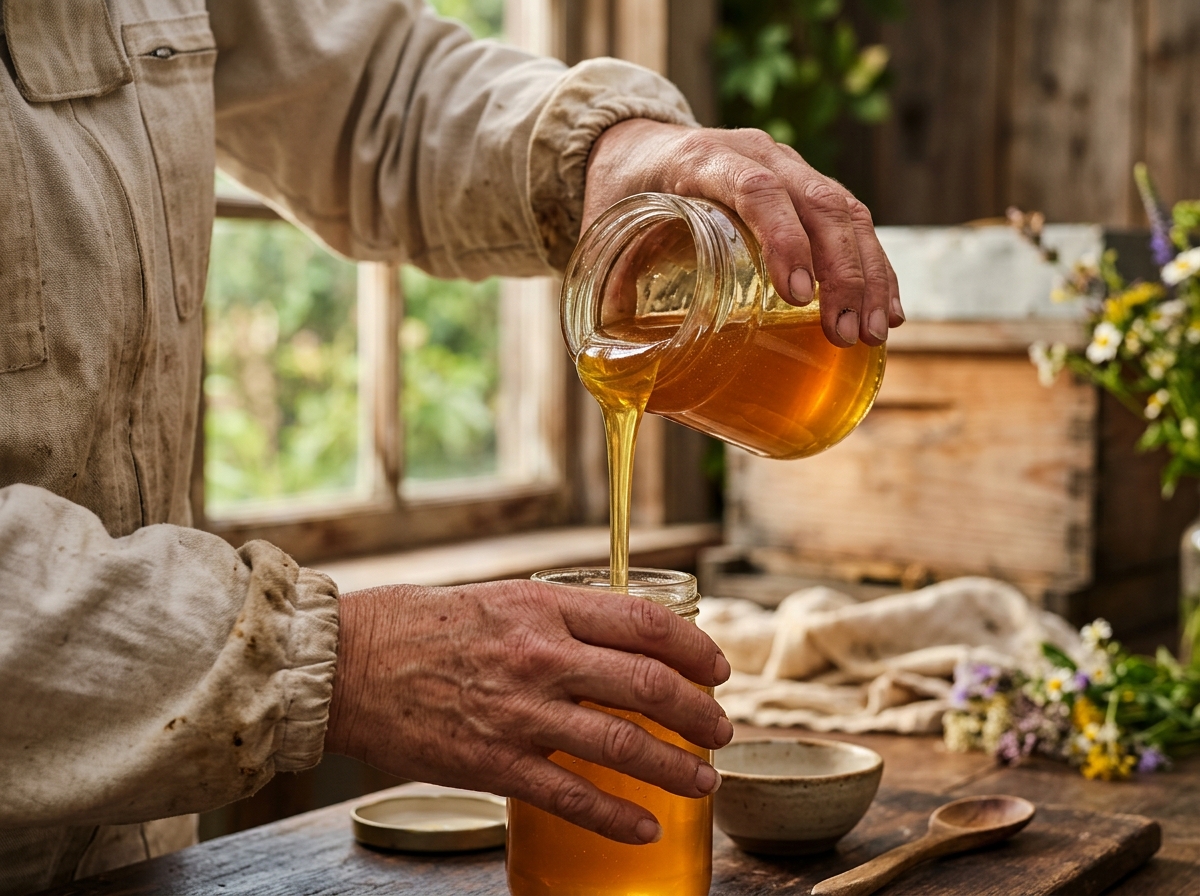
2. Jarrah Honey — The Low-Glycemic Australian Outlier
Jarrah comes from Eucalyptus marginata, a hardwood tree that grows in the southwest corner of Western Australia and almost nowhere else. Here's the catch: those forests don't bloom on a yearly schedule. A serious flowering event happens roughly every two to four years, so beekeepers can go multiple seasons without a real harvest. That irregularity is the whole reason the price sits where it does.
The flavor is the surprise. Think butterscotch first, then caramel, with a faint molasses finish. It's dark, thick, and not floral at all. Stir it into black coffee or spoon it over plain yogurt and it behaves more like a dessert sauce than a sweetener.
Why It Stays Liquid on the Shelf
Jarrah carries an unusually high fructose-to-glucose ratio — glucose is what seeds crystals, so with less of it, the jar stays pourable for years. That same sugar profile puts it lower on the glycemic scale than most table honeys, which is why it gets recommended to people watching blood sugar. It's still sugar. Just a gentler curve.
It also tests high for total activity, the peroxide-based antimicrobial rating Australian labs use. Activity ratings get scored differently across regions, so reading up on manuka honey vs raw honey helps you compare the numbers honestly before you spend. Plenty of buyers treat Jarrah as a Manuka alternative at a friendlier price, and it's sold raw and unheated in single-source form. Brands like Nature's Nutrition and Wedderspoon carry eucalyptus-family options if you want to taste around.
3. Buckwheat Honey — Dark, Malty and Antioxidant-Dense
Pour it and almost no light comes through. Buckwheat honey runs nearly black, with a thick molasses-and-malt profile and a finish some people call earthy or even barnyard. It's the most polarizing jar in any lineup. You'll either love it on the first spoonful or decide it's not for you — there's rarely a middle ground.
The payoff is density. Buckwheat consistently tests among the highest honeys for phenolic and antioxidant content, in the same range as dark berries and cherries. Research on the nutraceutical value of natural honey ties that color directly to polyphenol concentration, which is why pale table honeys don't compete here. Darker floral source, more compounds. Simple as that.
Who Should Start With Something Milder
It's a traditional pick for nighttime throat comfort — a spoonful stirred into warm, not boiling, water, since high heat degrades the enzymes you paid for. On food, it shines where sweetness needs a backbone: aged cheddar, dark rye bread, barbecue glazes, gingerbread. Drizzle it on yogurt expecting clover and you'll be disappointed.
Because it's harvested raw and unblended, the depth comes from the buckwheat bloom itself, not from added flavoring or syrup. If you want variety in your rotation, that's the honest way to get it. New to dark honeys? Buy the smallest jar first.
4. Orange Blossom Honey — The Everyday Table Jar
Bees working citrus groves bring back nectar that turns into a light amber honey with a distinct orange-peel aroma and a clean floral finish. It's mild. That's the whole point. Where a dark varietal fights your food for attention, this one slips in behind it and lifts the sweetness without leaving a heavy aftertaste.
That makes it the most food-flexible jar on your counter. Stir it into hot tea, whisk it with olive oil and lemon for a vinaigrette, swap it for granulated sugar in muffin batter, or spoon it over ricotta on grilled bread. The raw, unfiltered version harvested from California hives keeps its pollen and enzymes intact, and pollen content is part of why real honey differs from cheap imitation syrups sold at the same shelf price.
Crystallized Doesn't Mean Ruined
Give a jar of raw orange blossom four to eight months and it'll go cloudy, then firm. People panic and toss it. Don't. Crystallization is glucose doing exactly what glucose does in unheated honey, and the result is a soft, spreadable texture — essentially what shoppers pay extra for in whipped or creamed jars, minus the mechanical whipping and minus any additives.
Want it pourable again? Warm it gently. Set the jar in a water bath that stays under 104°F and stir every few minutes until the crystals dissolve. A microwave blows past that temperature in seconds and cooks off the enzymes you paid for. Same goes for boiling water straight from the kettle. Slow and lukewarm wins, and you can repeat it as often as you need without harming the honey.
The Best Honey Picks Compared Side by Side
Quick-Reference Buying Chart
Nine picks, one chart. For purity shoppers, the last column matters most — whether you can actually pull a lab certificate for that jar, with hive location and harvest date attached. Everything else is taste and texture.
| Pick | Floral Source | Color & Flavor | Standout Attribute | Best For | Crystallizes? | Lab-Tested? |
|---|---|---|---|---|---|---|
| Manuka MGO 263+ / 514+ | Leptospermum, New Zealand | Dark amber, medicinal, bitter finish | Graded MGO potency | Targeted daily wellness use | Rarely; thickens instead | Yes — MGO certificate standard |
| Jarrah | Eucalyptus marginata, Australia | Deep russet, caramel-molasses | Low glycemic, high fructose | Sugar-cautious buyers | Almost never | Yes, from serious sellers |
| Buckwheat | Buckwheat blossom, NJ hives | Near-black, malty, mineral | Highest antioxidant load | Cough relief, baking, glazes | Yes, in 3–6 months | Yes |
| Orange Blossom / Raw Honeycomb | Citrus groves, CA hives | Pale gold, floral, bright | Comb retains wax and pollen | Everyday table jar, kids | Yes — spreadable, not spoiled | Yes |
| Supermarket wildflower, clover, bulk | Blended, often unlisted | Light, generic sweet | Price per ounce | Cooking volume only | Sometimes; often filtered to prevent it | Rarely |
The California and New Jersey rows are single-source and traceable. Grocery clover is usually a blend from three continents. Regional bee research programs like the honey bee lab at UF/IFAS publish useful background on how floral source shapes composition. And for readers tracking lineage in other fields — say, a family lineage chart — the same principle applies: provenance explains the product. Buy the row you'll actually finish.
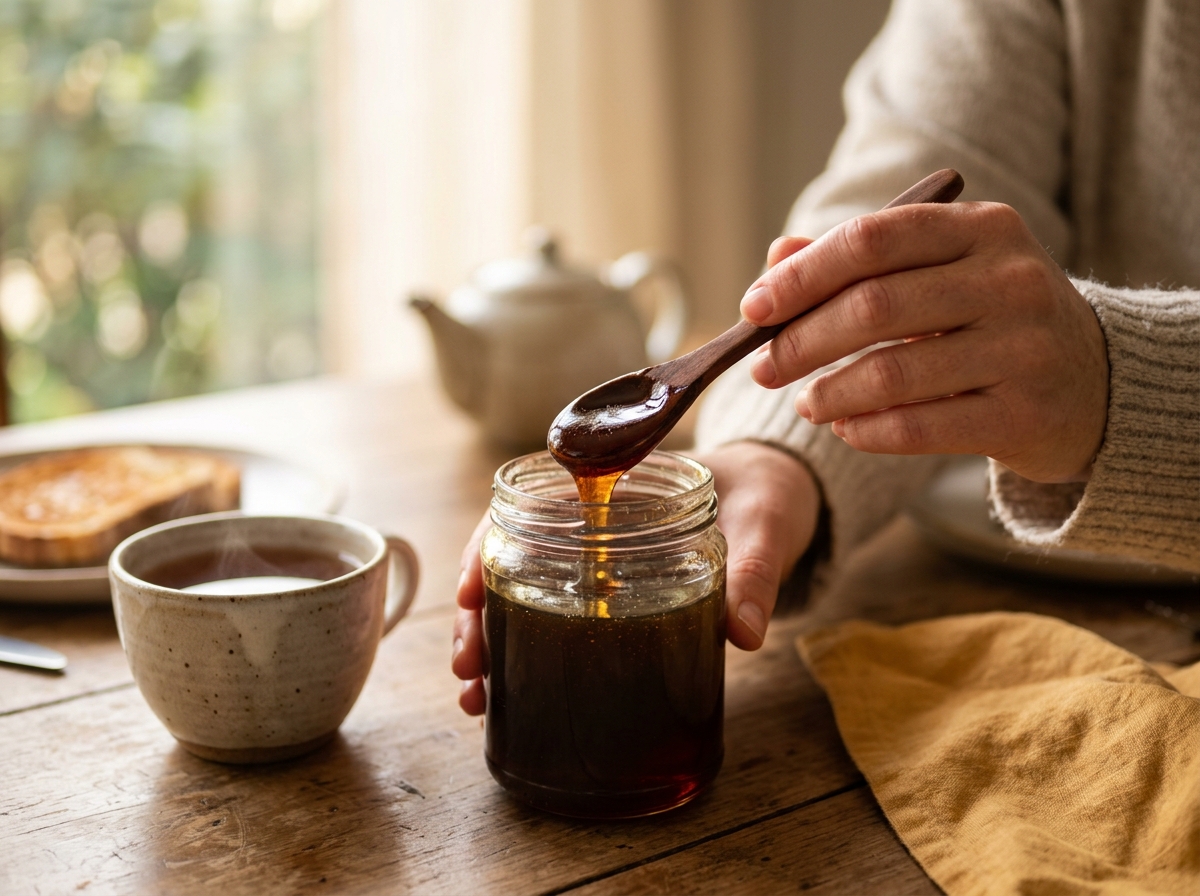
5–7. Three Picks Beyond the Jar: Comb, Propolis and Royal Jelly
Honeycomb vs. Extracted Honey
Extracted honey has been spun out of the wax. Raw honeycomb is the whole thing — wax cells still sealed, honey still inside, plus the pollen and trace propolis the bees packed in there. It's the closest you'll get to eating straight from the hive without a veil and a smoker. Chew a square like gum, then swallow or spit the wax. Either is fine. On a cheese board it's excellent with sharp cheddar, walnuts, and a dry white. One note that trips people up: this is food-grade comb, not a crafting supply.
- If you want beeswax blocks or pastilles for candles, balms or furniture polish, buy those from a wax specialist — chewing comb is the wrong raw material and a waste of good honey.
- If you're hunting bee pollen granules, those come from other specialty suppliers, and raw unfiltered honey and honeycomb already carry pollen naturally.
- Parents researching local comb for seasonal comfort should still run any allergy or infant question past a pediatrician first — and honey is never for children under 12 months, comb included.
- Store comb at room temperature in its sealed container; refrigeration makes the wax hard and brittle, and it doesn't help shelf life.
- Expect some crystallization around the comb over months, which is a rawness signal, not spoilage.
Propolis Without the Ethanol
Propolis is the resin bees collect to seal and sterilize the hive. The classic format is an alcohol tincture, which many households skip on purpose. Two ethanol-free routes exist: organic bee propolis powder, sold raw and unextracted as an ingestible, and an alcohol-free propolis immune support spray — same propolis, gentler delivery. Fresh royal jelly rounds out the trio for energy and immune interest. Bee research keeps expanding, and the launch of a university honey and pollination center shows how seriously the science is being taken now.
8–9. Royal Jelly and Bulk Raw Honey for Serious Users
Royal jelly is the milky secretion nurse bees feed a developing queen. It's graded by 10-HDA content — the fatty acid used as the industry marker for freshness and potency. Higher isn't automatically better for you. It's about format. Here's how the four common ones stack up.
Royal Jelly Formats at a Glance
| Format | 10-HDA | Storage | Taste | Dosing | Best for |
|---|---|---|---|---|---|
| Premium fresh raw | 2.1%+ | Frozen or refrigerated | Sharp, tangy | Small spoon, under the tongue | First-time daily users |
| Limited Edition, never-frozen | 2.3%+ | Refrigerated, short window | Strongest, most acidic | Spoon, taken straight | Purists chasing peak freshness |
| Freeze-dried powder | 6%+ (about 3x) | Shelf-stable, cool and dry | Mild, faintly sour | Measured by spoon into cold food | Travelers, tang-averse users |
| Bulk fresh royal jelly | 2.1%+ | Freezer, portioned out | Sharp, tangy | Decanted into small jars | Retailers, large families |
That powder column matters. Plenty of supplement brands sell royal jelly in pre-dosed capsules or softgels. If you'd rather skip capsules entirely, a loose freeze-dried powder lets you stir a measured scoop into a smoothie, yogurt or cold oats. You control the amount. Nothing thaws in transit.
When Bulk Ordering Makes Sense
Bulk raw honey and royal jelly are worth it once you're moving real volume — a café sweetening drinks, a retailer stocking a wellness shelf, or a household that goes through a pound a month. Home cooks like it as a clean, unheated base ingredient. Note that bulk honey isn't a brewing kit; if you're making mead, you'll source yeast and equipment separately.
Logistics are simple: free shipping over $84, FedEx 2 Day Express with a Saturday delivery option, and third-party lab testing every six months covering purity, 10-HDA and glyphosate screening.
Storing Your Honey and Getting the Most From It
Good honey survives bad storage, but it doesn't stay good. Heat and moisture are the two things that quietly wreck a raw jar. Here's how to keep what you paid for.
- Room temperature in a dark cupboard is the gold standard — not the fridge, since cold speeds up crystallization dramatically.
- Use a dry spoon every single time; even a few drops of water can kick off fermentation in raw, unpasteurized honey.
- Never boil or microwave it. If a jar sets solid, sit it in warm water and keep the temperature under 104°F so enzymes, pollen and aroma compounds stay intact.
- Royal jelly plays by different rules: fresh forms need refrigeration or the freezer, while freeze-dried royal jelly powder and propolis powder sit happily on a shelf.
- Skip the decorative honey pot with the loose lid — an airtight glass jar wins because raw honey pulls humidity from the air.
Shelf Life and Heat Rules
Stored properly, raw honey lasts years. Crystallization isn't spoilage; it's a rawness marker. Watch for sour smells or bubbling instead — that's fermentation, and it usually traces back to a wet spoon.
Building a Tasting Lineup at Home
You can build your own sampler instead of buying a pre-made set. Pair Manuka, Jarrah, Orange Blossom and a tray of raw honeycomb, which typically clears the $84 free-shipping mark. Questions on hive location, harvest dates or lab certificates? Call 832-464-6639 or email support@gohoney.net.
Before you commit to a hive rental agreement, it's worth asking what you're really paying for: how many frames of bees per colony, what the contract says about replacement if a hive arrives weak, whether the beekeeper's inspection records are open to you, and how the timing lines up with your bloom window rather than someone else's. Growers who need contract pollination will find that relationship with a dedicated migratory beekeeper or a regional broker, and it's a different conversation entirely from buying finished hive products — raw honey, honeycomb, royal jelly, or propolis — which come from apiaries kept for harvest instead of placement. Knowing which of those two goals you're actually pursuing will save you a lot of mismatched phone calls, and if it's volume of the edible sort you're after, that's a wholesale question rather than a pollination one.


