

The 8 Types of Honey Every Health-Conscious Shopper Should Know
Sep 11, 2026
Walk down any grocery aisle and you'll find a dozen jars labeled "honey," yet almost none of them tell you what's actually inside. Some are cut with syrup. Others are heated until their enzymes and antioxidants are long gone. If you're trying to buy raw, pesticide-free honey for your family's health—or sourcing royal jelly and propolis with real therapeutic value—you need more than a pretty label. This guide breaks down 11 types of honey so you can identify exactly what belongs in your cart, your medicine cabinet, or your shop's shelves.
9 Types of Honey and What Makes Each One Unique
Not all honey is created equal. Once you start comparing jars side by side, the differences jump out fast. Floral source, region, and harvest season all shape the final product. Two honeys sitting on the same shelf can taste, look, and behave completely differently depending on what the bees were feeding on that week.
Light & Mild Varieties (Clover, Acacia, Orange Blossom)
Clover honey is the honey most Americans grew up on. It's mild, sweet, and pours easily, which is exactly why it shows up in so many supermarket bottles. Acacia honey is even lighter in both color and flavor. It stays liquid far longer than most varieties thanks to its high fructose content. Wildflower honey is the wildcard of the bunch. Since bees pull nectar from whatever's blooming nearby, no two batches taste quite the same. Then there's orange blossom, prized for its delicate citrus aroma and floral finish. If you're curious how this one is produced and why it's such a popular baking companion, it helps to read up on premium 100 pure orange blossom honey before choosing a jar for your tea cabinet.
- Clover honey works well as an everyday table honey because its flavor doesn't overpower coffee, oatmeal, or toast.
- Acacia honey suits diabetics-in-moderation and low-glycemic diets better than most, since its fructose-heavy makeup causes a slower blood sugar response.
- Orange blossom honey adds a citrusy lift to iced tea, glazes, and baked goods without introducing a heavy aftertaste.
- Alfalfa honey, another light variety, has a slightly buttery note and is common in the northern Plains and Canada.
- Wildflower honey shifts in flavor and color from batch to batch, making it a fun one to buy seasonally and compare.
Bold & Medicinal Varieties (Manuka, Jarrah, Buckwheat)
Now for the honeys with some bite. Buckwheat honey is dark, almost molasses-like, and noticeably more robust in flavor than anything in the light category. That darkness isn't just cosmetic — darker honeys generally pack more antioxidants than pale ones like clover or acacia. Manuka honey, harvested from New Zealand's manuka bush, gets its reputation from lab-verified MGO (methylglyoxal) ratings that measure antibacterial strength. The higher the number, the more potent the honey. Jarrah honey, sourced from Western Australian eucalyptus forests, offers a similar antibacterial profile with a distinct earthy, slightly medicinal taste. Eucalyptus honey, a cousin in flavor, brings a cooling, herbal note that pairs well with tea when you're fighting a cold. If you want a broader breakdown of how these bolder varieties stack up nutritionally, it's worth checking out this rundown on Types of Honey & Their Benefits for context on flavor and nutrient density across the board. Bottom line: if you want honey that does more than sweeten your tea, skip the light stuff and go dark.
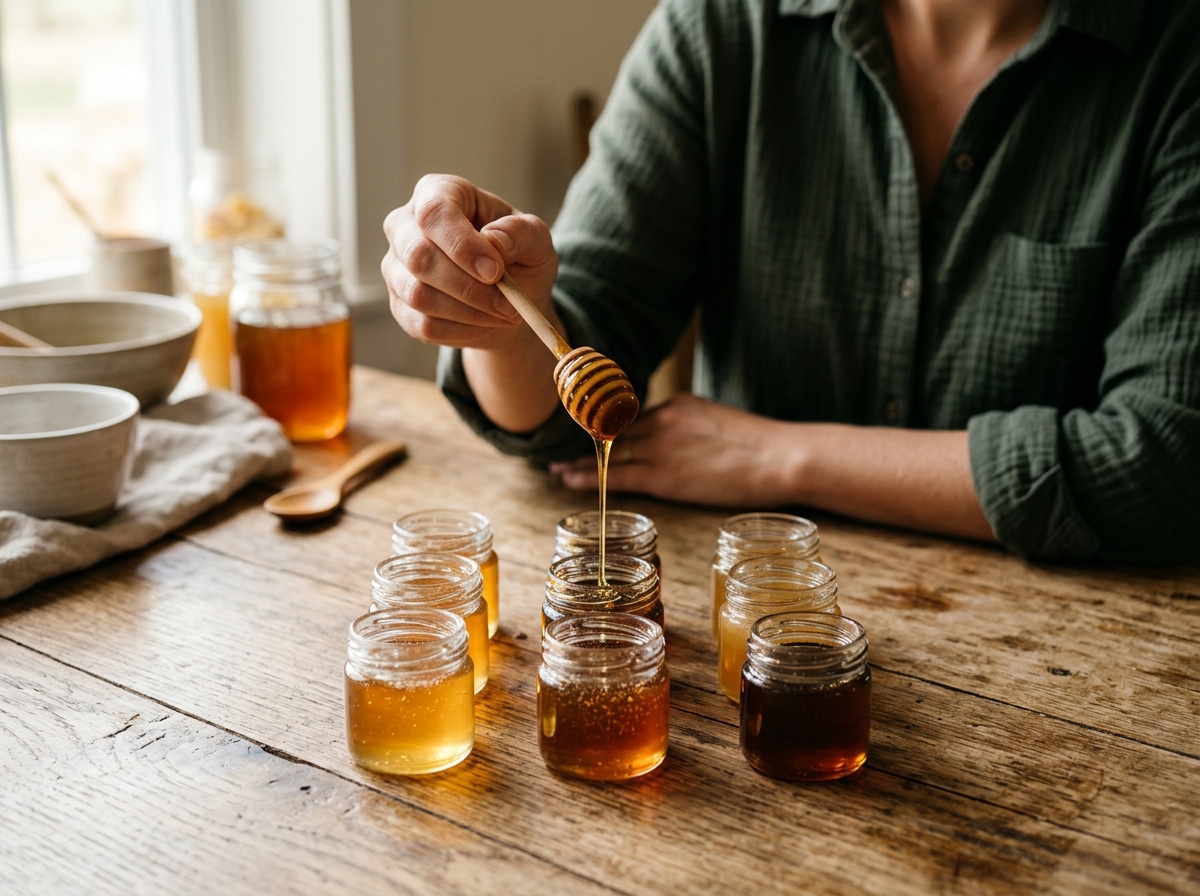
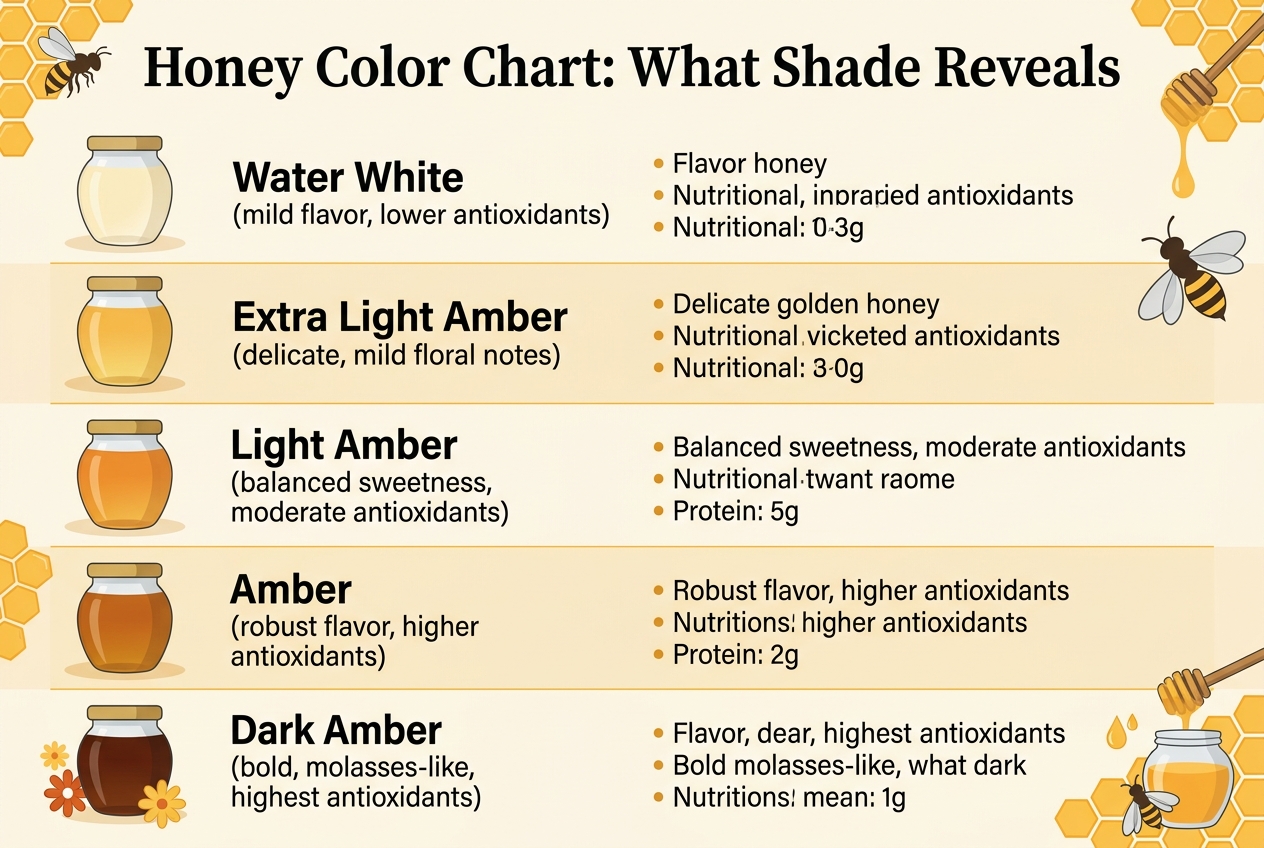
Honey Color Chart: What Shade Reveals About Flavor and Antioxidants
How Color Grading Works
Honey isn't just "gold." The USDA actually grades it on a scale from water white to dark amber, using a tool called a Pfund grader that measures how much light passes through the sample. It's a simple system, but it tells you a lot before you even taste the stuff. Lighter honey tends to taste mild and floral. Darker honey brings deeper, almost molasses-like notes — and usually more minerals along for the ride.
Here's a quick breakdown of where common honeys land on that scale and what it means for you as a buyer.
| Color Grade | Pfund Range (mm) | Typical Flavor | Antioxidant Level |
|---|---|---|---|
| Water White | 0–8 | Very mild, delicate | Lowest |
| Extra Light Amber | 9–34 | Light floral, clover-like | Low to moderate |
| Light Amber | 35–50 | Mild, slightly fruity | Moderate |
| Amber | 51–85 | Bold, caramel-like | Moderate to high |
| Dark Amber | 86–114 | Robust, molasses-like | Highest |
Color isn't random. It's shaped by the flowers bees visit, the season of harvest, and how much heat the honey sees afterward. A honey pulled in late summer from buckwheat blossoms will look nothing like a spring wildflower batch, and that's normal. If you're trying to compare a small-batch raw jar against a supermarket blend, checking a raw unfiltered honey buying guide first will save you some guesswork at the shelf. One honest note: color alone won't prove purity. Plenty of processed honey gets heated and filtered until it looks deceptively light and "clean" — so treat shade as a clue, not a certificate.
Raw Honey vs. Pure Honey vs. Organic Honey: Key Differences
Why Processing Method Matters More Than Labels
These three words get tossed around like they're interchangeable. They're not, and mixing them up can cost you money on a jar that isn't what you think it is. Raw honey skips heating and filtering entirely, so it keeps its pollen, propolis bits, and natural enzymes intact. Pure honey just means no added sugar or corn syrup snuck in — it can still be heated and filtered within an inch of its life. Organic honey is a completely different category: it's about how the bees were kept, not how the honey was handled afterward.
Here's the part that trips people up. A honey can be raw without being organic — think a small hive-keeper who doesn't heat their product but hasn't paid for organic certification. Flip it around, and you'll find organic honey that's been pasteurized and filtered clear, losing most of the good stuff along the way. Neither label tells you the whole story on its own.
| Term | What It Actually Means | What It Doesn't Guarantee |
|---|---|---|
| Raw | Unheated, unfiltered, minimally processed | Pesticide-free hives or organic certification |
| Pure | No added sugars, syrups, or fillers | Enzymes, pollen, or unheated status |
| Organic | Certified pesticide-free hive management | Raw processing or unfiltered texture |
| Raw + Organic | Both unprocessed and pesticide-free | Lab-verified potency without third-party testing |
So how do you know which box a jar actually checks? Labels alone won't tell you, and marketing copy definitely won't. If you're researching options beyond what's on shelf, browsing a rundown of types of honey that'll get you buzzin' can help you spot the terminology before you shop. But the only real proof of purity claims is independent lab testing — checking for glyphosate residue, confirming enzyme activity, verifying there's no sneaky syrup dilution. Anything short of that is just a guess dressed up in nice packaging.
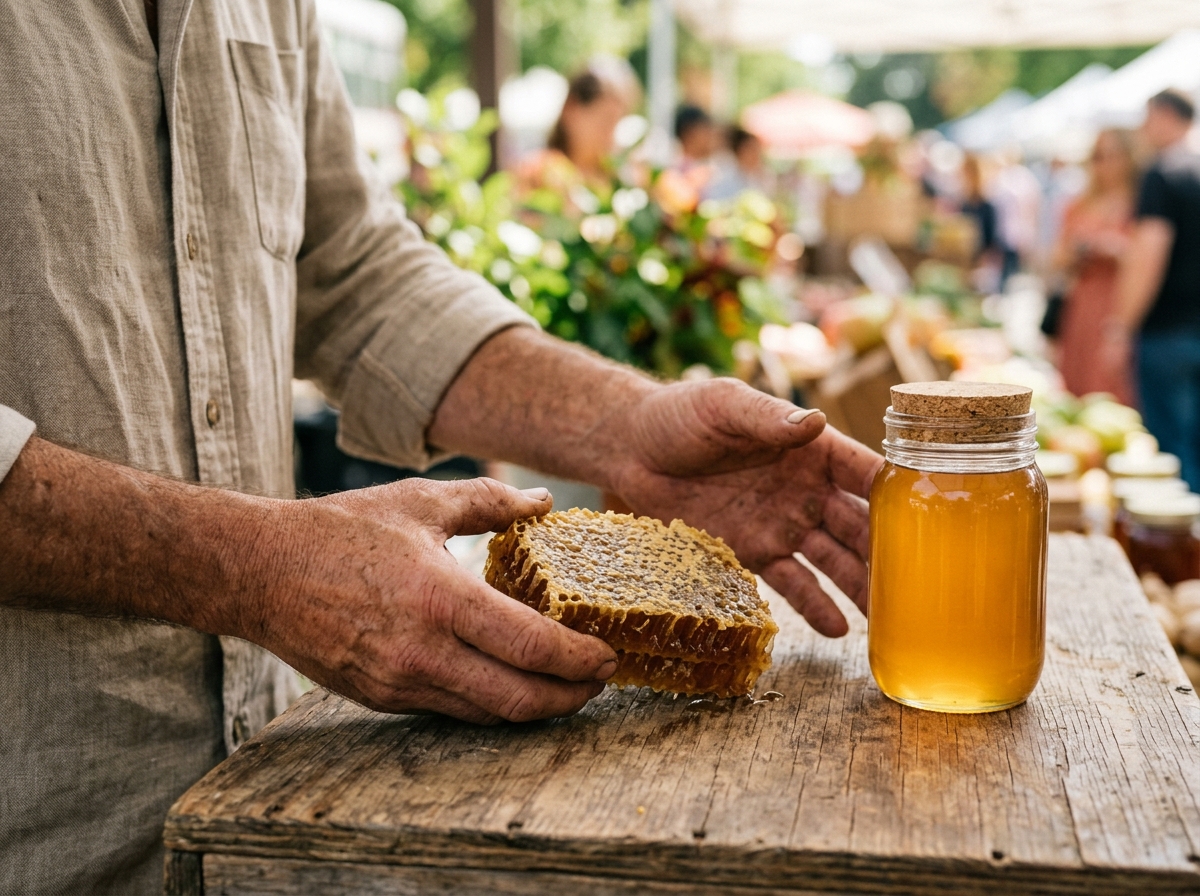
What Is Raw Honeycomb — and Is It Safe to Eat?
Honeycomb is exactly what the bees built it to be: a wax lattice of hexagonal cells where they store honey, cap pollen, and raise their young. When you buy raw comb, you're getting the whole package. That means honey plus beeswax, tiny trace amounts of propolis, and often flecks of pollen too. It's honey in its most unaltered form, nothing drained off, nothing filtered out. Some people find that intimidating at first. It's really just honey with its container still attached.
Is it safe? For most people, yes, in normal snacking amounts. Beeswax is not digestible, so it passes through your system largely unchanged, the same way fiber does. A small percentage of people notice mild stomach upset from eating a lot of wax at once, so moderation matters more than caution here. Anyone with a known bee product or pollen allergy should still steer clear, and that includes comb.
Sourcing matters as much as the eating itself. Comb built in hives treated with pesticides or miticides can concentrate those chemicals in the wax, since beeswax absorbs and holds onto residues over time. That's a real concern, not a marketing line. Comb from pesticide-free hives that's been lab-tested for purity avoids that risk entirely, giving you a cleaner product with a traceable history from hive to package.
How to Eat Honeycomb (Snacking, Cheese Boards, Tea)
The simplest way to eat honeycomb is to just cut a small square and chew it slowly. The honey releases first, sweet and floral, then you're left with a wax ball that you can swallow, chew on longer, or spit out like gum. There's no wrong answer. It's a texture thing more than a technique, and most first-timers are surprised by how mild the wax actually tastes on its own.
Cheese boards are where honeycomb really earns its reputation. A wedge of comb next to sharp cheddar, brie, or aged gouda gives you that classic sweet-and-savory contrast that a drizzle of liquid honey just can't replicate. For a deeper look at how comb stacks up against liquid, creamed, and other formats, an overview of honey varieties and uses is worth reading for anyone building out a full pantry. Pair it with crackers, walnuts, or sliced apple for a quick appetizer that needs zero cooking.
Tea is the other easy entry point. Drop a small piece of comb into a hot cup and stir; the honey dissolves while the wax floats to the top, easy to scoop out with a spoon once you're done. Some people leave the wax in and drink around it. Either way, it's a gentle, low-effort way to work raw comb into a daily routine without committing to a big chunk at once.
Creamed Honey and Hot Honey: Specialty Formats Worth Knowing
When to Choose Creamed vs. Liquid Raw Honey
Creamed honey isn't a different plant source or a lesser product. It's raw honey that's been seeded with fine crystals and stored cold, usually around 57°F, so it crystallizes in a controlled, uniform way instead of turning into a grainy, clumpy jar on your shelf. The result is a smooth, spreadable texture closer to soft butter than syrup. If you've ever wondered why one jar spreads like frosting while another pours off a spoon, that's the process at work, not the flavor.
Hot honey takes the opposite approach: instead of changing texture, it adds heat. Raw honey gets infused with chili peppers, often calabrian or red chili flakes, steeped for days to weeks until the sweetness carries a slow, building burn. It's become a genuine condiment trend, showing up on pizza, fried chicken, and cheese boards, but the base honey underneath is still whatever floral source it started as. Neither format changes what type of honey you're eating.
Both are good entry points if you're new to raw honey's range of textures and flavors, since they let you try something less intimidating than a jar of dense, cloudy wildflower honey. For a broader sense of how these fit alongside varietal honeys, an ultimate guide to different types of honey lays out the wider landscape well. Spreadable or spicy, you're still getting the same raw honey benefits underneath. That part never changes.
How to Choose the Right Honey for Your Wellness Goals
Matching Honey Type to Health Goals
Not every jar serves the same purpose. Honey isn't one product with one job — it's a category, and matching the variety to your actual goal matters more than grabbing whatever's on the shelf. Start by asking what you actually need it for. Immune support? Allergy relief? Just something good on toast? The answer changes what you should buy.
- Immune support calls for manuka honey or a propolis-infused blend with a verified MGO rating, since that number is the closest thing honey has to a dosage label.
- Seasonal allergy relief works best with local raw honeycomb sourced from regional wildflowers, on the theory that trace local pollen may help your body adjust to what's blooming nearby.
- Cooking and baking generally calls for a milder variety like clover or orange blossom honey, since their gentle sweetness won't fight with other ingredients the way a bold buckwheat or manuka would.
- Skin and energy support often means pairing raw honey with royal jelly or freeze-dried propolis powder, stacking benefits instead of relying on one product to do everything.
- Broad, general wellness use is where a straightforward raw honey earns its keep — no need to overthink it if you're just after everyday nutrition.
Questions to Ask Before Buying Online
Honey shopping online is mostly a trust exercise. You can't smell it, taste it, or ask the seller a follow-up question in person, so the burden falls on their documentation. Before you buy, dig into how the company sources and verifies its product. If you want the fuller landscape first, learning about the dozens of honey varietals and their uses helps you figure out which category you're even shopping for. Then ask the harder questions.
- Does the seller provide a third-party lab certificate confirming purity, potency, and the absence of glyphosate or synthetic additives?
- Can they tell you which region or hive the honey came from, and when it was harvested?
- Is the product raw and unheated, or has it been pasteurized in a way that strips enzymes and pollen?
- For royal jelly, is the 10-HDA percentage listed clearly, and is the batch fresh rather than sitting in storage for months?
- What's the return policy or guarantee if the product arrives damaged or doesn't match its description?
If a seller can't answer these plainly, that's a signal — move on. A little skepticism here saves you money and disappointment later.
How to Store and Judge the Quality of Raw Honey at Home
Keep your jar in a cool, dark cupboard, not the fridge. Refrigeration doesn't preserve raw honey; it just speeds up crystallization and makes scooping a chore. A cabinet away from the stove's heat is all it needs. If it turns cloudy and grainy over time, don't panic — crystallization is a natural process, not a sign of spoilage, and a warm water bath will loosen it right back up.
Signs You're Getting Genuine Raw Honey
Genuine raw honey rarely looks picture-perfect, and that's the point. Cloudiness, flecks of pollen, and a strong floral or earthy smell all point to minimal processing. If you're new to comparing varieties, it helps to first learn what separates one floral source from another, since color and aroma shift depending on what the bees foraged. Honey that pours like syrup off a spoon, looks glassy-clear, and smells like almost nothing has likely been heavily filtered or blended with cheaper syrups. That's not honey doing its job — that's honey dressed up for a photo shoot.
The table below breaks down what to check and why it matters.
| What to Check | Genuine Raw Honey | Likely Over-Processed |
|---|---|---|
| Texture | Cloudy, sometimes grainy | Perfectly clear, syrupy |
| Aroma | Rich, floral, or earthy | Faint or neutral |
| Crystallization | Occurs naturally over weeks or months | Rarely happens; stays liquid indefinitely |
| Pour speed | Slow, thick, uneven | Fast and uniform |
| Traceability | Hive location, harvest date, lab report available | No sourcing details provided |
Of every signal on that list, traceability is the one that can't be faked. A label naming the hive's region, the harvest date, and a lab report on purity tells you far more than texture ever could. Many local businesses now publish this information openly, and it's worth asking for if you don't see it. For a quick primer on how regional sourcing shapes flavor and quality, this rundown of common honey varieties is a useful starting point before you shop.
Before you commit to a hive rental agreement, it's worth asking the practical questions: how many colonies per acre your crop actually needs, what the contract says about hive strength and inspection rights, when the bees arrive and leave relative to bloom, and how the beekeeper handles pesticide communication during the window they're on your land. Those details matter more than price per hive, and a grower who asks them early tends to get better fruit set and fewer surprises. And if your interest in bees runs more toward the pantry than the orchard — raw honey, honeycomb, royal jelly, propolis — that's a separate conversation with different people, one where the questions turn to floral source, processing, and whether the jar in front of you has been heated or blended.


