

Manuka Honey Cream: Does It Really Help Your Skin?
Oct 13, 2026
You've probably scrolled past dozens of jars promising a miracle "manuka honey cream" for your skin, only to flip them over and find a watered-down blend of fillers, fragrance, and a trace of honey buried at the bottom of the ingredient list. That's not purity. That's marketing. If you actually want manuka's raw antibacterial power, you need the honey itself, unprocessed and unblended. This article breaks down why raw Manuka honey outperforms jarred creams, and what real skin and wellness benefits actually look like.
What People Mean by Manuka Honey Cream
Cosmetic cream vs. raw jarred honey
Search "manuka honey cream" and you'll mostly find face moisturizers in little jars, blended with oils, waxes, and a small dose of manuka honey. That's a skincare product, not a food. It's built for rubbing on your skin, not spooning into tea or eating straight. Many of these formulas list manuka honey well down the ingredient panel. Sometimes it makes up less than 5% of what's actually in the jar.
Raw jarred Manuka Honey is a different animal entirely. No lotion base, no preservatives, no fragrance. Just honey, harvested and bottled as close to its natural state as possible, meant to be eaten by the spoonful or stirred into food and drink. If your goal is ingestible wellness support, a cosmetic cream simply isn't built for that job.
Confusing the two leads people to buy the wrong product for their actual goal. Someone chasing immune or gut benefits grabs a moisturizer. Someone wanting a facial treatment ends up with a jar meant for the pantry. Worth sorting out before you buy, honestly.
Why MGO rating matters more than the word 'cream'
MGO stands for methylglyoxal, the compound behind manuka's reputation, and it's measured directly in the honey itself. Raw Manuka Honey can carry ratings like MGO 263+ or 514+, numbers that tell you something concrete about potency. A cream can slap "manuka" on the label and tell you nothing about how much active compound actually made it into the jar.
That's the real issue: the word "cream" describes a texture, not a strength. MGO rating is the number that actually matters, and it only means something when it's tested and disclosed on raw honey, not diluted into a lotion base where measuring it becomes almost meaningless. Readers comparing options should spend time on a manuka honey vs raw honey breakdown before assuming higher price equals higher potency.
So when you're shopping, skip the packaging buzzwords. Look for an actual MGO number, a lab test date, and proof the honey is raw and unheated. If a product can't show you that, the "manuka" on the front label is doing more marketing than anything else.
The Real Science Behind Manuka Honey's Reputation
Understanding MGO and UMF ratings
Manuka honey doesn't come from just anywhere. It's made by bees working the Leptospermum scoparium bush, a flowering shrub native to New Zealand and parts of Australia. That single floral source is what makes this honey chemically different from the clover or wildflower varieties sitting on most grocery shelves. The nectar itself carries a compound called dihydroxyacetone, which slowly converts into methylglyoxal, or MGO, as the honey matures in the hive and afterward in storage.
MGO is the reason manuka gets so much attention. It's a naturally occurring antibacterial compound, present in far higher concentrations here than in regular honey. Labels showing numbers like 100+, 250+, or 500+ aren't marketing flourishes. They reflect actual lab-tested MGO levels per kilogram, so a 500+ jar carries meaningfully more of the compound than a 100+ one. Some brands also use UMF, or Unique Manuka Factor, a rating system that correlates with MGO but adds checks for leptosperin and other markers unique to the plant. Either way, higher numbers mean stronger, verified potency, not just a bigger price tag.
Here's the catch: none of that matters if the honey's been heated or filtered to death. Raw, unheated manuka retains the enzymes, pollen, and antioxidants that give whole honey its broader nutritional profile, not just its MGO count. Processed honey and diluted jarred creams tend to lose much of this along the way. If you want the full picture on what separates the two, a raw unfiltered honey buying guide walks through what processing strips out and what to check before buying.
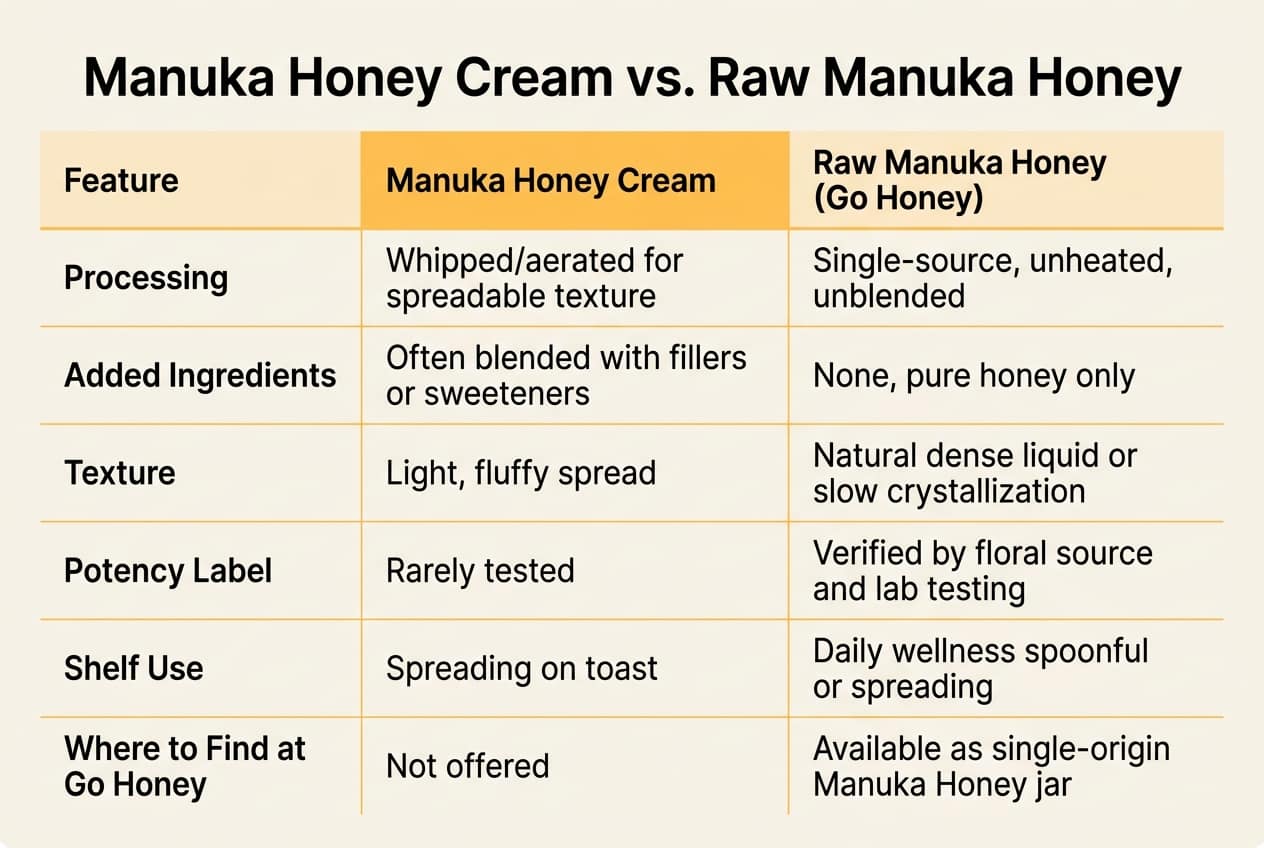
Manuka Honey Cream vs. Raw Manuka Honey: A Side-by-Side Look
Put a jarred manuka cream next to a jar of raw manuka honey, and they look related. They're not, really. One is a cosmetic formula built for spreadability and shelf appeal. The other is a single, unprocessed food that happens to work well on skin too. Here's how they stack up on the things that actually matter.
| Factor | Manuka Honey Cream | Raw Manuka Honey |
|---|---|---|
| Ingredient purity | Diluted honey plus emulsifiers, preservatives, fragrance | 100% pure, nothing added |
| Active concentration | Variable, often undisclosed | MGO 263+ or 514+, lab-rated |
| Intended use | Topical only | Ingestible, occasional topical use |
| Shelf life | 12-24 months, needs preservatives | Years, honey doesn't spoil |
| Traceability | Sourcing often unclear, blended batches | Hive location, harvest date, lab certificate |
Notice the gap in concentration. A cream can call itself "manuka" with barely a trace of actual honey inside, since there's no standard forcing full disclosure. Raw honey, by contrast, gets independently lab-tested every six months for MGO strength and checked for glyphosate or synthetic residue. That's a different level of accountability. A cream is formulated for texture and feel on skin; raw honey is formulated by nature, full stop, and whatever skin benefit it offers is a side effect, not the design goal. If you're comparing flavor profiles while you shop, reading about premium 100 pure orange blossom honey gives a useful sense of how single-source honey should be described honestly. Bottom line: a cream sells convenience, raw honey sells substance.
Where Raw Manuka Honey Fits Into a Wellness Routine
Most people who keep raw Manuka honey in the kitchen aren't reaching for a jarred cream at all. They're taking a spoonful straight, or stirring it into something warm, as part of an everyday immune and digestive routine. That's the honest, unglamorous truth of how this honey earns its keep.
Daily use ideas
There's no single "correct" ritual here, but a few habits come up again and again among people who use raw honey seriously rather than decoratively.
- A spoonful first thing in the morning, taken plain, to support digestion before coffee or food hits the system.
- Stirred into warm (never boiling) water or tea, since high heat can break down the natural enzymes that make raw honey worth buying in the first place.
- Swapped in for refined sugar in dressings or marinades, which keeps the enzyme content intact better than baking does.
- Paired with Royal Jelly Premium or a measured spoonful of Propolis Powder for concentrated daily support beyond what honey alone provides.
- Kept on the counter, not the fridge, since cold temperatures speed up crystallization without adding any benefit.
If topical skin benefits are what drew you here, it's worth separating fact from marketing; best Manuka honey for skincare guidance is a useful starting point before buying any cream at all.
Who should avoid raw honey internally
Raw honey is still honey, and that means some basic rules apply no matter how clean the sourcing is. Parents often turn to raw honey and honeycomb for natural seasonal wellness support, but there's one firm exception.
- Children under 1 year old should never be given raw honey, due to a small but real risk of infant botulism.
- Anyone with a diagnosed bee product or pollen allergy should check with a doctor before trying raw honey, honeycomb, or propolis.
- People managing blood sugar closely should treat honey as sugar, not a supplement, and dose it accordingly.
- Pregnant or nursing individuals considering royal jelly or propolis should get a doctor's sign-off first, since research is still limited.
Beyond that, it's mostly common sense. Start small, watch how your body responds, and treat it as food, not medicine.
What About Topical Use? Setting Honest Expectations
Why Go Honey stays in the wellness lane, not skincare.
Let's be straight about something. This is a food and wellness brand, not a cosmetics company. You won't find a jar labeled "face cream" or "overnight mask" anywhere in the catalog, and that's intentional. The products on offer — royal jelly, honeycomb, propolis powder, single-source honeys — are built for the kitchen and the supplement shelf, not the bathroom vanity.
If you came here hoping for a honey-based cleansing balm, a whipped moisturizer, or a propolis serum in a dropper bottle, you'll need to look to dedicated skincare brands that formulate specifically for topical use. Those companies blend, stabilize, and test for skin contact, which is a different science than food-grade production. There's no shame in that gap; it's just a different lane, and staying in one lane is part of how a small farm keeps its lab testing focused and its promises honest.
Royal Jelly Premium, the Limited Edition never-frozen batch, and the freeze-dried Royal Jelly Powder are all sold strictly as ingestible wellness products. Same with the Organic Bee Propolis Powder. They're meant for smoothies, capsless daily doses stirred into water, or eaten straight off a spoon if you can handle the taste. None of it is formulated, tested, or labeled for application on skin, and no amount of marketing language changes that fact.
Now, if you want to experiment on your own, nobody's going to stop you. Raw honey's natural humectant pull — its ability to draw and hold moisture — is well documented, and researchers have studied the composition and biological activity of manuka honey for exactly this reason. That's real science. But doing it yourself at home is a personal DIY choice, built on your own research and risk tolerance, not a packaged product category or a recommendation coming from this farm.
How to Choose a High-Quality Raw Manuka Honey
The manuka market is crowded, and not every jar on the shelf earns the hype. A surprising amount of what's sold as "manuka" is blended, watered down, or labeled in ways that hide more than they reveal. Knowing what raw manuka honey should actually look like on paper and in the jar saves you from paying premium prices for a mediocre product.
Red flags in mislabeled or diluted products
Some warning signs are easy to spot once you know where to look. Academic research on manuka honey production and sourcing underscores just how much floral origin and handling affect final potency, which is exactly why vague labeling should raise an eyebrow. Before you buy, run the product through this checklist:
- Check for a specific MGO number printed on the label — terms like "active" or "certified" without a figure attached mean almost nothing.
- Look for third-party lab testing results and batch traceability that ties the honey back to a specific hive location and harvest date.
- Confirm the honey is raw and unfiltered, meaning it was never heated or blended with cheaper, neutral-tasting honeys to stretch volume.
- Verify the brand behind it practices pesticide-free, sustainable beekeeping, since contaminated hives can quietly undercut even a strong MGO rating.
- Compare price per ounce against MGO strength rather than against the jar size alone, because potency — not volume — is what actually drives cost.
- Ask whether the seller can produce an actual lab certificate on request, not just a logo or badge printed on the jar.
Here's the blunt truth: if a seller can't answer where the honey came from or hand you a lab result, walk away. A real MGO number and a traceable harvest date aren't bonus features. They're the minimum bar for calling something raw manuka honey at all.
Manuka Honey, Honeycomb, and Other Raw Options Compared
Not every raw honey serves the same purpose, and picking one often comes down to what you actually want it to do. Some buyers want antibacterial strength. Others just want a jar that tastes good on toast and hasn't been stripped of anything. Before you choose, key attributes that signal genuine quality are worth understanding, since grading and sourcing claims vary wildly across brands. The table below breaks down five raw options by what makes each one distinct.
| Honey Type | Flavor Profile | Standout Trait | Best For |
|---|---|---|---|
| Manuka Honey (MGO 263+/514+) | Earthy, slightly bitter | Strongest antibacterial profile of the group | Immune-focused daily use |
| Raw Honeycomb | Sweet, waxy, floral | Retains pollen and enzymes intact | Full unprocessed comb experience |
| Orange Blossom Honey | Light, mild, citrus-floral | Naturally crystallizes as proof of rawness | Everyday mild-flavor use |
| Buckwheat Honey | Dark, malty, robust | Higher antioxidant content from its floral source | Those wanting a bolder, nutrient-dense honey |
| Jarrah Honey | Caramel-like, deep | Rare Australian source with notable antibacterial activity | Variety-seekers wanting something uncommon |
Here's the part people miss: none of these are blended or flavored. Every difference in taste comes from the flower the bees worked, not an additive dropped in afterward. Buckwheat's maltiness and Jarrah's caramel depth aren't tricks. They're just what those particular blossoms produce. If your jar of orange blossom honey turns cloudy and firms up in the cupboard, don't toss it. That's crystallization, a completely normal sign the honey is raw and unheated, not a defect or expiration.
For retailers stocking a shelf, variety matters more than it seems. A customer who finds manuka too strong might still want that antibacterial reputation in a milder package, and that's where Jarrah or a dark buckwheat earns its spot next to it.
Sourcing, Testing, and Buying Raw Manuka Honey Online
Questions to ask before buying
Before you add any jar to your cart, ask the seller one blunt question: can you show me the lab certificate? A real one covers purity, potency, and confirms there's no glyphosate or synthetic residue hiding in the mix. If the seller can't produce that, keep looking. A pretty label means nothing without paperwork behind it.
Next, ask where the honey actually came from. Can it be traced to a specific hive location and a harvest date, or is it a vague blend from "multiple sources"? Traceability is the difference between buying real raw honey and buying a marketing story. Farms with nothing to hide usually volunteer this information before you even ask.
Some farms test once and call it done. Look for ones that test every batch, every six months, on an ongoing basis, not a one-time snapshot from years ago. Pesticide-free hives matter too; ask directly whether the bees forage in sprayed areas. Farms operating in California and New Jersey with documented pesticide-free practices are worth noting as a benchmark for comparison.
Buying in bulk for resale or clinical use
If you're a wellness retailer, naturopath, or clinic stocking up regularly, buying single retail jars over and over is a waste of time and money. Look for a wholesale or bulk ordering program instead. It typically means better per-unit pricing, consistent batch testing, and a direct line to the farm rather than a middleman distributor.
This matters even more for royal jelly, where potency (measured in 10-HDA percentage) and freshness drive the price and the results your clients actually feel. A bulk buyer should ask the same purity and traceability questions as an individual shopper, just at a larger scale, and confirm lab documentation covers the specific batch being shipped, not a general average.
Shipping logistics matter for bulk orders too. Free shipping over $99 and FedEx 2-Day Express make frequent reordering practical, whether you're a solo acupuncturist restocking monthly or a shop moving cases at a time. Saturday delivery options help smaller businesses avoid weekday staffing gaps when shipments arrive.
Choosing between a contract pollination arrangement and simply sourcing finished honey and bee products comes down to what a grower or buyer actually needs solved: crop fertilization versus consistent, traceable raw ingredients. It's worth asking who will stand behind quality and volume over time, and whether a long-term supply relationship matters more than a seasonal service. Those priorities, once clear, tend to point toward the right kind of partner on their own.


